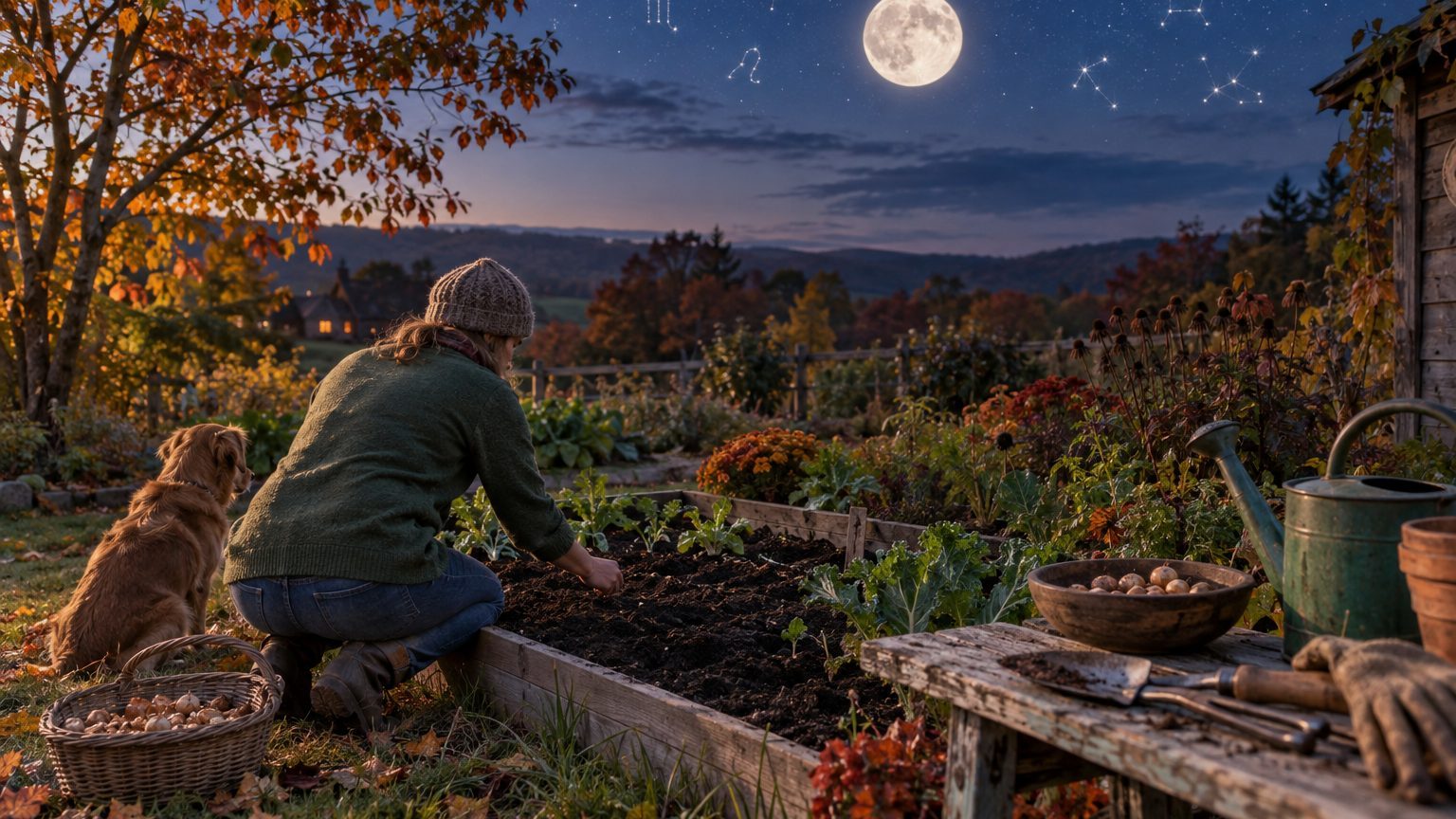

Moon sign gardening is an almanac tradition that picks planting days by the zodiac sign the Moon is passing through, not just by its phase. Almanacs label each sign fruitful, semi-fruitful or barren, and the biodynamic calendar sorts days into root, flower, leaf and fruit. No effect of the Moon’s sign on germination or yield has been established. This page sets out the custom, the labels and the October 2026 dates, all as tradition.
What moon sign gardening is
How the Moon moves through the signs
The zodiac is a belt of twelve signs around the sky, and the Moon crosses all of them in about 27.3 days. That works out to about two and a half days in each sign. The changes do not fall at midnight. The Moon enters a new sign at a specific clock time, so a “sign” begins in the morning or evening of one date and ends partway through another. This is why the dates below carry times in Eastern time (ET).
Gardeners who plant by the Moon pair that sign with the lunar phase. The phase gives the quarter, and the sign narrows the choice further. The result is a short list of traditional windows each month rather than a full week of open days.
Almanac labels and biodynamic day types
Moon-sign almanacs follow a convention that sorts the twelve signs into three groups for sowing:
- Fruitful: Cancer, Scorpio, Pisces
- Semi-fruitful: Taurus, Libra, Capricorn
- Barren: Aries, Gemini, Leo, Virgo, Sagittarius, Aquarius
Sources differ on Virgo, Sagittarius and Aquarius, so you may see them placed differently elsewhere. “Barren” is the convention’s label for seed-sowing days. It describes a calendar category, not anything about the sign itself.
The biodynamic calendar, associated with Maria Thun, uses a different scheme. It groups signs by element into four day types: root days (Taurus, Virgo, Capricorn), flower days (Gemini, Libra, Aquarius), leaf days (Cancer, Scorpio, Pisces) and fruit days (Aries, Leo, Sagittarius).
The phase side of the tradition splits the lunar month into four quarters:
- First quarter (new moon to first quarter): leafy crops that bear above ground, such as lettuce, spinach, cabbage, broccoli and celery.
- Second quarter (first quarter to full moon): above-ground crops that bear seed inside the fruit, such as tomatoes, peppers, beans, squash and corn.
- Third quarter (full moon to last quarter): root crops, bulbs and perennials, such as potatoes, carrots, garlic, onions and beets.
- Fourth quarter (last quarter to new moon): rest, meaning weeding, pruning, turning the soil and composting.
Tradition, and where this site stands
This is tradition, not a proven method. No effect of the Moon’s phase or sign on germination or yield is established, and this site presents every rule here as almanac custom and nothing more.
The Moon never overrides the calendar of your place. Frost dates and soil temperature decide whether a crop can go in the ground. A gardener who follows the Moon only chooses among days the local calendar already allows. For what to plant and when, use your state’s planting guide.
The twelve signs and what the tradition says about each
The table lists each sign with its element, its label in the almanac convention and its biodynamic day type. Read the labels as bookkeeping categories from two separate traditions.
| Sign | Element | Almanac label | Biodynamic day type |
|---|---|---|---|
| Aries | Fire | Barren | Fruit |
| Taurus | Earth | Semi-fruitful | Root |
| Gemini | Air | Barren | Flower |
| Cancer | Water | Fruitful | Leaf |
| Leo | Fire | Barren | Fruit |
| Virgo | Earth | Barren | Root |
| Libra | Air | Semi-fruitful | Flower |
| Scorpio | Water | Fruitful | Leaf |
| Sagittarius | Fire | Barren | Fruit |
| Capricorn | Earth | Semi-fruitful | Root |
| Aquarius | Air | Barren | Flower |
| Pisces | Water | Fruitful | Leaf |
Sorting the rows by element shows how the two systems relate. The three water signs, Cancer, Scorpio and Pisces, are the three fruitful signs in the almanac convention and also the three leaf days in the biodynamic scheme. The three fire signs are the opposite case. This convention labels all of them barren, while the biodynamic calendar calls them fruit days. The two traditions use similar vocabulary but do not agree, so a day described as a “fruit day” in one is a “barren” day in the other.
Earth and air signs fall in between. Taurus and Capricorn are semi-fruitful and root days. Virgo is also a root day but barren in this convention, which is one of the three signs where sources differ. Libra is semi-fruitful and a flower day, while Gemini and Aquarius are barren flower days.
The windows on this site come from the almanac convention only. A window needs a quarter rule and a fruitful or semi-fruitful sign to line up. Biodynamic day types are shown here for reference and do not enter the October windows below. Anyone who follows the biodynamic calendar will find its own published dates, which can differ from the ones on this page.
Because the Moon spends about two and a half days in each sign, a sign label covers a stretch of clock time, not a calendar date. The October table below gives the exact entry times.
Which zodiac this site uses
Every sign date on this page uses the tropical zodiac, which is the one almanacs use. The signs in this system are fixed to the seasons, so each starts at a set point in the year’s cycle. The Moon’s position is computed astronomically with JPL’s DE421 ephemeris, and the results were checked against the U.S. Naval Observatory (USNO). All times are Eastern time, ET.
Sidereal calendars measure the zodiac against the background stars instead, and they give different signs for the same moment. A Moon that is in Cancer in a tropical almanac can sit in a different sign in a sidereal one. If you follow a sidereal calendar, its dates will not match the ones here, and mixing the two sources will produce conflicting windows.
Time zones matter too. A sign change at 3:53 p.m. ET happens at 12:53 p.m. Pacific time on the same date, and a late-evening change in the East can fall on the next date for readers further west of the Atlantic or in the Pacific. Convert the clock times to your own zone before you use them.
This month’s sign changes
October 2026 begins with the Moon in Cancer and passes through the full cycle before ending back there. Phases for the month, in Eastern time: Last Quarter on October 3 at 9:25 a.m., New Moon on October 10 at 11:50 a.m., First Quarter on October 18 at 12:12 p.m. and Full Moon on October 26 at 12:11 a.m. That last one is the Hunter’s Moon in Old Farmer’s Almanac usage, and it falls in Taurus.
| Date and time (ET) | Moon enters |
|---|---|
| October 2, 3:54 p.m. | Cancer |
| October 4, 6:54 p.m. | Leo |
| October 6, 10:52 p.m. | Virgo |
| October 9, 4:10 a.m. | Libra |
| October 11, 11:21 a.m. | Scorpio |
| October 13, 8:59 p.m. | Sagittarius |
| October 16, 8:57 a.m. | Capricorn |
| October 18, 9:39 p.m. | Aquarius |
| October 21, 8:35 a.m. | Pisces |
| October 23, 3:53 p.m. | Aries |
| October 25, 7:34 p.m. | Taurus |
| October 27, 9:01 p.m. | Gemini |
| October 29, 10:05 p.m. | Cancer |
Combining the quarter rule with a fruitful or semi-fruitful sign gives these traditional windows for October 2026:
- Leafy crops (first quarter): October 10-13, with the Moon in Libra and Scorpio, and October 16-18, with the Moon in Capricorn.
- Fruiting crops (second quarter): October 21-23, with the Moon in Pisces.
- Root crops, bulbs and perennials (third quarter): October 26-27, with the Moon in Taurus, and October 30-31, with the Moon in Cancer.
Check each window against the table above, because the edge days start and end partway through. The Pisces window, for example, is bounded by the sign change at 8:35 a.m. on October 21 and the entry into Aries at 3:53 p.m. on October 23. Whether any crop can go in the ground in these windows depends on your frost dates and soil temperature, so check your state’s planting guide first. For the method behind the quarters, see our guide to planting by the moon.
Questions
Is moon sign gardening scientific?
No. It is an almanac tradition, and no effect of the Moon’s phase or sign on germination or yield has been established. This site publishes the custom so readers can follow it or simply understand it, and it does not promise any result from it.
Which moon sign does the tradition favor for planting?
According to almanac convention, the fruitful signs are Cancer, Scorpio and Pisces, and the semi-fruitful signs are Taurus, Libra and Capricorn. The six remaining signs, Aries, Gemini, Leo, Virgo, Sagittarius and Aquarius, carry the barren label, though sources differ on Virgo, Sagittarius and Aquarius. The biodynamic calendar is separate and ranks days by type, not by fruitfulness.
Do I need to follow both the sign and the phase?
The windows on this page use both. A day counts as a traditional window when the quarter rule for a crop type lines up with a fruitful or semi-fruitful sign. Some gardeners follow only the phase, and the guide to planting by the moon covers that simpler version. Whichever route you take, your local frost dates and soil temperature still decide whether planting can start.