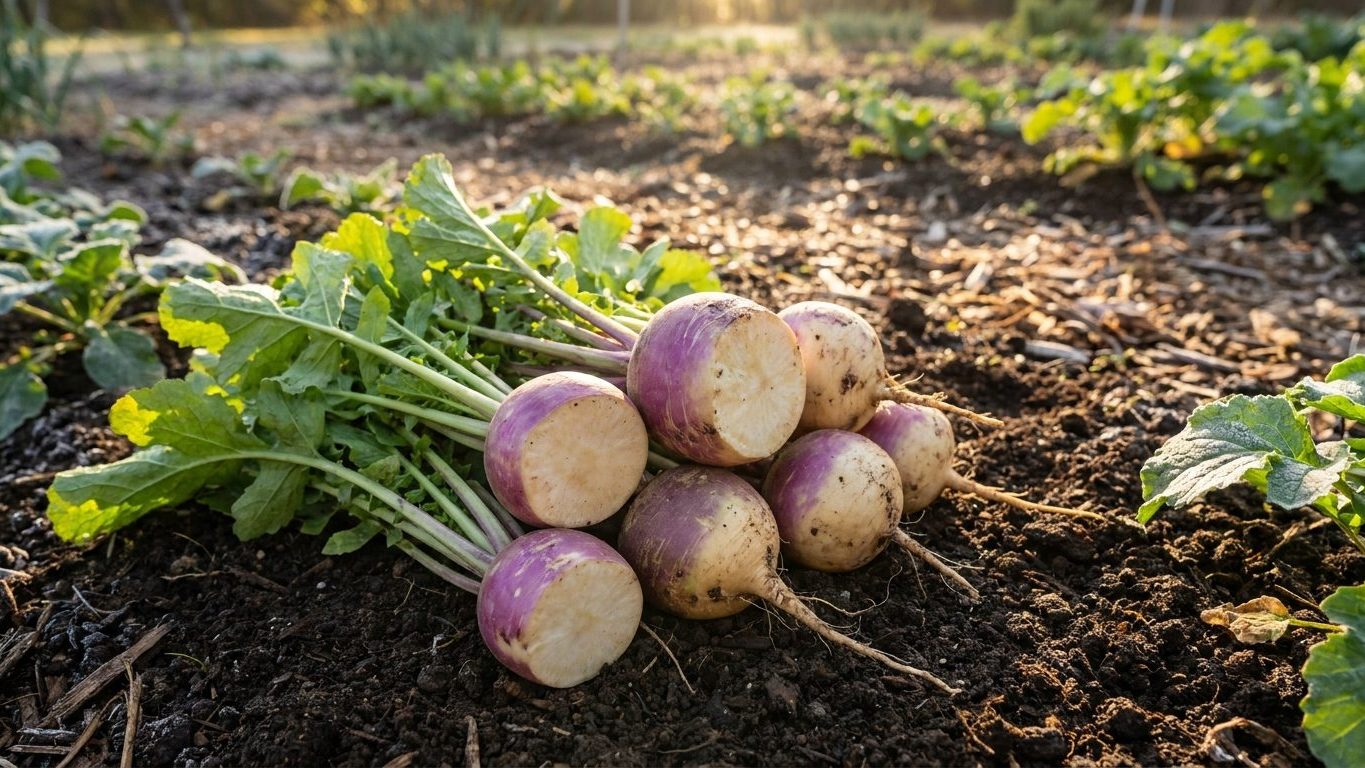

Montana gardeners can grow both roots well, but the calendar does the deciding. Around Billings, the last spring freeze falls between April 29 and May 10, and the first fall freeze between October 1 and October 14. That leaves room for a spring sowing, a fall sowing, or a slow rutabaga. Colder valleys leave less. Everything below starts from those two dates and from what they leave out.
When the soil is warm enough in Montana
The question every seed packet raises is when to sow. For Billings, NOAA’s 1991-2020 Climate Normals place the last spring 32F freeze between April 29 and May 10. That is the stretch where the odds of a freeze sit in the 30 to 70 percent band. Those dates are odds, not a promise, and a freeze after May 10 happens in some years.
A frost date is only a stand-in
Turnips and rutabaga care about soil, not air. Air temperature swings by 30 degrees in a day. Soil moves slowly, and it warms after the frost risk ends, not at the same moment. A bed that is wet, shaded or on a north-facing slope can lag the calendar by weeks. Seed in cold, soggy ground sits and sometimes rots. Young plants hit by a long cold spell can lean toward flowering instead of building a root.
So treat April 29 to May 10 as the point where you start checking, not the point where you sow. Push a soil thermometer about 2 inches deep in mid-morning for several days running, and sow when the reading holds steady. The target temperature for the type you grow is on the packet, and your Montana State University Extension office can confirm it for your county.
Billings is not all of Montana
The Billings dates come from one of the milder valleys in the state. Mountain valleys elsewhere in Montana can frost in any month, so a gardener in one of them should not borrow these dates. Take them as a reference point and shift them using your own last frost, which a neighbor with a decade of gardening behind them can usually tell you.
The USDA Plant Hardiness Zone Map (2023) puts Montana anywhere from zone 3a to 6a, a spread that tells you how much the state varies. That map rests on a single variable, the average annual extreme minimum temperature. It says little about when a seed bed warms up.
Type matters here too. Turnips are the quick root and the more forgiving one for a spring sowing. Rutabaga is the slower, longer commitment and gains the most from an early, warm-soil start. The varieties that have been trialled in your area are the ones worth chasing, and the extension service is where that information lives. This page does not name a variety it cannot source.
How long the season lasts here
Subtracting the Billings dates gives two numbers. The longest span runs from the earliest last spring freeze (April 29) to the latest first fall freeze (October 14), which is 168 days. The shortest runs from the latest spring date (May 10) to the earliest fall date (October 1), which is 144 days. In weeks, that is roughly 21 to 24.
| Scenario | Last spring freeze | First fall freeze | Days between |
|---|---|---|---|
| Longest span | April 29 | October 14 | 168 |
| Shortest span | May 10 | October 1 | 144 |
These are freeze-to-freeze counts at a single station, and a light frost does not stop these roots. A fall crop usually keeps growing for a while after the first 32F night, so the practical fall window runs a little longer than the table suggests. The spring end is the one to treat with suspicion, because soil warmth trails the last freeze.
What does 144 to 168 days allow? A second sowing, for one thing. Sow a quick turnip crop once the soil warms and pull it before summer gets serious. Then sow again in late summer for fall. For the second sowing, count backward from the first fall freeze using the days-to-maturity printed on the packet, and leave a margin because growth slows as days shorten. The Growing Turnips and Rutabaga: An Autumn Crop, Sweetened by Frost guide covers the autumn logic, and the succession sowing guide on this site covers how to stagger the rows.
Rutabaga is the slow one. If it follows a spring turnip crop, it has to be counted back with the same care, and in a colder valley it may be the only root you sow that year. Where the window is short, the first sowing is the only one. That also changes the transplanting question. Both roots resent disturbance, and a bruised or kinked taproot comes up forked or stunted. In a long window, sow direct and skip the risk. In a short one, starting seedlings in individual pots to gain a couple of weeks can be worth the root check, as long as you handle the roots gently at planting.
Heat and water in Montana
This is the section where a count of days above 90 F and a summer rainfall total would normally go. The verified figures on this page do not include either one for Billings, and guessing would mislead you. Your local extension office or the NOAA normals for the nearest station carry the real numbers. What you can plan around is that turnips and rutabaga are an autumn crop, and the two facts that govern them are cold ones.
The coldest month decides: mulch or lift
At the Billings reference station, the mean daily minimum of the coldest month is 17.9 F. That is an average of nightly lows, not a record, so real cold snaps run well below it. A night around 18 F is not a night a root bed shrugs off for months, and the ground freezes hard. Deep mulch can hold the soil open a little longer in late fall and stretch your harvest, but I would plan to lift the roots in most of Montana instead of counting on them overwintering. In a colder valley the case for lifting gets stronger, since the 3a end of the state’s range sits well below Billings.
Lifted roots need inspection, not trust. Before anything goes into storage, check each root for a firm feel all the way through. A soft patch, a weeping spot or a moldy crown ends the question, and that root should be discarded. A root that looks sound is not a root that is safe, and no keeping time can be promised, so check the stored crop regularly and cull as you go.
The winter low decides how sweet the crop gets
Frost sweetening needs cold nights while the roots are still in the ground. At Billings the first fall freeze arrives between October 1 and October 14. The sweetening window is the stretch between those first frosts and the day the soil freezes hard, and this page has no date for that second event. Watch for it. Harvest after a few frosty nights, and before the ground locks up or the roots go through repeated freeze and thaw.
On water, keep it steady. Dry spells followed by a soaking downpour split roots and make them woody. If a summer runs cool and damp, the trouble shifts to mildew, slow ripening and rotting disease rather than heat stress. A gardener in a wetter climate can compare notes with Growing Turnips and Rutabaga in Oregon.
Which turnips and rutabaga suit Montana
Choose by type, and let the territory’s facts steer. A short season favors the earliest types, the quick-to-mature turnips, and in a cold mountain valley those may be the only ones that finish. With 144 to 168 days at Billings, there is room for slower roots. Where the first freeze comes early, the packet’s days to maturity matter more than any other line on it.
Heat is a secondary concern here, but where summer runs hot, types that shade their own shoulders and sit well in a bed with good airflow do better. Spacing, light mulch over the root zone and an open bed all help. A humid or damp season moves disease resistance to the top of the list, because the troubles of these roots multiply in wet foliage. Gardeners in a muggier climate may find Growing Turnips and Rutabaga in West Virginia useful for comparison.
When you read a packet, look for a short list of things:
- Days to maturity, counted against your own fall freeze date
- Any stated disease resistance
- Whether it is sold as a turnip for quick use or a rutabaga for longer growth
- Tolerance for cold or for bolting, if the grower mentions it
No variety is named here, and that is the honest answer. This page cannot source the varieties trialled in Montana, and a name copied from somewhere else is exactly the kind of mistake a local gardener catches at once. Montana State University Extension and your county office hold the local trial results and know which varieties do well in your valley.
Both roots are brassicas. They share their pests and diseases with cabbage, kale and mustard, so a bed that carried any of those last year is the wrong bed. Rotating a turnip into a cabbage patch rotates nothing, because the soil still holds the same troubles. Give them a bed that has been clear of the whole family for a few seasons, and use the rotation guidance on this site.
Common questions
Can I sow turnips before the last frost date?
The frost date is a proxy. Soil temperature is the real signal, and soil warms after frost risk passes. Use a thermometer in the bed and the target on the packet or from extension, not the calendar alone.
Will turnips or rutabaga overwinter in Montana soil?
Plan on lifting them. The mean daily minimum of the coldest month at Billings is 17.9 F, and the ground freezes hard. Mulch can extend a fall harvest but should not be counted on to carry roots through winter.
Do the Billings dates apply to my town?
Only roughly. Billings is one of the milder valleys, and mountain valleys elsewhere in Montana can frost in any month. Use your own local frost record and ask your county extension office.
Can I plant them where cabbage grew last year?
No. They are brassicas and share diseases and pests with cabbage, kale and mustard. Rotate away from the whole family, not only from other roots.