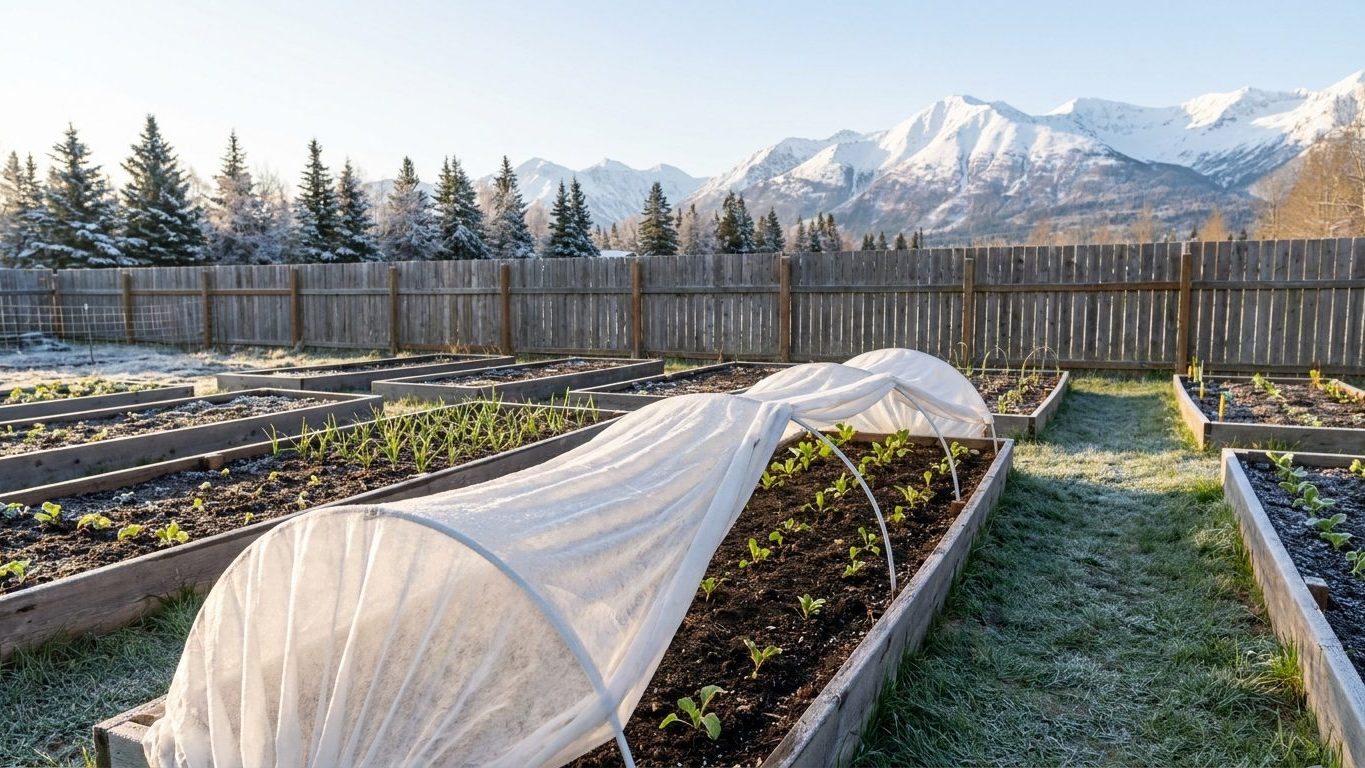

In the low desert, you cover plants against cold only on the rare night a freeze is forecast, and some winters never bring one. The covering that matters more runs the other way: shade against summer sun. In the high country, northern-style frost rules apply. Which of those three gardens you have decides when the cover goes on.
The short answer for Arizona
Cover for frost only when the forecast shows 32F, and in the low desert that happens between late December and mid January, if it happens at all. At the Phoenix reference station, NOAA’s 1991-2020 records show 32F in only 6 of 30 springs, and NOAA lists the frost-free season there as 365 days. A fall freeze can’t be counted on either.
The cold-season numbers explain why. The mean daily minimum of Phoenix’s coldest month is 45.3F. That is the average night at the coldest point of the year, and it sits well above freezing. A freeze here is a rare cold snap, not a seasonal pattern you can mark on a calendar. A cold-snap cover is also a short-term job: put it on in the evening before the forecast low, take it off the next morning. Leaving it on through a sunny day invites overheating.
Because of that, this page does not offer a frost-based planting calendar for the low desert. There is no last-frost date to count back from. What limits the garden is summer heat, which stops fruit set for months. Tomatoes, peppers and squash may flower and then drop those flowers or fail to set fruit. In that stretch, the useful “cover” is shade, not warmth.
The page does not have a dated shade calendar for the low desert, and it does not have frost dates for the high country. Both would need a local source (more on that below). For the cover materials themselves, including what holds up against Arizona sun and wind, see Which Season Extenders Work in Arizona. For the wider picture, start with Extending the Growing Season in Arizona.
What will not work here
The most common failure is borrowed advice. Gardening books written for colder states say to wait until the last frost date, then plant. In the low desert there is no dependable last frost date to wait for, since 6 springs out of 30 reached 32F. A gardener who waits for a frost-free signal waits forever, and loses the mild months that actually grow food.
Covering year-round “just in case” fails too. On a typical winter night the low sits far above freezing, as the 45.3F coldest-month average shows. A cover left in place on those nights, and through sunny afternoons, traps heat and can cook seedlings. Clear plastic is the worst offender because it lets sunlight in and holds the warmth. The cover should live in a closet most of the winter and come out only when the forecast calls for 32F.
Warm-weather crops fail for a different reason. Summer heat stops fruit set for months, so a frost cover does nothing for a tomato plant standing in July sun. Only shade, or a different planting window, helps. Buying a row cover sold for cold protection and using it against heat misreads the problem. Row covers that hold in warmth are a poor match for a season when the goal is to shed it.
Weekly watering doesn’t hold up in a hot, dry summer. Shallow-rooted vegetables in exposed beds dry out between sessions, and a plant already stressed by heat has little margin. Mulch and shade lower the demand, but they don’t turn a weekly schedule into an adequate one for most vegetables. This page has no summer rainfall or temperature figures, so it can’t say how often your beds need water. Check the soil by hand instead.
Finally, the cold-snap rule fails in the high country. Flagstaff and the surrounding high country freeze hard, and the guidance that works for Phoenix (cover only for the rare snap) would leave plants unprotected there on ordinary nights. Anyone gardening at altitude needs a real frost calendar, not a Phoenix shortcut.
What changes across Arizona
Arizona is not one garden. The USDA Plant Hardiness Zone Map (2023 edition, built on 1991-2020 normals) spans zones 4b through 10b across the state. That is a wide spread. The system rests on one variable, the average annual extreme minimum temperature, so it tells you how cold the worst nights get, not how hot the summers are or how long the season runs.
No single answer fits that range. A gardener near Phoenix is dealing with occasional 32F nights in a narrow winter window and a long, hot summer that blocks fruit set. A gardener in the high country is dealing with hard freezes and a season shaped by cold. The same question, “when do I cover?”, gets different answers because the limiting factor flips from heat to cold.
Anyone in the north or at altitude should shift their thinking toward the frost-based logic found in colder states. Covering becomes a regular part of spring and fall, not a once-in-a-winter event. This page does not carry high-country frost dates, so use a local source rather than a Phoenix number.
Day length adds another wrinkle. The 33.43 degrees north figure belongs to Phoenix, not to the whole state. It matters because day length, not warmth, tells an onion to stop making leaves and start making a bulb. Arizona spans several degrees of latitude, so a reader near the northern or southern edge should check their own latitude before leaning on a Phoenix-based timing.
Which zone you are in is not something this page can tell you. Look up your location on the USDA Plant Hardiness Zone Map and read the zone for your own address. Neighbors a few miles apart, at different elevations, can land in different zones.
Where to check this for your own county
Your state extension service is the next stop. University of Arizona Cooperative Extension is the land-grant extension service for the state, and its county offices exist to answer exactly this question for local conditions.
Two things are worth looking for there. The first is the local planting calendar for your county, which will give actual sowing and transplanting windows that account for your elevation and climate. The second is the list of varieties trialled in your county. A variety that sets fruit through a hot spell in one place may not perform in another, and trial results show what has actually been grown near you.
A county recommendation beats a state one. This page is the state one: it works from a single reference station in Phoenix and a statewide zone range, and it cannot see your valley, your slope or your elevation. Where the two disagree, trust the county source.
The page does not have county-level calendars to quote, so none are given. Treat what you find at your extension office as the dates, and this page as the reasoning behind them.
Checking this against your own garden
Your own observations outrank every date on this page. Three are worth watching, and none needs equipment.
- Soil warmth by feel. Push your hand a few inches into the bed in the morning. Soil that feels cool when the air is already warm marks a shaded or low spot. Soil that feels warm early marks a spot that heats fast and may need shade sooner.
- The first flush of male flowers. On squash and cucumbers, male flowers appear before female ones. If they show up and then the plant stalls or drops its fruit, you are watching heat limit fruit set in your own bed.
- The first true leaves. Seedlings first put out seed leaves, then true leaves. Slow, pale or scorched true leaves point to cold, wind or sun hitting that spot harder than its neighbors.
Keep notes across a year. A bed that frosts when the rest of the yard does not is a cold pocket, and it earns a cover on the nights the forecast gets close to 32F. A bed against a south-facing wall that scorches early is the one that needs shade first.
Common questions
Do I need to cover my garden in Phoenix every winter?
No. Phoenix reached 32F in only 6 of 30 springs in NOAA’s 1991-2020 record. Cover only when a freeze is forecast, usually in a cold snap between late December and mid January.
Is there a last frost date for the Arizona low desert?
Not a reliable one. NOAA lists the frost-free season as 365 days at the Phoenix reference station, so a frost-based planting calendar doesn’t fit the low desert.
Why won’t my tomatoes set fruit in summer?
Summer heat stops fruit set for months in the low desert. Covering for cold doesn’t help. Shade and a different planting window are the tools that matter.
Does the same advice apply in Flagstaff?
No. Flagstaff and the high country freeze hard and behave like a different climate. USDA hardiness zones across Arizona run from 4b to 10b, so use your county extension office for local frost timing.