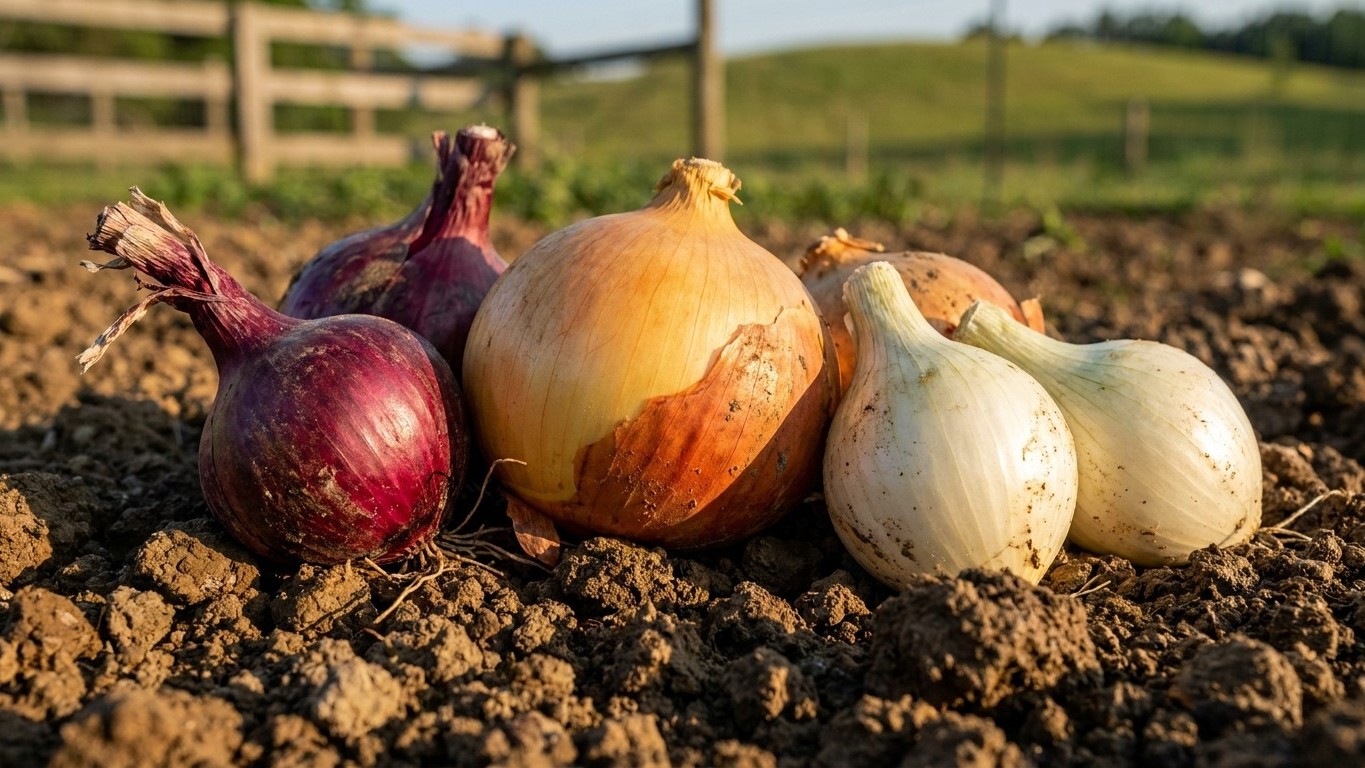

Lift New York onions when most of the tops have flopped over and turned yellow. Then cure them in a dry, airy, shaded spot until the necks are tight and the skins turn papery. Pulling early or skipping the cure is how a good crop turns soft by December. The calendar matters less than what the plant is showing you, and those signals trace back to day length, not warmth. This page covers the trigger, the mistakes that waste a season, and what your pantry looks like in March.
The short answer for New York
New York City, the reference point for the figures on this page, sits at 40.78 degrees north (the coordinates of NOAA NCEI station USW00094728, the same station the climate normals come from). On the longest day of the year the sun is up for 14 h 56. That is long enough to trigger bulbing in long-day onions, which wait for 14 to 16 hours of daylight. Bulbs swell through early summer, and the tops start to fall in the weeks after. The daylight figure is calculated from the latitude at the June solstice with a geometric horizon. Atmospheric refraction adds roughly seven minutes of real daylight that the number does not count.
What day length actually does
An onion does not bulb because the weather turns hot. It bulbs because the days reach a length its variety recognizes. Until then the plant makes leaves, and each leaf eventually becomes one ring of the bulb. The day the trigger fires, the plant stops adding leaves and starts swelling the ones it has. Whatever size the plant has reached at that moment is the size of the bulb you will lift.
A short-day variety triggers at about 12 hours, a threshold published by Clemson Cooperative Extension. New York’s days pass 12 hours in spring, so a short-day onion starts bulbing early, on a small plant. A long-day variety holds out until the days stretch toward 14 to 16 hours, and at 14 h 56 New York gets there. That is why long-day types are the natural fit here. For named varieties, see The Best Onion Varieties for New York.
Reading the plant, not the calendar
Once bulbing is under way, the tops tell you where the crop stands. The necks soften, the leaves bend over, and the green fades to yellow and brown. Lift on a dry day, shake off the loose soil without washing the bulbs, and lay them in a single layer somewhere warm, dry, shaded, and out of the rain. Curing is finished when the necks are tight and the outer skins are papery. Only then do the bulbs go into storage, never straight from the ground.
The right date for your garden depends on when you planted, the variety, and your local frost dates. Frost dates are not published on this page, so use your county office for them (more on that below). The broader growing picture is in Onions in New York.
What will not work here
Planting late does not push the harvest back. It shrinks it. The trigger arrives on schedule with the daylight, and a plant set out late meets it with fewer leaves, so you get a smaller bulb. No amount of extra watering in July makes up for leaves the plant never grew in May.
The variety mistake
At 40.78 degrees north, every day-length group will form a bulb. The risk is not “no bulb” but a bulb far too small. Short-day types hit their 12-hour trigger early in the season and stop leafing out while the plant is still a seedling. The reverse failure shows up in the Deep South, where a long-day onion never sees a day long enough, grows leaves all season, forms no bulb, and rots. New York’s daylight rules that out, but it does not rescue a short-day type from staying small.
The harvest and storage mistakes
Most lost crops in the cellar were lost in the garden or on the curing rack. These are the ones that fail here, each for a clear reason:
- Short-day varieties as your main crop: they trigger at about 12 hours, so they bulb early on a small plant and give small bulbs at this latitude.
- Sweet onions for winter storage: they carry fewer of the sulfur compounds that protect a bulb in storage, so they soften and sprout first.
- Lifting while the tops are still green and upright: the bulb is still sizing, and the thick, wet neck is an open door for rot.
- Storing uncured bulbs: moisture trapped in an open neck or damp skin rots the bulb from the inside.
- Storing onions in a damp cellar next to carrots: onions want 50 to 60 percent humidity, the opposite of root crops, and a single cellar rarely holds both well.
- Setting nicked or chewed bulbs aside with the keepers: damage is where rot starts, so eat those first. What Eats Onion in New York, and When explains which pests leave those wounds.
What changes across New York
New York is a long state from the harbor to the Canadian border, and 40.78 degrees north describes only the city. The state is also not one climate. Lake Ontario, the Hudson Valley, and the higher ground of the Adirondacks and the Catskills each shift the frost calendar by weeks. The city sits close to the state’s southern edge, so most gardens elsewhere in New York are farther north than the reference point.
North and south at a glance
Farther north means a longer summer day, so the daylight figure at the border is higher than 14 h 56. The exact figure for your latitude is not published here, so work it out for your own address.
| Location | Latitude | Longest-day length | What it changes |
|---|---|---|---|
| New York City (reference) | 40.78 degrees north | 14 h 56 | Long-day types get the 14 to 16 hours they need; short-day types bulb early and small |
| Upstate and the North Country | Higher than 40.78 (check your own) | More than 14 h 56 (exact figure not published here) | Stronger long-day signal; a shorter season, so lifting and curing can fall at a different time than in the city |
The practical effect is that a gardener in the far north is even more firmly in long-day territory than the city, with less room for short-day types. The frost calendar can differ by weeks, which moves the lifting window. A late wet autumn up there makes curing outdoors a gamble, so be ready to bring the bulbs under cover.
Sweet now, or onions that last
An onion cannot be both very sweet and a long keeper, and the reason is chemistry, not luck. An onion’s bite comes from volatile sulfur compounds, and those same compounds are what protect the bulb in storage. A sweet variety has fewer of them. That makes it better raw, but it will not last the winter. University of Missouri Extension puts it plainly in its onion guide: “As a rule, ‘sweet’ onions do not store as well as the more pungent types.”
How day length lines up with the trade
The trade follows day length. Short-day types run sweeter, and long-day types keep longer. A southern garden therefore gives you onions to eat soon, and a northern one gives you onions that feed you into March. New York gardens lean toward the pungent, long-keeping end. The sweet ones suit a few weeks of fresh eating, not a winter of storage.
What the pantry looks like in March
Come March, a basket of properly cured long-day onions stored at 45 °F to 55 °F and 50 to 60 percent humidity (Clemson Extension’s ideal range) should still be firm, with papery skins and tight necks. A basket of sweet onions from the same garden will have gone soft, started to sprout, or been eaten long before. If you want both, grow both, and eat the sweet ones first. Never plan a winter around a sweet onion that stores, because that onion does not exist.
Checking this against your own garden
The figures here come from one city. Before you trust the timing, run a few checks on your own ground. Your county’s Cornell Cooperative Extension office is the place to start, since it can tell you what is true for your part of the state and not just for the reference city. Everything below can be done this week:
- Look up your own latitude and compare it with 40.78 degrees north. If you are well north of the city, expect longer summer days than 14 h 56.
- Ask your county extension office for the frost dates for your location, and write them down next to your planting and lifting dates.
- Read the day-length class on your variety’s label or catalog description. If it says short-day, plan to eat it fresh.
- Put a thermometer and a humidity gauge where you plan to store the crop, and compare the readings with 45 °F to 55 °F and 50 to 60 percent humidity.
- Find a spot for curing that is warm, shaded, and airy, and decide where the bulbs go if rain arrives.
- Check last year’s storage losses, and note whether the bulbs that failed were uncured, damaged, or stored too damp.
Common questions
How do I know when it is time to lift my onions?
Watch the tops. When most of them have fallen over and turned yellow, the bulbs have finished sizing. Lift on a dry day and move straight to curing. A date on the calendar is only a rough guide, since planting date, variety, and local frost dates all move it.
How long does curing take?
There is no fixed number of days. Curing is done when the necks are tight and the skins are papery, and weather sets the pace. Warm, dry, breezy conditions speed it up, and a damp spell slows it down. Keep the bulbs out of the rain.
Can I store sweet onions through the winter?
Do not count on it. Sweet onions have fewer of the sulfur compounds that protect bulbs in storage, so they are the first to soften and sprout. Eat them first and keep the pungent, long-day onions for winter.
Where should I keep cured onions?
Somewhere cool and dry, at 45 °F to 55 °F and 50 to 60 percent humidity. That rules out the damp corner of a cellar where you keep carrots. A basement that suits root crops is usually too humid for onions, so cured onions often do better in a different spot, like a cool, dry closet or a mesh bag hung in an airy room.