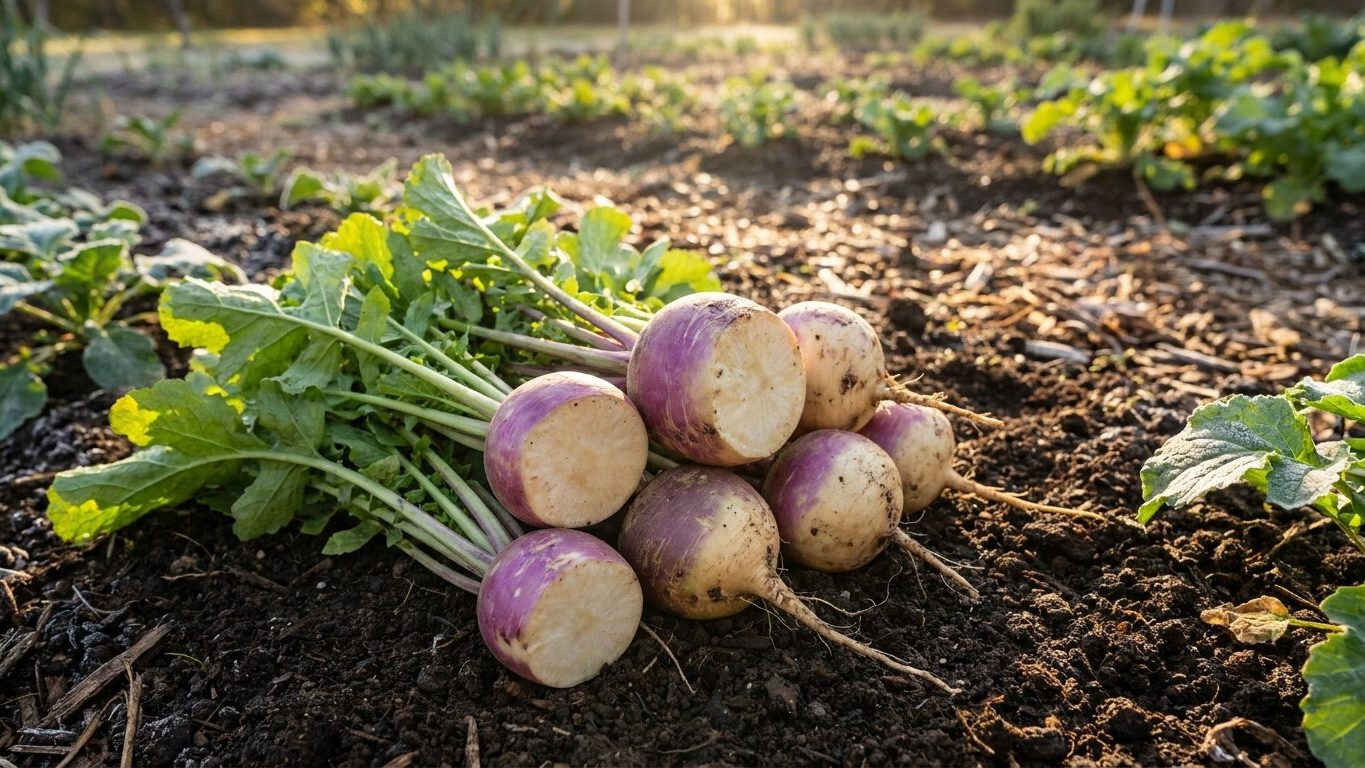

Yes, turnips and rutabaga can be grown in the Northwest Territories, but the calendar leaves little slack. At Yellowknife the average last spring frost is May 25 and the average first fall frost is September 18. Sow cool-soil roots as soon as the ground allows, choose early types, and plan the harvest around a hard freeze that arrives sooner than most gardeners expect. This is the territorial version of the broader guide to Growing Turnips and Rutabaga: An Autumn Crop, Sweetened by Frost.
When the soil is warm enough in Northwest Territories
The date most people want is the last spring frost, and the number comes from Environment and Climate Change Canada’s 1981-2010 Canadian Climate Normals for the YELLOWKNIFE A station (climate ID 2204100): on average, May 25. That is a mean, not a safe date. In one year out of two the last frost falls later than that, so treat May 25 as the middle of a window. Say it once and keep it in mind: it is a probability, not a promise.
The frost date is also a stand-in for what the crop actually cares about. Turnips and rutabaga wait for warm soil, and soil warms after frost risk ends, not at the same moment. Air can climb above freezing in a sunny afternoon while the top few inches of a north-country bed are still cold and wet from snowmelt. Seed sown into that soil sits, or rots, or sprouts unevenly. A date on the calendar tells you when the air stops threatening young leaves. It says little about the ground.
So the practical approach is to let the soil, not the date, give the signal. A bed that has drained, crumbles in the hand instead of smearing, and no longer feels like a cold cellar floor is ready. A cheap soil thermometer pushed in at seed depth, checked in the morning when the soil is at its coolest, beats guessing. Beds raised above the surrounding ground and dark soil that absorbs sun tend to thaw and warm sooner than flat, shaded plots. That matters in the Territories, where many gardens sit on thin soil over rock or on imported soil in raised frames.
Why the Yellowknife figure is not the whole territory
The frost dates here come from one station. The Northwest Territories stretches from the boreal forest south of Great Slave Lake to the Arctic coast, and a single reading cannot describe all of it. Northern and upland districts run weeks behind Yellowknife, so a gardener in Inuvik or the Sahtu should push everything later and expect less margin. Note too that the Canadian normals cover 1981-2010, while the US figures elsewhere on this site cover 1991-2020, so the two sets are not on the same footing.
The Canadian hardiness zone for the reference city is 1b, according to Natural Resources Canada’s Plant Hardiness Site (1991-2020 normals). That is a Canadian zone and does not translate into a USDA zone, because the Canadian system weighs seven climate variables and the American one weighs a single one. It is useful mainly as a signal that this is about as cold as Canadian gardening gets, and that anything marginal will be tested.
For the types of turnip and rutabaga that suit the territory, and for the varieties tried in northern conditions, the last section below points to the territorial agriculture service. Names that work in Ontario or Colorado tell you little about a Yellowknife bed.
How long the season lasts here
Count from the average last spring frost, May 25, to the average first fall frost, September 18. That is about 116 days. Both dates are means from the same Yellowknife station, so the subtraction is a midpoint estimate. In a year when spring runs late and fall comes early, the real window is shorter, and in a kind year it stretches a little. Half the years will fall short of that figure.
What does 116 days allow? For a cool-season root crop, it allows one sowing done well, and perhaps nothing more. In a long-season territory, a gardener sows turnips in spring, again in midsummer, and harvests the second batch after the frost has sweetened it. Here the arithmetic does not support that. A midsummer sowing would have to mature in a window that closes in September, with days getting shorter and the ground heading toward a hard freeze. The sensible plan is to make the first sowing the main sowing, and to treat any later sowing as a small bonus, not a plan. For how to stagger sowings where the season does permit it, see the succession sowing guide on this site.
The short window also changes the transplanting question. Roots resent disturbance, and moving a seedling can leave a forked or stunted root, so direct sowing is the norm for turnips and rutabaga. Starting transplants indoors to gain a couple of weeks is tempting in a place where every week counts. Even so, it only pays off if the roots are checked at planting and the seedlings go out undamaged, with their taproot straight. If you transplant, check the root before it goes in the ground. A kinked or crushed taproot wastes the weeks you were trying to save.
Rutabaga is the harder case. It generally needs a longer stretch than turnip to size up, so a window of about 116 days between mean dates leaves it a thinner margin. Gardeners at the colder end of the territory may find turnip dependable and rutabaga a gamble. For a comparison, Growing Turnips and Rutabaga in Nunavut shows what a still shorter season does to the plan, and Growing Turnips and Rutabaga in Colorado shows the opposite problem, where heat, not cold, sets the limits.
Heat and water in Northwest Territories
This page does not carry a verified count of days above 90 °F (32 °C) for Yellowknife, or a verified figure for summer rainfall, and it will not guess at either. A hot-climate paragraph about bolting and root splitting under heat would be the wrong paragraph for a subarctic territory anyway. At this latitude, the two facts that govern an autumn root crop are both cold ones.
The first is the coldest month. At the Yellowknife reference station, the mean daily minimum of the coldest month is -29.5 °C (-21.1 °F). That is an average low, not the record low, and real winter nights go well beneath it. For a gardener, the lesson is blunt: roots left in the ground under mulch will not be waiting for you in spring, and they will not wait for a December harvest either. Soil that freezes hard turns a root to mush on thawing and makes digging a matter of a pickax. In this territory, plan on lifting the crop and storing it, not leaving it in the bed.
The second is how much frost sweetening the crop actually gets. Cold nights push starch toward sugar in turnips and rutabaga, which is why a root pulled after a few light frosts tastes better than one pulled in August. The average first fall frost at Yellowknife is September 18. After that date, the gardener has a short stretch to let the roots sweeten before the ground locks up. The page has no verified freeze-up date, so the working rule is to watch the soil: harvest after a few frosts, before the top inch or two of ground stays frozen through the day.
Where do cool, damp summers come in? If a summer turns cool and wet, the likely trouble is slow ripening, with roots that sit small through July, plus mildew and leaf disease from foliage that stays wet. Give plants room, water in the morning so leaves dry, and avoid crowding. Slow growth is the bigger worry, because a late root never catches up before the freeze.
Storage is where food safety enters. Before any root goes into cold storage, inspect it by hand. It should be firm all over, with clean skin and a dry crown. A soft patch, a weeping spot, or a moldy crown ends the question for that root. Looking sound from the outside is not proof that a root is sound, and no keeping duration can be promised, so check the pile regularly and pull out anything that has turned.
Which turnips and rutabaga suit Northwest Territories
Start from the facts. A season of about 116 days between mean frost dates favours the earliest-maturing types, the quick small turnips that size up well before the window closes. For rutabaga, the gamble is real, so choose the earliest-maturing types available, and be ready to settle for smaller roots. Heat is not the limit here, so shade and airflow at the root matter less than they would in Colorado. Disease pressure in a cool, damp summer, however, makes resistance to leaf and root diseases a sensible criterion once earliness is satisfied.
This page names no varieties, and the omission is on purpose. A cultivar list borrowed from southern Canada or the northern states would be a guess about a place with a very different season length, and gardeners spot an invented or ill-fitting variety right away. The varieties that count are the ones trialled in northern conditions, and that information sits with the Government of the Northwest Territories agriculture service. It is a territorial service, not a state extension office, but it fills the same role: local advice from people who know the soil and climate of the territory.
One rule holds for every type. Turnips and rutabaga are brassicas, in the same family as cabbage, kale, and mustard. They share pests and diseases with those crops, so rotating them into a bed where cabbage grew last year is not rotation at all. Keep them at least a few seasons away from any brassica bed, and follow the rotation page on this site for the details.
Common questions
When should I sow turnips in Yellowknife?
Once the soil has thawed, drained, and warmed, which comes after the average last spring frost of May 25. Because that date is a midpoint, half of years run later. Let the soil tell you, not the calendar.
Can I leave turnips and rutabaga in the ground over winter?
Not reliably. The mean daily minimum of the coldest month is -29.5 °C (-21.1 °F) at the reference station, and hard-frozen ground ruins roots. Lift them after a few frosts and store them.
Is a second sowing worth trying?
Rarely. Between the mean frost dates there are about 116 days, and half of years offer less. Make the first sowing the main one and treat any later sowing as an experiment.
What does hardiness zone 1b mean for these crops?
It is the Canadian zone for the reference city, from Natural Resources Canada, and it does not convert to a USDA zone. For an annual root crop it matters less than frost dates and season length.