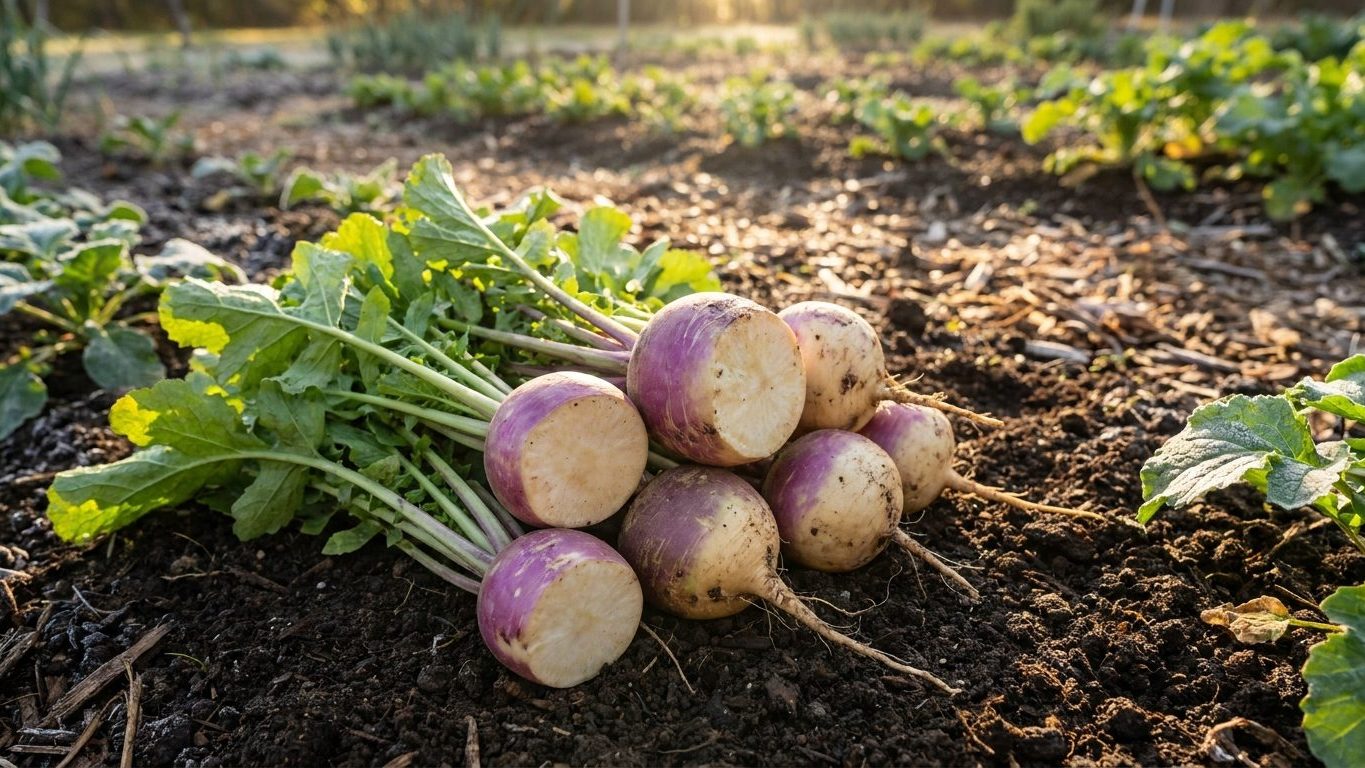

Turnips and rutabaga in Colorado are best treated as a fall crop, not a spring one. Sow turnips from mid-June through late July for autumn harvest, and get rutabaga in the ground even earlier, since it needs more days to bulk up before the ground freezes. The two frost windows on the Front Range set the calendar; everything else follows from them.
When the soil is warm enough in Colorado
The frost question gets asked first, so here’s the number: NOAA’s 1991-2020 Climate Normals put Denver’s last spring freeze (32F) between May 1 and May 11, based on data from station USW00003017. That’s a probability band, not a promise, and it applies to the Denver reference station specifically. Mountain towns run far shorter seasons and can frost in July; the western slope tells a different story again. Whatever county you garden in, treat that date as a starting point to check against local records, not a fixed line on a calendar.
Here’s the part that trips people up: frost date and soil temperature are not the same thing. Turnip and rutabaga seed will germinate in cool soil, but the seedlings sit and sulk until the ground actually warms, which lags behind the air by a week or two on the high plains. A gardener who sows the day after the last frost date on the calendar is often sowing into soil that hasn’t caught up yet. The practical fix is to wait for the soil itself to feel workable and warmed through, rather than racing the calendar.
Rotation matters from day one
Turnips and rutabaga are brassicas, the same family as cabbage, kale, and mustard. That means they share the same soil-borne diseases and the same pest pressure, and planting them into a bed that grew any of those crops last season is not a rotation at all, it’s a repeat. Colorado State University Extension can point you toward a rotation schedule suited to your county; the principle holds everywhere: brassicas follow non-brassicas, every season, without exception.
Once roots are ready to store, resist the urge to trust appearance alone. A root that looks fine on the outside can still be compromised. Check each one before it goes into storage: a soft patch, a weeping spot, or a moldy crown means that root gets used now or discarded, not stored. No amount of good-looking skin overrides that inspection.
How long the season lasts here
Subtracting the two frost windows gives a real answer, and it’s worth doing precisely because both numbers come from the same source. The last spring frost runs May 1 to May 11; the first fall frost runs September 30 to October 12. Depending on where the actual dates fall within those bands in any given year, Denver’s frost-free window stretches somewhere between roughly 142 and 164 days.
| Milestone | Date window | Source |
|---|---|---|
| Last spring frost (32F) | May 1 to May 11 | NOAA NCEI, station USW00003017 |
| First fall frost (32F) | September 30 to October 12 | NOAA NCEI, station USW00003017 |
| Frost-free window | Approximately 142 to 164 days | Calculated from the two dates above |
That’s a genuinely long window by Front Range standards, and it changes what’s worth attempting. A season that long allows a second sowing of turnips after an early spring batch bolts or gets pulled, since turnips mature fast enough to fit two rounds into 150-plus days. Rutabaga, slower to bulk, is usually a one-shot crop here: get it in by early-to-mid summer and let it run through to fall, rather than trying to squeeze in a second planting.
If you’re timing a succession of sowings rather than a single planting date, the site’s succession sowing guide walks through spacing those windows so you’re not harvesting everything at once, or worse, sowing a second round too late to size up before the first hard freeze arrives.
The one thing that changes with a long window like this is whether transplanting is worth the trouble. With this much season to work with, direct sowing usually wins for turnips, since they resent root disturbance and a longer window removes the pressure to get a jump-start indoors. Rutabaga sometimes gets started as transplants specifically to buy a few extra weeks, but that only makes sense where the window is tight, and Denver’s isn’t.
Heat and water in Colorado
This is where a lot of turnip advice written for other regions stops applying. Turnips and rutabaga in Colorado are almost entirely an autumn story, and the facts that actually govern that story are cold ones, not summer heat or rainfall totals. Colorado’s hardiness range spans USDA Zone 3b to 7b across the state, a spread wide enough that a single summer-heat figure for “Colorado” would be meaningless anyway; a garden in a mountain valley and one on the eastern plains are living in different climates under the same state line. What matters for this crop is what happens as the days shorten, not how hot July got.
The mean daily minimum for Denver’s coldest month sits at 18.4F, per NOAA’s 1991-2020 Climate Normals. That single figure decides two practical things at once. First, it tells you whether roots left in the ground under a heavy mulch layer are likely to survive the winter intact or need to come out before the ground locks up hard; at that kind of cold, unprotected soil freezes deep enough that lifting and storing indoors is the safer bet for most gardeners, rather than gambling on mulch alone. Second, it sets the ceiling on frost sweetening, the process where cold converts stored starches to sugars and makes turnips and rutabaga taste noticeably better after a few light frosts. Colorado’s autumn cold arrives reliably enough that most gardeners get a real sweetening window before the ground freezes solid, which is one of the genuine advantages of growing this crop here rather than somewhere with a milder, wetter fall.
Where this territory doesn’t hand you an advantage is humidity. Colorado’s high plains climate runs dry and sunny through summer, which is generally good news for brassica roots (less foliar disease pressure than a humid eastern garden faces), but it also means irrigation is doing the work that rainfall would do elsewhere. Consistent watering through root sizing matters more here than in wetter regions, since these roots split and turn woody under alternating drought and sudden soaking far more than under steady moisture.
Which turnips and rutabaga suit Colorado
Given a long frost-free window, cold-driven autumn ripening, and dry summer conditions, the logical choice leans toward earlier-maturing turnip types for a potential first sowing, and toward the standard longer-season rutabaga types for the single fall crop, given how much time this window actually allows. Faster types also give a buffer if a sowing gets delayed by a wet spring or a late soil warm-up, since they can still finish before the fall frost window arrives.
This page won’t name a specific variety, and that’s a deliberate choice rather than an oversight. Naming a cultivar without knowing which ones have actually been trialled and performed well in Colorado’s specific combination of elevation, dry air, and cold autumns would be a guess dressed up as advice. Colorado State University Extension maintains variety trial data and local recommendations built on actual field performance in this state, and that’s the resource that carries real weight here, not a generic list assembled without Colorado conditions in mind.
What’s worth asking your local extension office or garden center about, by type rather than name, includes:
- Early-maturing turnip types, useful for a first sowing or as insurance against a late start
- Standard-season turnip types suited to a single fall harvest timed off the first frost window
- Longer-season rutabaga types bred for the extended bulking time this crop needs before storage
- Disease-resistant selections, worth asking about specifically if your garden sits in a wetter microclimate or irrigates heavily
Whatever type you land on, keep the rotation rule in mind before you even choose seed: turnips and rutabaga follow the same brassica-family disease and pest pressures as cabbage, kale, and mustard, and a bed that grew any of those crops last year isn’t a fresh start for this one. Check with Colorado State University Extension for the rotation timing that fits your specific county, since soil conditions and growing seasons shift noticeably from the plains to higher elevations within the same state.