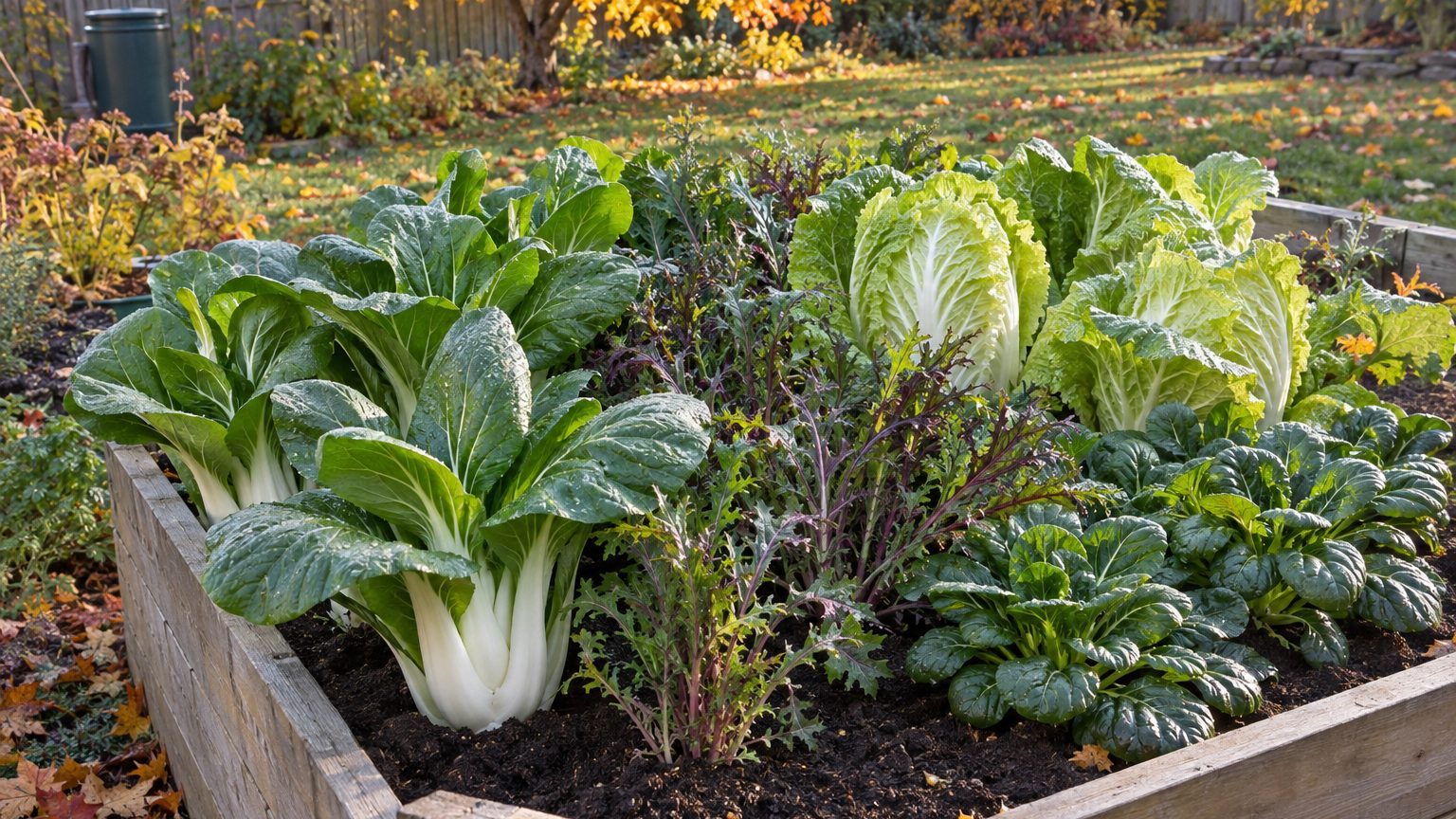

Asian greens such as bok choy, napa cabbage, mizuna and tatsoi grow fast and shrug off frost, but they run to flower when sown into lengthening days. Sow them in late summer and fall, and they give tender leaves well into winter. Sow them in April, and many will bolt before they size up. For this family, timing counts for more than technique, and the sections below show how to read it for your own yard.
Why these are autumn crops

Bok choy sown in April sends up a flower stalk by early summer, and the gardener assumes something went wrong with the soil, the watering or the seed. Nothing did. The crop was sown at the wrong end of the year. Nearly all of these greens bolt when sown in spring and produce beautifully when sown into shortening days.
What the young plant is reading
These plants are biennial by nature. They grow leaves in year one, sit through a cold spell, and flower in year two. A young seedling that gets chilled and is then met with lengthening days reads the sequence as a winter already passed, so it skips ahead to flowering. A cool snap in April followed by days stretching toward the June solstice delivers exactly that signal. Heat and long days add their own push, which is why a spring planting can fail even without a cold snap.
Fall reverses the sequence. Seedlings start in warm soil and days shrink from there. Cold arrives late, after the plant has already built its leaves, and the shortening light never tells it that spring is coming. The plant stays leafy and sweet, and the cold itself brings out sugars in the leaves.
What it means for the calendar
Plan backward from your average first fall frost. Sow slow types early enough that they reach full size while days are still shortening, and sow fast types in repeated small batches so you are never harvesting all at once. Late summer is the usual window across much of the country. The seedlings still need shade cloth or a bit of afternoon shade and steady water while the soil is hot.
Spring is not closed to you, but the rules change. Sow as soon as the soil can be worked, harvest young as baby leaves, and treat the planting as a quick crop rather than a full-size one. Some seed companies sell types bred to resist bolting. Which of them have been trialed where you live is a question for your state extension service, since a type that holds in Oregon may flower early in Georgia.
A bolted plant is not a total loss. The flower buds and tender stalks of several Asian greens are eaten as a vegetable, much like broccoli raab. The leaves, though, turn bitter and tough once the stalk rises.
Bok choy, napa cabbage, mizuna and tatsoi
Four crops carry most of the family in American gardens. They look alike in a seed catalog and behave very differently in the ground, especially on the clock.
| Crop | Time to harvest | Cold tolerance | How it is eaten | When it bolts |
|---|---|---|---|---|
| Bok choy | Baby plants in a few weeks, full heads take longer | Handles light frost, mature heads are damaged by a hard freeze | Stir-fried, braised, steamed, in soups. Stems and leaves both used | Quickly in spring warmth and long days, stalk rises from the center |
| Napa cabbage | Slowest of the four, most of the autumn for a full head | Tolerates light frost, tight heads suffer in a hard freeze | Raw in slaws, fermented as kimchi, cooked in soups | The most touchy, a chilled seedling can flower instead of forming a head |
| Mizuna | Picking size in weeks, cut-and-come-again after that | Very hardy, among the last greens standing | Raw in salads, wilted into soups, mild peppery bite | Bolts in warmth and long days, but you have usually harvested by then |
| Tatsoi | Baby leaves in weeks, full rosettes take longer | Very hardy, a flat rosette sits low and rides out cold well | Raw or lightly cooked, spoon-shaped leaves with a mild flavor | Sends up yellow-flowered stalks in spring, leaves turn coarse |
One sowing date does not fit all four
The time difference is large. Mizuna is picking size in weeks, while napa cabbage needs most of the autumn. Sow them on the same date and you get one crop and one failure. Either the mizuna is bolting and bitter by the time the napa heads up, or the napa goes in late enough to suit mizuna and never fills out before hard frost. Sow napa first, bok choy next, and keep the quick leaves for the last weeks before frost and for repeated small sowings.
Each name covers several types. Bok choy comes in full-size and baby forms, and napa comes in tall barrel-shaped and shorter wrapped-head forms. Both vary in bolt resistance and in how long they hold. Seed packets and catalogs list the specifics, but your state extension service is the better guide to what has actually been trialed in your climate.
Inspecting heads and stalks before you eat them
Napa heads and bok choy are often held for a while after harvest. Look at the outer leaves, the cut base and the center of the head. A soft patch, a weeping spot or a moldy crown ends the question, and that plant goes to the compost rather than the kitchen. A sound appearance on the outside never proves the middle is fine, so cut into the head and check there too. This guide gives no keeping times, because they depend too much on temperature, humidity and the condition of the plant at harvest.
They share every problem with the cabbage bed
Bok choy, napa, mizuna and tatsoi are brassicas. So are cabbage, kale, broccoli, mustard, radish, arugula, turnip and rutabaga. Whatever bothers one of them bothers the rest, and the pests and diseases do not care whether the leaf is labeled Asian or European.
The four usual troublemakers
Flea beetles chew tiny round holes that give young leaves a shot-pellet look. Seedlings and thin-leaved crops like mizuna and tatsoi take the worst of it. Cabbage worms, including the imported cabbageworm and the cabbage looper, are green caterpillars that chew ragged holes and leave dark droppings in the heart of a head. Root maggots are the larvae of small flies that lay eggs at the base of the plant, and they tunnel into the roots. Clubroot is a soil-borne disease that swells and distorts the roots. Affected plants stunt and wilt in the afternoon heat even when the soil is moist.
The physical barrier works against the first three. Floating row cover, laid over the bed at planting and sealed along the edges, keeps flea beetles, egg-laying moths and root flies away from the plants. Hand-picking caterpillars and checking leaf undersides for egg clusters also helps on a small bed. For anything beyond that, follow your extension service and the product label rather than a recipe from a forum.
What that means for rotation
Clubroot is the reason rotation matters most. Its resting spores can persist in soil for many years, so a bed that grew infected cabbage keeps the problem long after the cabbage is gone. Root maggots and many leaf pests overwinter in or near the bed too, and they emerge in spring to find a fresh crop of the same family waiting.
Here is the trap. A gardener who rotates bok choy into last year’s cabbage bed has rotated nothing. The same goes for turnip or rutabaga dropped into a former kale or mustard bed, since a turnip is just another brassica with a fat root. A real rotation moves the whole family to a different bed and puts something unrelated, such as beans, tomatoes, onions or lettuce, in its place. How many years to wait before the family returns depends on your disease history, and the rotation page in this silo walks through the schedule. If you have seen clubroot, treat it as a longer commitment and keep infected roots out of the compost.
Why the answer changes with where you garden
Everything above holds across the country, but two local facts decide how it plays out in your yard. The first is your first fall frost date, which sets how late you can still sow. The second is your winter low, which decides whether the hardiest of these greens stand through the cold or end with it.
The first frost sets the sowing window
In the northern tier of states, the first frost can arrive in September or early October, so slow crops like napa cabbage have to go in during late summer, with little room for error. Along the Gulf Coast and in much of the lower South, frost may hold off until late fall or early winter. Sowing there stretches deep into autumn, and spring bolting starts early the following year. Count backward from your own date, leaving a margin for a cool, slow fall. Your extension service publishes average frost dates for your county, and those are better than a national chart.
The winter low decides who survives
Tatsoi and mizuna are the hardiest of the four, and in milder regions such as much of the Pacific Northwest and parts of the South, they can stand outdoors through most of winter. Bok choy and napa are less forgiving, since a hard freeze damages mature heads. In colder regions, a low tunnel or cold frame can add several weeks of harvest, but plan on the crop ending with winter unless the cover is sturdy. Check your USDA hardiness zone, then check what your extension service says about overwintering brassica greens in your state.
The state pages in this silo take these two facts and turn them into sowing windows for your region. Start there, then ask your state extension service which types have been trialed locally for bolt resistance and cold tolerance.
Common questions
Can I grow bok choy in spring?
Yes, but expect a short window. Sow as early as the soil allows and harvest it young, because lengthening days and warmth push the plant toward flower. A bed sown in late summer will do far better, and your extension service can tell you which types resist bolting in your area.
How late can I still sow Asian greens in fall?
It depends on the crop and your first frost date. Mizuna and baby tatsoi mature quickly and can go in later. Napa cabbage needs the longest runway and should be sown first. Count back from your average first frost and keep the slow crops at the front of the schedule.
Can I plant turnips or rutabagas where Asian greens grew?
Not if you want a rotation. Turnip and rutabaga are brassicas that share flea beetles, root maggots, cabbage worms and clubroot with bok choy, napa, kale and mustard. Move the whole family to a new bed and plant an unrelated crop in the old one.
Is a bolted plant safe to eat?
Bolting itself is not a safety problem, and the flower buds of several Asian greens are eaten. The leaves usually turn bitter and tough. Whatever you harvest, inspect it first, and if you find a soft patch, a weeping spot or a moldy crown, throw the plant out.