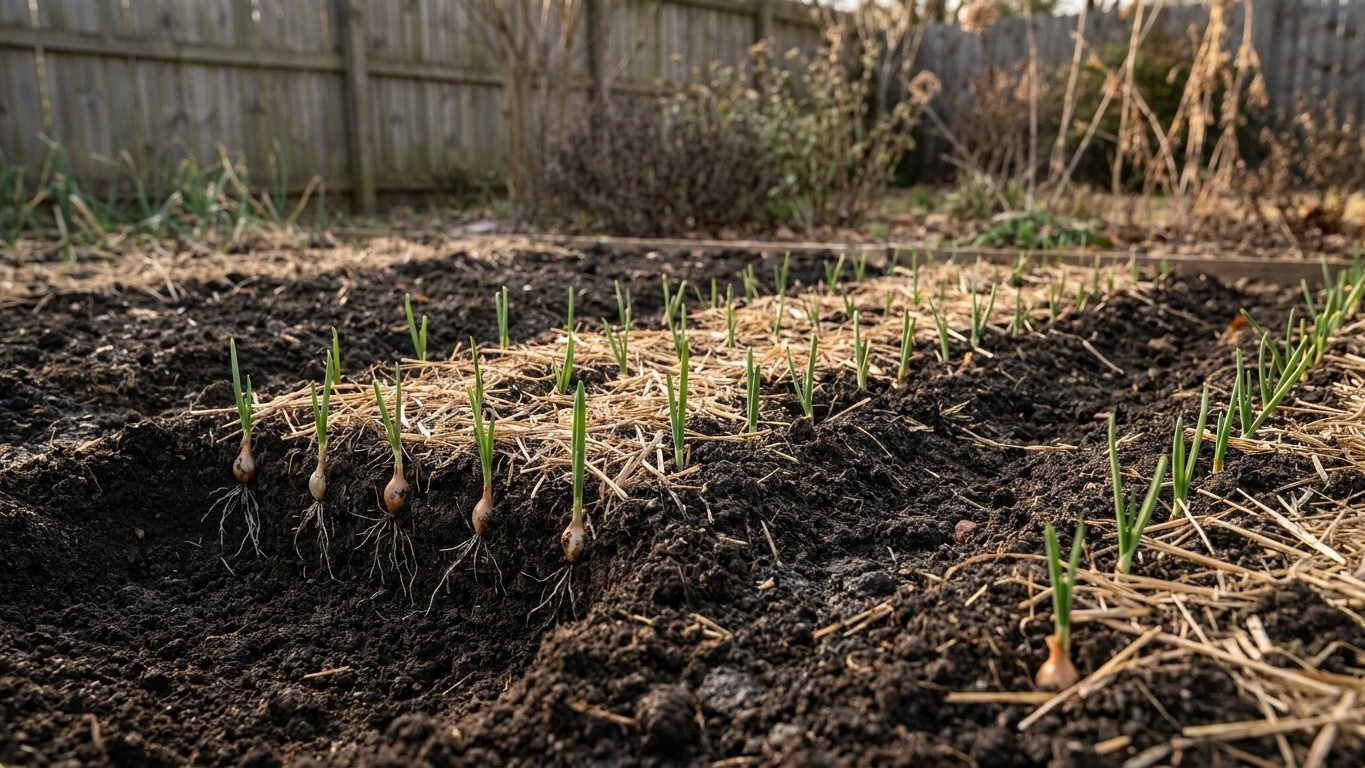

Garlic has fewer enemies than most vegetables, which is half the reason people grow it. New York still has a real list: allium leafminer, onion maggot, bulb and stem nematodes, thrips, wireworms and, over winter, voles. Each one is active in a different season, and the nematode arrives hidden inside the cloves you buy. Garlic goes in during autumn and comes out the following summer, so it passes through every one of those windows.
The short answer for New York
In New York City, the first 32°F freeze of fall arrives between November 14 and November 27, according to the NOAA NCEI U.S. Climate Normals 1991-2020 (the 30 to 70 percent probability band at Central Park). That is the New York City figure, not a state-wide one. Central Park is a dense urban site, and upstate New York and the Adirondacks frost far earlier in fall and later in spring.
Why does a frost date belong in a pest article? Because the whole pest year of a fall-planted garlic bed hangs on it. The freeze marks the end of the planting season and the start of the rodent season. Spring pests, in turn, wake up according to how long the ground stays cold after that freeze.
Treat the date as a midpoint, never a safe date. In one year out of two the first freeze falls later, so a bed you thought was safely rooted and mulched can still be sitting in mild weather.
Roughly, the calendar runs like this:
- Planting time (fall): wireworms in beds cut from sod, and nematodes riding in on seed cloves.
- Winter: voles and mice tunneling under mulch and snow.
- Spring: allium leafminer, onion maggot, and in the north, leek moth.
- Early summer: thrips, as the weather dries and the tops begin to yellow.
- Curing and storage: mites in bulbs that were stored damp or warm.
The fall and winter entries follow the frost. The spring entries follow warmth, and they shift from year to year with no regard for the calendar.
Working it out for your own garden
A state is not one climate. Elevation, a large lake and the coast can each move these dates by as much as two weeks either way, so the Central Park band is a starting point and not an answer for your yard.
Start from your own first freeze
Find the first-freeze date for the weather station nearest you. Then do the subtraction that sets your planting window, which the When to Plant Garlic in New York: Counting Back From the First Frost page walks through. Here is the pest overlay. Wireworm and nematode risk is fixed on planting day, so nothing you do in spring will undo a bad start. Vole risk begins when you lay mulch, so mulch once the ground has actually cooled and not the day the garlic goes in.
As an illustration only (this is arithmetic, not a published figure), take the New York City band and slide it two weeks earlier. November 14 to November 27 becomes October 31 to November 13. Slide it two weeks later and it becomes November 28 to December 11. A garden at a higher elevation than Central Park might plausibly sit near the first of those, and a garden on the Long Island coast near the second.
Then read the spring, not the calendar
The second half of the arithmetic is harder because no one publishes it for your yard. Leafminer and maggot flies emerge when the soil and air warm, not on a fixed day. An early frost followed by a late spring means a long dormant stretch, and the spring pests meet your garlic later and for a shorter stretch before harvest. A late frost and an early spring compress everything.
The practical move is to scout. For leafminer, look for neat rows of small white dots on the new leaves, which are the egg-laying punctures. Cover the bed with floating row cover as soon as you see them, or sooner. Thrips show up as silvery streaks on the leaves in the first hot, dry spell of early summer. Use what you see on the leaves as your clock.
What changes across New York
The same garlic faces a different calendar depending on where in the state it sits. The table gives the cause of each shift and what it does to the pest year. None of the rows carries a published date beyond the New York City band above, so read them as direction, not as numbers.
| Area | What moves the timing | Effect on the pest year |
|---|---|---|
| New York City and Long Island | Ocean and urban heat hold off frost the longest | Longest mild fall; spring flights start earliest |
| Hudson Valley | River valley, between the coast and the uplands | Intermediate timing; leafminer and maggot pressure in spring |
| Finger Lakes and Lake Ontario shore | Large lakes release heat in fall and cool the spring | Frost delayed; cool springs slow fly emergence |
| Southern Tier, Catskills, Tug Hill | Elevation and heavy snow cover | Earlier frost; deep snow shelters voles all winter |
| Adirondacks and North Country | Elevation and latitude | Frost far earlier in fall, later in spring; leek moth reported in the northern part of the state |
Lakes and snow
The lakes work in two directions. They keep fall mild near the shore, which pushes the first freeze later, and then they chill the spring, which holds back insects that need warmth to emerge. Snow does something different. A deep, steady snowpack insulates the ground the way a blanket does, and voles take full advantage. The lake-effect snow belts east of Lake Ontario are not the place to mulch thickly and walk away.
Altitude and the far north
Climb into the Catskills or the Adirondacks and the dormant period lengthens at both ends. That shortens the spring pest window but compresses planting into a narrower stretch. Leek moth, a European species, has turned up in the north of the state, so growers there should check leaves for the small windowpane mining it causes. The Growing Garlic in New York overview covers the broader picture for each region.
The mistakes this climate punishes
New York is a cold-winter state with a mild pocket around the city, and the errors that cost a crop depend on which side of that line you garden on.
In a mild winter
Near the coast, the usual error is planting a hardneck type that wants a long cold spell and getting small, weak bulbs. Stressed plants are no easier to protect from pests. Advice written for a milder state, like When to Plant Garlic in North Carolina: Counting Back From the First Frost or Garlic Varieties That Suit North Carolina Winters, rests on a different winter and can mislead a New York gardener who copies it. The Garlic Varieties That Suit New York Winters page matches type to region.
In a hard one
Upstate, planting too shallow or too late to root is the costly mistake. Cloves that have not made roots before the ground locks up get pushed upward by repeated freezing and thawing, and a clove sitting at the surface is an easy meal for a vole or a mouse. Plant with the tip well below the surface, and mulch after the ground has cooled and not before.
Three more errors show up in either climate, and each is a pest problem. Saving cloves from a bulb that showed swollen, twisted or yellowing growth can carry bulb and stem nematodes into next year’s bed, and the nematodes then persist in the soil. Planting alliums in the same ground year after year gives onion maggot and nematodes a head start. And skipping row cover in spring, when leafminer flies are laying eggs, leaves the leaves open to larvae that tunnel down toward the bulb. Grocery-store garlic is a poor seed source for the same reason: nobody has checked it for nematodes or disease.
Checking this against your county
New York has a county-level network for exactly this kind of question. Your local Cornell Cooperative Extension office can tell you which pests are active in your county this season, supply local frost figures, and identify a damaged bulb if you bring one in. Ask about allium leafminer and bulb nematodes by name, because reports of both change from year to year.
Common questions
What is the most common garlic pest in New York?
No ranking is published here, and it varies by region and by year. Allium leafminer is the one most gardeners now ask about, nematodes are the hardest to remove once they are in the soil, and voles do the most damage in winter.
Do deer eat garlic?
Deer and rabbits generally leave garlic alone, which is one reason it is used as a border plant. Voles, mice and wireworms are the animals that actually go after the cloves and bulbs.
How can I tell leafminer from onion maggot?
Leafminer shows up first on the leaves, as rows of small white dots, and its larvae later tunnel toward the bulb. Onion maggot attacks from below, with wilting plants and soft, hollowed bulb bases.
Can I plant grocery-store garlic?
It will sprout, but it is a risk. Store garlic is not screened for nematodes or disease, and it may be a type poorly matched to a New York winter. Buy seed garlic from a grower and plant it in autumn for harvest the following summer.