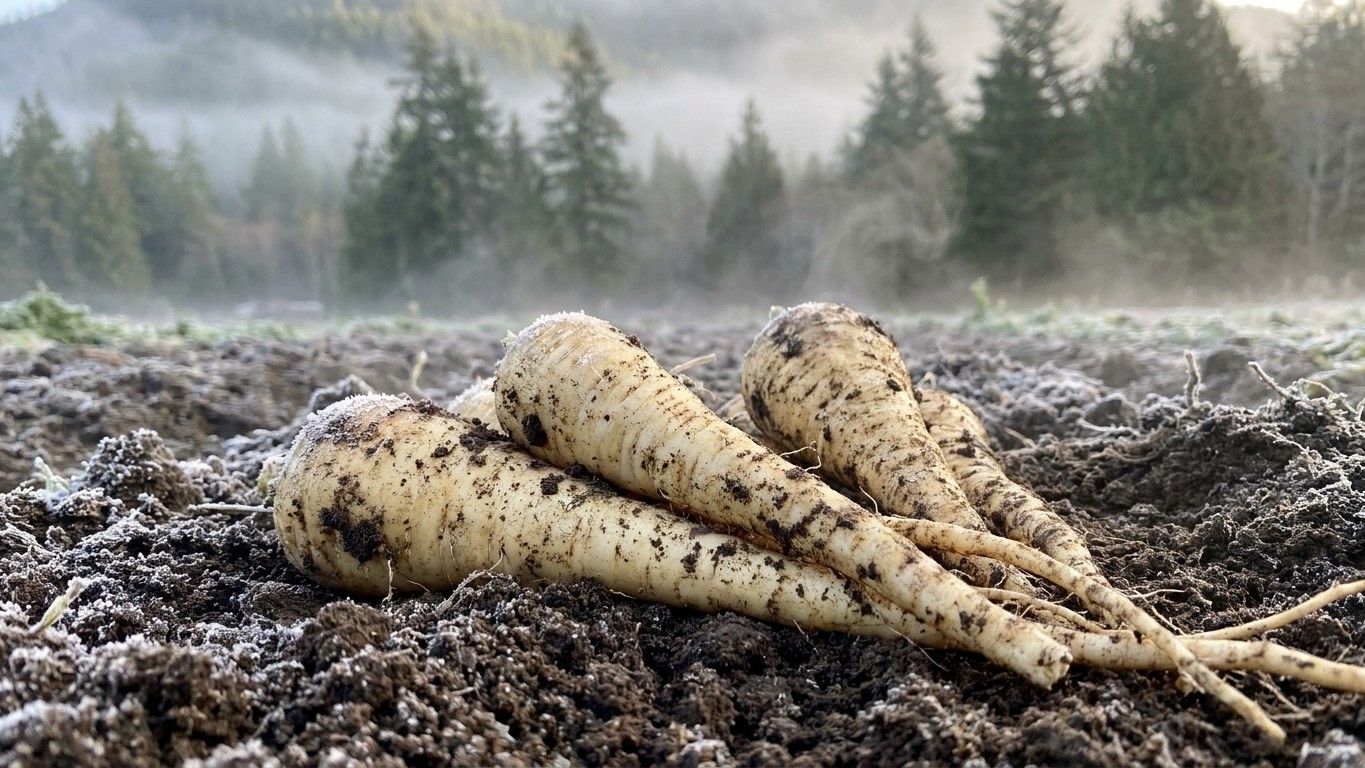

Lift Iowa parsnips after several weeks of frost, which for a spring sowing means November onward, not the day the first frost hits. The first fall frost normally lands between October 14 and October 25, and the sugar builds in the weeks after that. Roots left to sweeten, lifted and stored properly, keep four to six months. That figure comes with conditions most kitchens can’t meet, and one neighbor in the fruit bowl can ruin the batch.
The short answer
Does Iowa deliver several frosty weeks? It does, by a wide margin. At the Des Moines reference station, the mean daily minimum of the coldest month is 13.8 F, according to NOAA NCEI climate normals. That’s the average overnight low, not the record and not the monthly average, so plenty of nights run colder. It sits about 18 degrees under freezing, and it describes frost exposure, which is what a parsnip responds to. A hardiness zone number can’t stand in for it. A comfortable zone says a plant survives the winter. It says nothing about whether the nights are cold enough for long enough to turn starch to sugar.
A parsnip grown here will therefore sweeten, not merely grow. Utah State University Extension describes the mechanism: parsnips taste best after several weeks of cool, frosty weather, which converts stored starch to sugar. The full story is in Will Parsnips Sweeten in Iowa?. For lifting, the arithmetic is simple. If the first fall frost arrives October 14 to 25, a few weeks of frost puts the first worthwhile digging in early to mid November. Those dates come from the airport station, which is the optimistic end. Iowa State Extension county figures run about 4 days later in spring and 10 days earlier in fall. In a colder county the frost clock starts sooner, and so does the sweetening.
Storage is where the long number lives. USDA Agricultural Handbook 66 puts parsnip roots at 4 to 6 months at 32 to 34 F with 98% relative humidity. That’s a long keeper by any standard. It also assumes those conditions are held steady, and almost no house does that. A refrigerator drifts, and a garage swings with the weather. Expect the low end of the range, or less, unless you have a cold, humid cellar.
The surprise is what spoils them. The same handbook says parsnips are not chilling sensitive, so cold isn’t the threat. Ethylene is. The roots make almost none themselves (under 0.1 microliters per kilogram per hour at 68 F), but low levels from outside turn them bitter, likely through a compound called xanthotoxin. Apples and any other ripening fruit give off ethylene. A parsnip stored beside them goes bitter even at the right temperature, so keep roots in their own bin. Top them after harvest, but do not trim into the crown.
Does the season fit?
Parsnips are sown in place, and the 100 to 120 days run from seeding, not from the day a seedling shows. Here is the calendar worked through for Des Moines-station dates:
- Allow for slow germination. Seed takes 14 to 21 days to emerge, so bare soil in the first three weeks is normal. Don’t dig it up and re-sow. The clock is already running.
- Set the sowing window. The last spring frost falls between April 12 and April 24 (the 30 to 70 percent band of 32 F freeze probabilities). Sowing 2 to 3 weeks ahead of that means roughly March 22 to April 10. Using the county figures, which run about 4 days later, the window slides to roughly March 26 to April 14.
- Add the growing time. From a March 22 sowing, 100 days ends around June 30. From an April 10 sowing, 120 days ends around August 8. Roots reach full size somewhere between those two dates.
- Measure the slack. The first fall frost arrives October 14 to 25. From August 8 to October 14 is about 67 days. Take the pessimistic case, with a sowing 4 days later and a fall frost 10 days earlier, and you still have about seven weeks between full size and the first freeze.
- Read the verdict. The season fits comfortably, and not by a rounding error. The crop finishes growing in summer, then waits.
That wait is the point. A parsnip lifted in August is a full-size, starchy root. The same root left through October and November frosts is the one worth eating. Iowa gives the grower a long runway, so a delayed sowing costs flavor less than it would in a short-season state. The tighter risk is a late sowing in a cold county, where the frost arrives earlier than the airport numbers suggest. For the rest of the crop’s needs, see Growing Parsnips in Iowa.
What goes wrong here
Most parsnip failures in Iowa come from the ground, the water, or impatience. Each has its own cause and its own fix.
- Forked roots from heavy or stony ground. A root that hits clay or a stone splits around it. Utah State University Extension calls for deep sandy soil, and says heavy soil must be double dug. Iowa’s ground varies from bed to bed. Treat any statewide soil description as a starting point, not a diagnosis, and push a spade down in your own bed before you sow.
- Forked roots from overwatering. This is a separate cause from the first, and the fix is different. Soggy soil can fork a root even in good ground. Water evenly and let the bed drain between soakings, rather than keeping it wet.
- A season that runs out. Late seeding is the usual reason. The calendar above shows how much slack Iowa has, but a sowing pushed well past mid-April eats into it. Sow within the window, and wait the full 14 to 21 days before deciding a row has failed.
- A winter too mild to sweeten. With a coldest-month mean minimum of 13.8 F, this is a rare problem in Iowa. The more common cause is lifting too early, before several frosty weeks have passed. The roots will be edible but starchy. Hold off until the frost has had time to work.
- Bitter roots in storage. Ethylene from apples or ripening fruit is the culprit, not cold. Keep parsnips apart from fruit, top them, and leave the crown uncut.
If the roots are sound but chewed, the damage has another source. What Eats Parsnip in Iowa, and When covers the timing.
Common questions
Can I lift parsnips before the first frost?
You can, and they’ll be edible. They’ll also be starchy, because the conversion to sugar needs several weeks of cool, frosty weather. In Iowa that means waiting until at least early November for a spring sowing.
How long do lifted parsnips really keep?
USDA Handbook 66 gives 4 to 6 months at 32 to 34 F and 98% relative humidity. A household refrigerator or garage rarely holds those numbers steady, so plan on less unless you have a cold, humid cellar.
Why haven’t my seeds come up?
Parsnip seed takes 14 to 21 days to germinate. Three weeks of bare soil is normal, so leave the row alone and don’t re-sow early.
Can I store parsnips next to apples?
No. Parsnips aren’t harmed by cold, but low levels of ethylene in storage make them bitter, and apples are a steady source of it. Keep them in a separate bin from any ripening fruit.