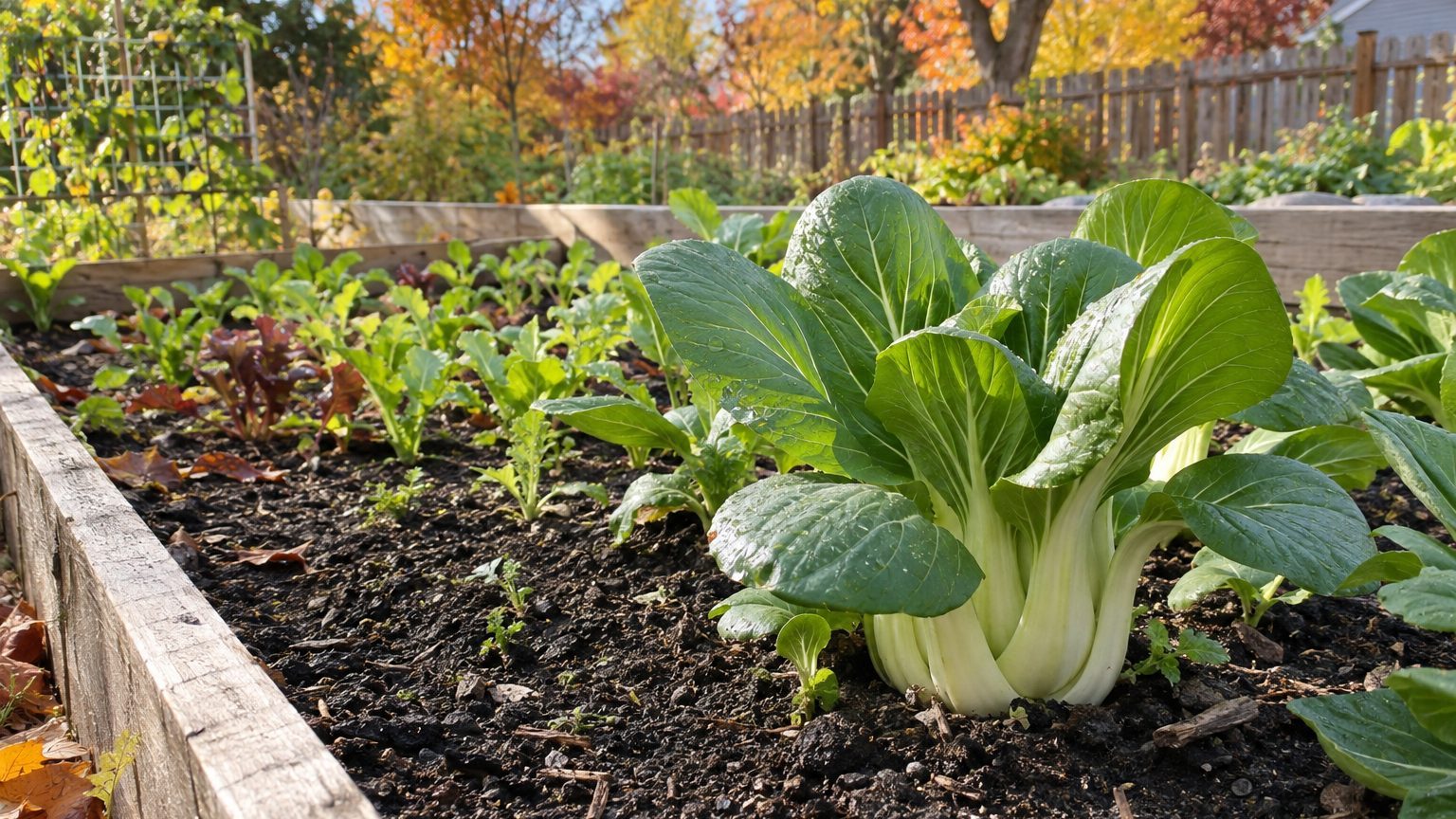

Bok choy bolts for two reasons: a cold snap early in its life, or heat and long days later on. Plant it when neither is coming, which for most of the US means early spring, then again from mid-summer through fall. Everything else about growing Brassica rapa subsp. chinensis is easy by comparison. It sprouts in a few days, reaches baby size in about a month, and forgives mediocre soil. The calendar is what trips people up.
This page covers that calendar, plus the spacing, watering, pest and harvest details that keep the crop tender. For the wider family and how its members differ, start with Growing Asian Greens: Fast, Cold-Hardy, and Prone to Bolting.
What makes bok choy bolt (and why it feels so sudden)
Bolting is the plant switching from making leaves to making seed. A central stalk shoots up, yellow flowers open, and the leaves turn bitter and tough. In bok choy the switch can happen at baby-leaf size, which is why a bed that looked perfect on Monday can look wrecked by the following weekend.
Two triggers do most of the damage. The first is cold exposure when the plants are young. Brassicas in this group respond to a stretch of nights in the 40s, and young seedlings set out in a chilly early spring can “read” that stretch as winter having passed. They then flower as soon as days lengthen. The second is the familiar one: warm weather combined with long days. Once daytime highs sit in the 80s and the sun is up 14 hours or more, the plant races to finish its life cycle.
Drought and root disturbance add stress that speeds things along. A seedling that dried out in its nursery flat, or one whose roots were crowded before transplanting, is more likely to bolt early than one that grew without interruption. Weather you cannot control, but those two mistakes you can.
Bok choy also differs from its big cousin in how it handles the cold. Napa cabbage needs a longer season and fusses about temperature swings, as covered in Napa Cabbage: The Long One of the Family. Bok choy is the sprinter of the two: quicker, smaller, and much more willing to shrug off a light frost, as long as that frost arrives after the plants are well established rather than during their first weeks.
Timing by season and region
Bok choy germinates in soil anywhere from roughly 45°F to the 90s, with the best results in the 70s. Its growing comfort zone is narrower. It does best with daytime temperatures in the 60s and low 70s, and it handles a light frost down into the upper 20s once it has size. That profile points straight at two windows: spring and fall.
Fall is the better one in most places. Seeds sown from late summer into early fall mature as days shorten and nights cool, which is the opposite of what bolting wants. Count back 6 to 8 weeks from your average first frost date for full-size heads, or 4 to 5 weeks for baby bok choy. Gardeners in the Upper Midwest and Northeast often sow in mid to late August. Those in the Mid-Atlantic and Pacific Northwest usually have until September. In the Gulf states, Texas, and Florida, fall sowing runs well into October or November, and winter is the main season. Bok choy is a cold-weather crop there, planted when tomato season is over.
Spring is trickier, particularly in the North. Sow too early and a cold spell can push seedlings toward bolting. Sow too late and the plants run into summer heat before they size up. Two practical moves help. Start seeds directly in the garden about 3 to 4 weeks before the last frost date, once the soil can be worked, and choose a variety sold as bolt-resistant. Row cover also keeps nights a few degrees warmer, though it will not prevent every cold-triggered bolt.
Summer growing is possible in cooler pockets, such as parts of the Pacific Northwest, coastal California, and high elevations in the mountain West. Elsewhere, a bed of bok choy in July tends to stall, flower, and attract flea beetles all at once. Skip it and plan ahead for August.
Picking varieties that buy you time
Seed catalogs flag bolt tolerance, and it is worth paying attention to. Compact green-stem types such as Mei Qing Choi, Joi Choi, and Toy Choy are popular and typically offered as reliable choices for spring. White-stemmed types in the Shanghai-green family are usually listed as more cold-tolerant and suit fall and winter. Check the days to maturity on the packet and the sowing advice from the seed company, since different strains within the same type can behave differently in your climate.
Sowing, spacing, and care
Sow seed about 1/4 to 1/2 inch deep in loose, fertile soil with a pH between 6.0 and 7.5. Direct sowing is the most dependable route because bok choy resents root disturbance. If you start transplants indoors, use cell trays rather than a shared flat and move them out while they are still small, with two or three true leaves.
Spacing depends on what you want to eat. For baby heads, thin to 3 to 4 inches apart. For full-size plants, give them 6 to 10 inches, with larger types at the wide end. Rows around a foot apart work fine. Crowded plants compete, stress, and bolt sooner, so thinning is one of the few chores that genuinely changes the outcome. Eat the thinnings; they make a perfectly good stir-fry.
Water is the other lever. Aim for about 1 inch per week, delivered evenly, because swings between soaked and dry soil cause stress and tough leaves. A 2-inch layer of straw or shredded leaves keeps roots cooler and moisture steadier. In the fall, mulch also moderates the swing from warm days to cold nights.
Feeding should be modest. Work compost into the bed before sowing, and if growth looks pale after a few weeks, side-dress lightly with a nitrogen source such as fish emulsion or a balanced organic fertilizer. Bok choy is a fast leafy crop that runs through nutrients quickly, but heavy feeding on a plant under heat stress will not stop a bolt.
Rotation matters if you grow other brassicas. Avoid planting bok choy where cabbage, broccoli, kale, or radishes grew in the past year, and aim for a three-year gap when you can. This reduces soil-borne problems such as clubroot, which is persistent once it takes hold in acidic soil.
Pests, harvest, and what to do with a bolted plant
Flea beetles are the most common reason bok choy leaves look like they were hit with birdshot. The adults are tiny, jump when disturbed, and chew round holes, hitting seedlings hardest in spring. A floating row cover installed at sowing, with the edges buried or weighted, is the simplest defense, and the details are in Shot Holes in Young Asian Greens. Fall plantings usually see less beetle pressure, though cabbage worms and aphids show up then instead. Hand-picking worms and spraying aphids off with water handles most small plantings, and slugs, which love the juicy stems, can be managed with evening checks and a few boards laid out as traps.
Harvest comes in three forms. Baby bok choy can be cut whole about 30 days after sowing, when plants are 4 to 6 inches tall. Full-size heads usually take 45 to 60 days, and they are ready when the stalks are thick and the leaves are glossy and upright. Cut-and-come-again harvesting also works: slice the plant about an inch above the soil and it will often regrow a smaller second flush if the weather stays cool, or pick the outer leaves and leave the center to keep growing. Harvest in the morning when the leaves are crisp, and refrigerate promptly. Bok choy keeps for roughly a week in the crisper drawer in a perforated bag, though sooner is better.
If the plants bolt anyway, do not rush to the compost bin. The flower stalks and buds of young bolting plants are edible and taste something like mild broccoli rabe. Cut them before the flowers open, and sauté them with garlic. Once the flowers open and the stems turn woody, the plant is done for the table. Leaving a few plants to bloom is not a bad idea, though. The flowers draw bees and other pollinators in cool weather when little else is open, and the seed that follows can be saved, with the caveat that brassicas cross-pollinate readily, so seed from a patch with other Brassica rapa relatives nearby may not come true.
One last nuance: a bolted bok choy is not a failure of technique so much as a signal about the calendar. Keeping a simple log of sowing dates, first bolt, and local weather for a single season will tell you more about your own best planting window than any generic chart can.