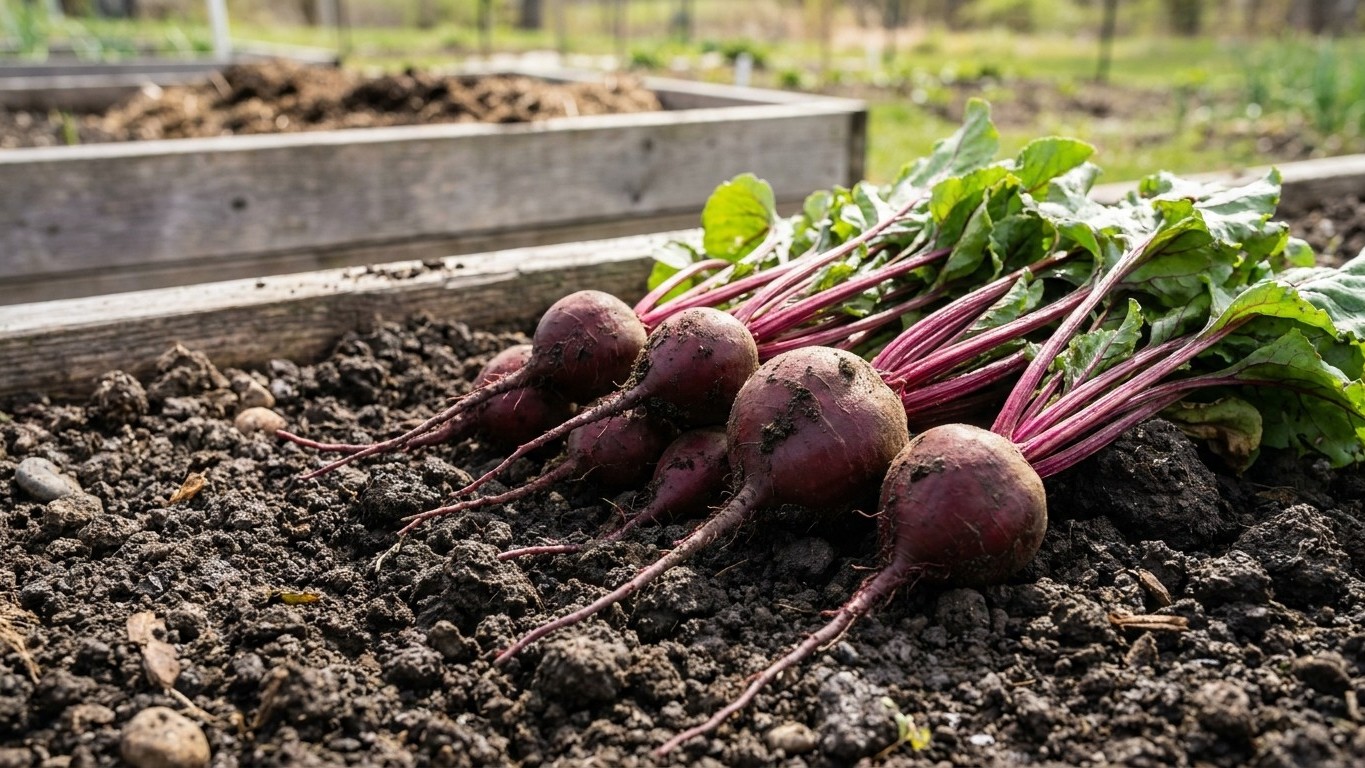

Pull Iowa beets 60 to 80 days after seeding, once the roots reach the size you want, and don’t leave them sitting through a hot, dry stretch. For storage, top them the day they come out and hold them at 33 to 36 F with very high humidity. Colder is not better here. Near-freezing storage produces more black spot and rot than a few degrees warmer, which is the opposite of what carrots, parsnips and most other root crops want.
The short answer
What Iowa’s ground does for a beet
Iowa’s state soil is the Tama series, a Mollisol: the deep, dark prairie ground that made the Corn Belt. USDA’s representative values for its surface layer read 4 percent sand, 26 percent clay and 70 percent silt, with organic matter near 3.5 percent, a pH of about 6.5 (slightly acid) and a well-drained rating. Set that beside what Utah State University Extension says beets want: deep, sandy, well-drained soil rich in organic matter. Tama delivers depth, drainage and a reasonable organic matter level. It falls short on sand, with only 4 percent.
For a beet, that mix has two sides. Silt-heavy ground holds moisture well, which helps seedlings get through their first weeks. The same silt tends to seal over after a hard rain, and a crusted surface is tough on a beet sprout. The deep profile gives the root room to size up without forking against a hard layer.
This is a starting point, not a diagnosis. Iowa spans hundreds of soil series, and river bottoms, loess hills and any lot a builder has scraped or filled can behave completely differently. The numbers above are USDA’s representative surface values for the mapped series, not a reading from a worked garden bed, and the 6.5 is not your pH. A soil test gives you your own figure, and Beet Soil in Iowa: What the Root Will Meet walks through what to do with it. Extension’s advice on compost is modest: no more than 1 inch of composted organic matter per 100 sq ft. On ground that already carries around 3.5 percent organic matter, there is little reason to go heavier.
Where heat comes in
The count of days per year that the reference airport station passes 90 F is not published in the figures behind this page, so I won’t guess at one. The mechanism matters more than the tally. Extension ties woody roots to heat above 85 F combined with water stress, and 90 F sits well above that line. A beet that is warm but well watered is a different case from a beet that is warm and thirsty.
That woodiness is a late-season failure, and it is not the same thing as bolting. Bolting comes from water stress early on, and the next section covers it. If a hot, dry spell is forecast and your beets are near size, pulling them is a better bet than waiting for a few more ounces.
The six weeks that decide it here
Counting back from the last frost
Beets are sown in place, so the 60 to 80 days run from seeding. No transplant date resets the clock. The usual advice is to sow 2 to 3 weeks before the last spring frost. NOAA NCEI climate normals put that frost between April 12 and April 24 at the airport station. Iowa State Extension’s county figures run about 4 days later in spring and 10 days earlier in fall than that airport, so the airport dates are the optimistic end.
Work the arithmetic with the airport dates. Three weeks before April 12 is March 22, and two weeks before April 24 is April 10. Add 60 to 80 days and the first harvests land between about May 21 and June 29. Shift everything four days later if your county reads like the Extension numbers. Frozen or soggy ground will decide your real sowing day, not the calendar. This timing also fits the broader plan in Growing Beets in Iowa.
Where the bolting risk sits
The first six weeks after seeding are when water stress triggers premature flowering. On those dates, that window closes between about May 3 for the earliest sowing and about May 22 for the latest. An Iowa spring tends to swing, with cold, wet spells followed by warm, drying stretches, and rainfall totals by week are not published here. The risk is not the wet spells. It is the dry gap after a good start, when the top inch of silty soil dries and crusts while the seedlings are still shallow-rooted.
Bolting and woodiness are separate failures on separate clocks. Early thirst pushes a young plant toward flowering. Later heat above 85 F with dry soil toughens the root. “Keep it watered” covers both only loosely. In the first six weeks, the job is steady moisture at the seedbed. After that, the job is not leaving mature roots in the ground through a hot dry spell.
What goes wrong here
Most of the trouble in an Iowa beet bed traces back to water timing, a silty surface or storage that is too cold.
- Bolting after a dry start. Water stress in the first six weeks sends plants to flower instead of building a root. Keep the seedbed evenly moist from sowing through about week six, and check it after any warm, windy day.
- Woody roots in a hot, dry stretch. Heat above 85 F combined with water stress is the trigger. Water deeply when a heat spell arrives, and pull roots at eating size instead of letting them grow on.
- A crusted seedbed after a hard rain. Silt-rich surfaces tend to seal, and sprouts struggle through. Keep the rows damp, and break the crust gently with a light raking before seedlings emerge.
- Too much compost. More than 1 inch of composted organic matter per 100 sq ft is past Extension’s limit, and Tama-type ground already starts near 3.5 percent organic matter. Test first, then amend only if the test says so.
- Storing too cold. USDA Handbook 66 reports more black spot and rot at 32 to 34 F than at slightly higher temperatures. Aim for 33 to 36 F at 98 percent humidity for topped roots, and keep pits and cellars between 31 and 41 F.
- Storing with the leaves on. Bunched beets last only 10 to 14 days at 32 F and above 98 percent humidity. Top them first.
- Storing the small ones. Large roots keep much better because they lose water and shrivel more slowly. Eat the small roots first and save the big ones for storage.
Leaf damage during the season is a separate problem, covered in What Eats Beet in Iowa, and When. The storage numbers come from USDA Agricultural Handbook 66.
Common questions
How many days from seeding until I can pull beets?
Plan on 60 to 80 days from seeding. Beets are sown in place and not transplanted, so the count starts the day the seed goes in. Pull when the roots reach the size you want, and don’t let a hot, dry spell catch them still in the ground.
Is the Tama soil description my garden’s soil?
Probably not exactly. Tama is the series USDA lists as representative of Iowa, with 4 percent sand, 26 percent clay, 70 percent silt and a surface pH of about 6.5. Iowa has hundreds of soil series, so treat those figures as what the region’s ground tends to do, then take a soil test for your own numbers.
How cold should I store beets?
Topped roots do best at 33 to 36 F and 98 percent humidity. USDA Handbook 66 notes more black spot and rot at 32 to 34 F, so a spot that sits right at freezing is the wrong end of the range. Pits and cellars should stay between 31 and 41 F.
Which beets should I store and which should I eat first?
Keep the big roots for storage, since they shrivel more slowly. Eat the small ones first. Top everything before it goes in, because bunched beets with leaves last only 10 to 14 days.