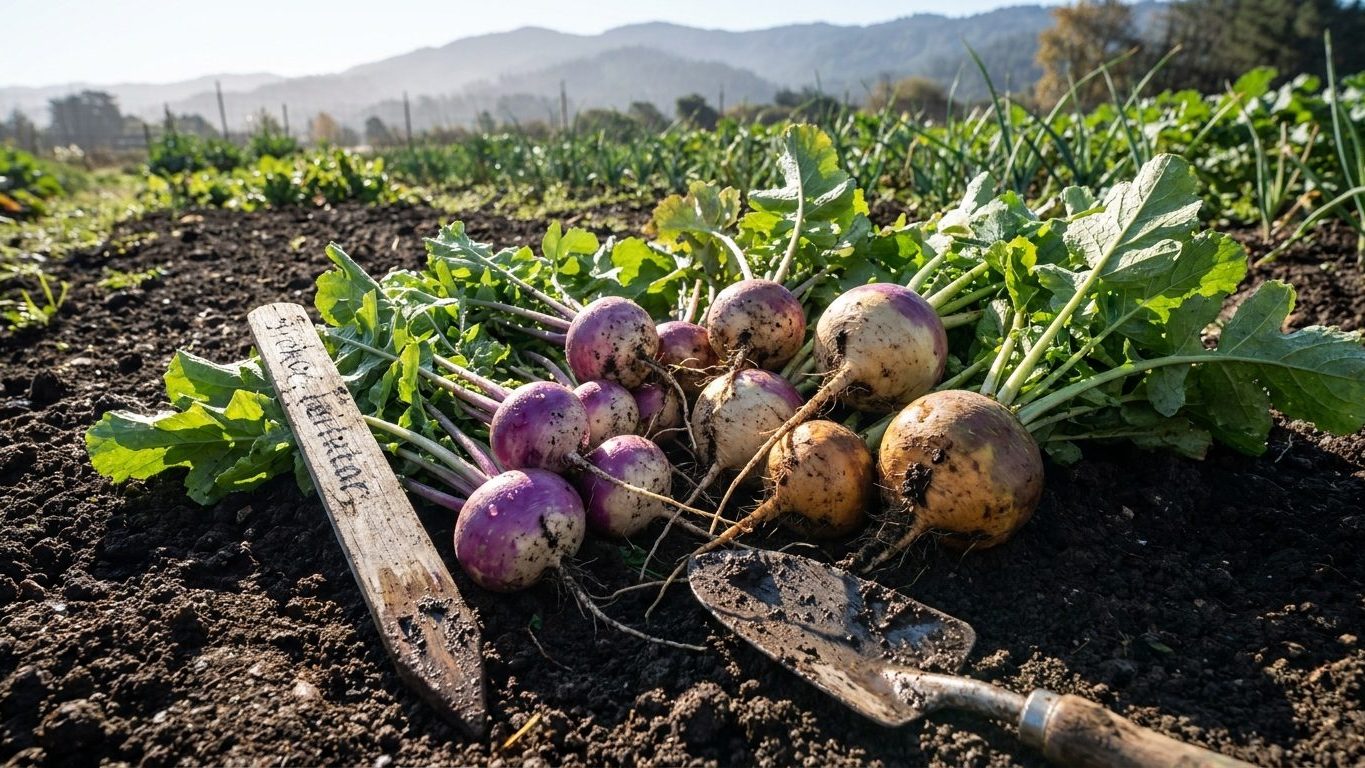

For most Alberta gardens, the best turnips are quick white or purple-top globe types that finish in about two months, and the best rutabaga is a hardy, cold-tolerant type that is allowed a full summer to bulk up. Choose by days to harvest first and flavor second. The season here is short, and that one number sorts nearly every seed packet.
The short answer for Alberta
The reference weather station for this page, Calgary International Airport, shows a last spring frost on average May 21 and a first fall frost on average September 16 (Environment and Climate Change Canada, Canadian Climate Normals 1981-2010). Counting the days between them gives about 118. Both dates are means, so in one year out of two the spring frost lands later than May 21 and the fall frost lands earlier than September 16. Read them as the middle of a window, not as safe dates.
A 118-day average frost-free stretch is generous for turnips and snug for rutabaga. Turnips grown for roots typically need roughly 40 to 65 days from seed, and they shrug off light frost at both ends. Rutabaga typically needs 90 days or more, and it wants cool weather to finish sweet. That sorts the decision by type:
| Type | Typical days from seed | Fit for Alberta | Best use |
|---|---|---|---|
| Small white salad turnips | About 35 to 50 | Excellent; fits two or three sowings | Eating fresh, early summer |
| Purple-top globe turnips | About 50 to 65 | Very good; sown in spring or midsummer | Fall harvest, short storage |
| Rutabaga | About 90 to 110 | Good if sown on time and kept growing | Winter storage, roasting, mash |
| Greens-type turnips | About 30 to 45 for leaves | Excellent | Cooked or raw greens |
Those day counts are the ranges printed on typical seed packets, not Alberta trial results. This page has no variety trial data for the province, so it names types rather than crowning a single cultivar. Within each type, look for the shortest days-to-maturity number and for catalog notes about cold hardiness or Canadian breeding. Laurentian, a long-standing Canadian rutabaga, is one name worth checking for, though availability varies by seed house.
For exact sowing dates inside that window, see When to Sow Turnips in Alberta. For the broader crop picture, start with Growing Turnips and Rutabaga in Alberta.
What will not work here
Slow rutabaga sown late. That is the clearest failure. A rutabaga that needs 100 days has to start by early June at the latest, and then it still depends on a fall that stays open. Sow it in July because the bed was free and you get a plant with a fine tops and a root the size of a golf ball when the ground freezes.
Hardiness itself is not the issue for these crops. The mean daily minimum of the coldest month at the Calgary reference station is -13.2 °C (8.2 °F), which would kill a tender perennial but is irrelevant to an annual root harvested in fall. The real cold limit is the day the soil locks up, which can arrive before a gardener feels finished. Turnips and rutabaga tolerate light frost, but roots left in frozen ground turn mushy after repeated freeze and thaw cycles, so lift them while the soil is still workable.
Counting on May 21 as a safe date is the second mistake. Since it is an average, half of all years bring frost after it. Hardy roots can usually take that, but tender seedlings under a hard freeze can be wiped out, particularly in a cold snap right after germination. A cheap row cover absorbs the surprise. The Calgary station also sits in one spot, and northern or upland gardens run weeks behind it.
The third failure is sowing a spring turnip crop so late it matures in the warm stretch of midsummer. Turnips grown through warm weather tend to turn woody, sharp and prone to bolting, which is why the fall crop usually tastes better than the early one. This page does not have Alberta summer temperature or rainfall figures, so it cannot tell you how often that happens in your yard. What it can say is that the fix is timing: sow early for spring harvest, or sow in mid to late summer so roots size up in cooling weather.
Last, a warning about pests. Prairie gardeners know flea beetles, which pepper brassica seedlings with tiny holes, and root maggots, which tunnel into roots. Both punish slow, stressed seedlings the hardest. Fast varieties and covered rows reduce the exposure window, which is another argument for short-maturity types.
What changes across Alberta
Alberta is not one garden. The hardiness figure on this page is zone 4a in the Canadian system, for the reference city only, and it comes from Natural Resources Canada, which built its map on seven climate variables. The province spans several zones, so there is no single answer for the whole of it. The page only has the one reference value and not the full spread, so it will not guess at the rest.
A note on comparisons: Canadian zone 4a overlaps nine USDA zones, from 3a to 7a, according to NRCan itself. Do not translate it into a USDA number, and do not borrow advice written for American zones. To find your own, use the Canada Plant Hardiness Site from Natural Resources Canada and look up your municipality there.
What should a reader shift? Someone in the north or at higher elevation should treat the Calgary dates as optimistic. A later last frost and an earlier first frost both squeeze the season from each end, and rutabaga is the first crop to feel it. In that case, move to the quickest rutabaga you can find, sow as soon as the soil can be worked, and lean harder on globe turnips and salad types, which finish with room to spare. Someone in a milder southern pocket can run a second sowing of turnips later in summer and let rutabaga take its full time.
Elevation and exposure matter inside a single property too. A low corner where cold air pools may frost weeks before the south-facing bed beside the house. Knowing which is which is worth more than any regional date.
Where to check this for your own county
Start with Alberta Agriculture and Irrigation, the provincial agriculture department that fills the role a state extension service would in the United States. What you want from it is narrow: a local planting calendar for your part of the province, and any list of vegetable varieties trialled near you. Root crops are not always the headline there, so expect to search by crop name or look for general vegetable guidance for your region.
When you find a calendar, check which weather station it was built on and which years its normals cover. Canadian figures such as the ones here use 1981-2010, while the US figures elsewhere on this site use 1991-2020, so numbers from the two countries are not like for like.
A county or municipal district recommendation beats a provincial one. This page is the provincial one, built around a single reference station, and it can only show the shape of the decision. Someone who has watched a local trial plot for several seasons knows which rutabaga sized up in a cold year and which one stalled. If your municipality, a regional horticultural society or a local garden club publishes its own sowing dates, trust those over any figure here. If nothing local exists, ask at an independent garden center that sells prairie-adapted seed. They usually know which packets come back for repeat purchases.
Checking this against your own garden
Your own observations outrank every date on this page. Three are worth making, and none needs a gadget.
- Soil by feel. Squeeze a handful from about 2 inches (5 cm) down. If it crumbles rather than clumps, and feels cool but not cold to your palm, it is ready for turnip seed. Note the date each year; after a few seasons that date is your own microclimate calendar.
- First true leaves. The first pair after the rounded seed leaves is the signal that seedlings have settled. Time from sowing to that point tells you how quickly your bed warms. A slow bed means a rutabaga that needs the earliest possible start.
- Where frost lingers. On a cold morning in spring and fall, walk the yard and see where white rime sits longest. That corner is your early-frost spot and the wrong place for a slow crop.
Write all three down in a notebook. A weather station 50 miles away cannot tell you any of them, and a plain record of three seasons often beats the printed normals for your own plot.
Common questions
What is the best rutabaga for Alberta?
Pick the shortest-maturity, cold-hardy type you can find, and sow it on time. This page has no provincial trial results, so check Alberta Agriculture and Irrigation or local seed sellers for named varieties that perform in your area.
Can I grow turnips twice in one Alberta season?
Often yes. Fast types finishing in about 40 to 65 days leave room for an early sowing and a later one, with the second maturing in cooler fall weather. The average frost window at the Calgary reference station is about 118 days, though real years vary.
Is May 21 safe to plant?
No. It is the mean last spring frost at the Calgary reference station, so in one year out of two frost comes later. Hardy turnips and rutabaga tolerate light frost, but cover seedlings when a hard freeze is forecast.
Does the 4a hardiness zone decide my variety?
Barely. Zone 4a is the Canadian-system value for the reference city only, and turnips and rutabaga are annual crops. Season length and days to harvest matter far more. Look up your own municipality on the Natural Resources Canada map.