
Pull carrots about 70 to 100 days after you sow the seed. Carrots are sown in place and never transplanted, so the count starts at seeding. Clemson Extension puts harvest at about 65 to 75 days after planting, so start checking at the early end of that window. To keep them, cut the tops off first, then store the roots at 33 °F in high humidity. Oregon’s state soil also shapes how straight the roots come out, which is where we start.
The short answer
What the state soil looks like
Oregon’s official state soil, named by Oregon law, is the Jory series. It is an Ultisol, an old, heavily weathered and leached soil that is naturally acid and low in nutrients. USDA NRCS records representative values for the surface layer of the major components of the series as mapped (119 components in all). Those values are 14 percent sand, 34 percent clay and 52 percent silt, with organic matter around 5.0 percent and a surface pH of about 5.6, which is slightly acid. The drainage class is well drained.
Those numbers describe mapped ground, not a worked garden bed. Nobody measured your raised box or the strip beside your fence. And a state this varied holds hundreds of soil series, so treat Jory as a starting point, not a diagnosis. River bottoms, hill country and any lot a builder scraped or filled can look nothing like it.
Will a carrot fork in it?
Utah State University Extension says carrots want deep, sandy, well-drained soil rich in organic matter, and that heavy or rocky soil makes the root fork. Hold Jory up against that. Sand is only 14 percent, clay is 34 percent, and silt makes up more than half. That is a heavy, fine-textured mix, the opposite of the sandy ideal. Drainage is the saving grace. Water does not sit, and soggy ground is the worse problem for a root crop.
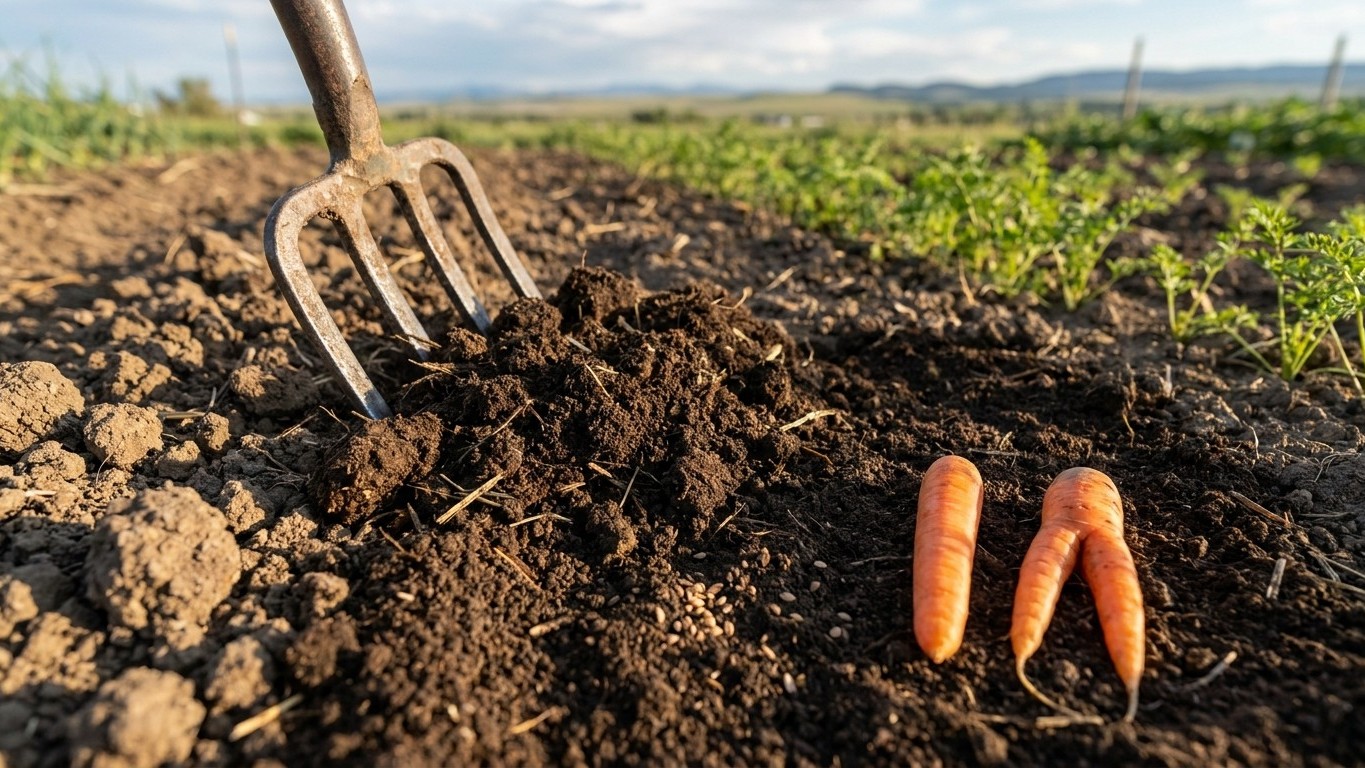
So yes, a carrot sown into untouched ground like this can fork or stall, especially if the bed is compacted or was dug while wet. The Extension fix for heavy soil is plenty of compost and double digging. That means loosening the lower layer with a fork, without flipping it, and working compost through both layers. Where the ground is shallow, stony, or slow to drain, a raised bed filled with loose, compost-rich mix is the cleaner route.
Notice what is not on that list: a different variety. The source names none, and the problem is the ground, not the seed. Fix the bed and the roots follow. The same bed also decides how easily they come out at harvest, because roots that snap on the way up will not store well. For more on the soil side, see Will Carrots Fork in Oregon Soil?, and for the full growing calendar, Growing Carrots in Oregon.
The test that settles it in your own garden
The state soil is an average. Your yard is a specific place, and an hour with a spade tells you more about it than any map. Do this when the ground is moist but not soggy.
- Dig a test hole about as deep as you want your carrots to run. Pay attention to how the digging feels. If the spade goes in easily and then hits a wall, you have found a hard layer, and a carrot root will find it too.
- Look at the depth and the stones. Crumble a few spadefuls through your fingers and count what you find. Rocks, chunks of old construction fill and thick roots all turn a straight carrot into a forked one.
- Feel the texture. Squeeze a damp handful. Gritty means sand. Smooth and floury means silt. Sticky, with a slick shine when you rub it, means clay. Open your hand: a handful that crumbles at a poke is friendly to carrots, while one that holds a hard, molded shape is not.
- Watch the water. Fill the hole and let it drain, then fill it again and watch. Steady disappearance means good drainage. Water that lingers and pools means a raised bed is the better choice, and a different spot in the yard may drain better.
- Get a soil test through a lab or your local county extension office. The report gives you your own pH and organic matter numbers. Do not borrow the 5.6 from the state soil, because that is not your pH.
- Decide what to do. Loose, stone-free ground that drains can take seed as is, with a little compost. Heavy ground that still drains calls for compost and double digging. Ground that holds water or is full of rock calls for a raised bed.
Everything here uses only your hands, a spade and a hose. No figure is needed, because you are comparing one spot in your yard against another, and the carrot will tell you the rest.
What goes wrong here
Heavy ground and an Oregon growing season produce a handful of repeat failures. Most have a simple remedy.
- Forked or stubby roots. This is the classic result of heavy or rocky soil, and the clay and silt in Jory-type ground make it likely. Remove stones, work in plenty of compost, double dig, or move to a raised bed. Skipping the soil work and hoping a new seed packet will solve it does not work.
- Compaction from working wet ground. Fine-textured soil smears when dug wet and sets up hard as it dries, and a root cannot push through that. Wait until a handful crumbles instead of rolling into a ribbon or ball, then loosen the bed.
- Poor germination in a hot spell. Carrot seed is small and sown in place, so the top of the bed can dry out and crust before anything sprouts. Keep the seedbed evenly moist, lay a board or burlap over the row until the first sprouts show, then take it off. Re-sow any gaps. Do not count the 70 to 100 days from the first failed sowing, because the clock runs from the seeding that took.
- Splitting from uneven water. Roots that sit dry for weeks and then get a soaking, from rain or a hose, swell faster than the skin can handle and crack. Water on a steady schedule and mulch the bed. The compost you added for forking also helps here by holding moisture evenly.
- Thin fertility in acid ground. Jory is naturally acid and low in nutrients, so a bed built on that kind of ground may need feeding. Compost is the gentle first step. The soil test from the previous section tells you what your own bed actually needs, and the sources used here give no pH target for carrots, so guessing at lime is a mistake.
- Snapped roots at harvest. Heavy soil grips a carrot hard. Loosen the ground beside the row with a fork before you pull, and lift by the base of the tops. A broken or bruised root will not keep, so use the damaged ones first in the kitchen.
Pests are a separate list, and the timing matters as much as the soil. What Eats Carrot in Oregon, and When covers it.
Common questions
How many days from seeding until I can pull carrots?
Plan on 70 to 100 days from the day you sow. Clemson Extension says to harvest about 65 to 75 days after planting, so begin checking near the early end. Carrots are sown directly in the bed and never transplanted, so there is no transplant date to count from. If a hot spell wiped out your first sowing, count from the seeding that actually came up.
How long will carrots keep after I pull them?
With the tops on, bunched carrots keep for about 10 to 14 days. Trimmed roots, stored properly, keep for months. Clemson Extension’s storage advice is 33 °F and high humidity, which prevents wilting.
Why cut the tops off before storing?
The leaves keep drawing moisture out of the root. That is why bunched carrots last only 10 to 14 days while trimmed ones last months. Cut the tops off soon after pulling, and the root holds its water instead of feeding the greens.
Can I store carrots in a cool cellar or garage?
Only if it is truly cold. 33 °F is just above freezing, colder than most cellars and many refrigerators. At 50 °F, carrots sprout and go soft in a fraction of the time. If you cannot hold the temperature near 33 °F, pull only what you will use in the next couple of weeks and leave the rest in the ground.