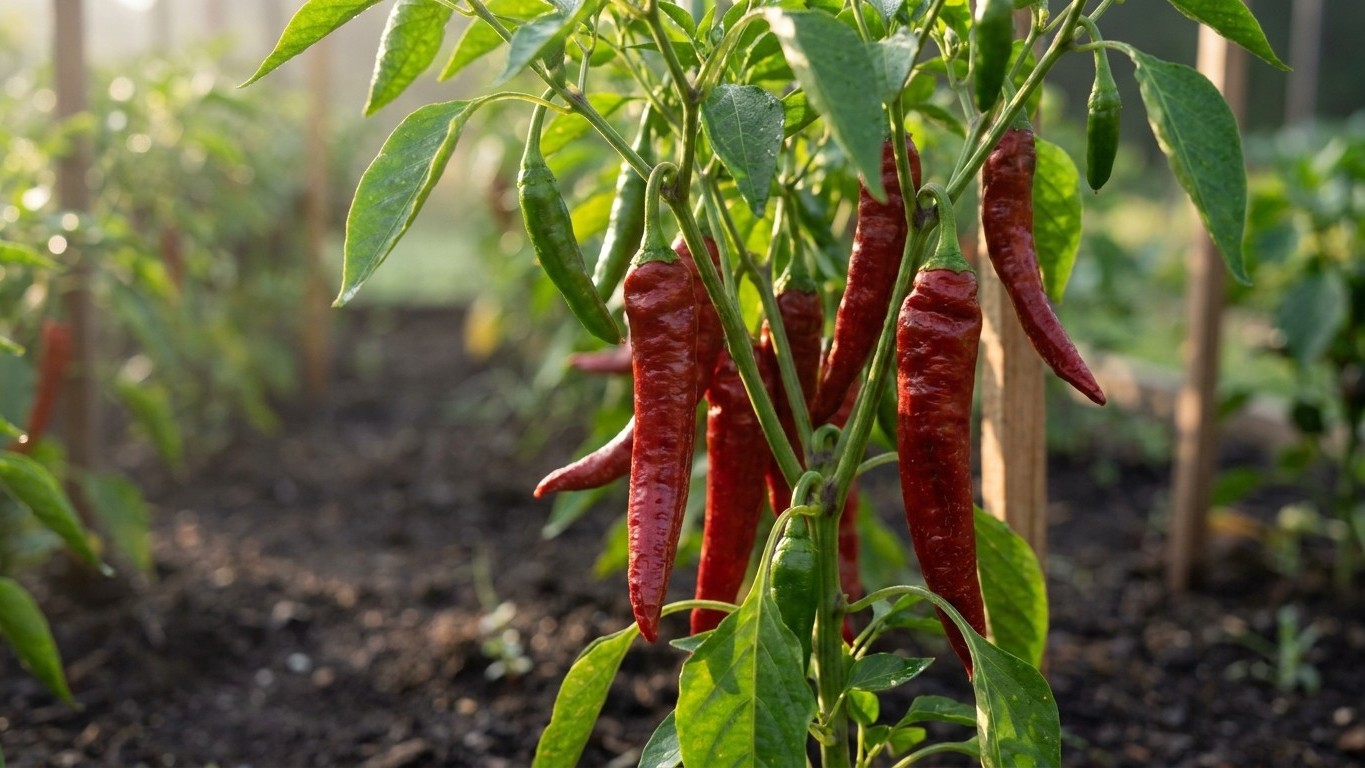

Pick peppers when the fruit is full size, firm and glossy. Clemson Extension puts that at about 70 to 85 days after transplanting. Bring them in before the first freeze, then keep them out of the refrigerator. Storage works best at 45 to 50 °F, and below about 45 °F peppers pit and soften from chilling injury. Minnesota’s season is short, so the dates that matter most get set months earlier, at the seed tray.
The short answer
Both ends of the temperature window
At Minneapolis, the reference station for this site’s climate data, NOAA NCEI climate normals show an average of 10.6 days a year reaching 90 F or higher. That is roughly a week and a half scattered across an entire summer. Utah State University Extension says pepper fruit set fails when days climb above 90 F, so in the Twin Cities the hot end is a short-spell problem. A few bad afternoons in midsummer can make open flowers drop. The plant usually keeps flowering afterward, and the cost is a gap in the crop, not a lost season. Treat 10.6 as a Twin Cities figure, though. Your own backyard may run hotter or cooler, especially on a south-facing wall or a gravel patio.
The other end is nights below 55 F. Utah State lists it right next to the hot limit, and peppers fail at both. This site does not carry summer night minima, and guessing them from latitude or from how cold the winters are would be worse than saying nothing. So the job falls to you. A cheap min/max thermometer placed near the plants will tell you what the garden does between dusk and dawn. Log it for a couple of weeks around first flowering. If the readings dip under 55 F, expect stalled or dropped blossoms even when the afternoons feel warm. The longer diagnosis is in Why Peppers Fail to Set Fruit in Minnesota.
For the bigger picture of the pepper season here, from variety choice to planting out, see Growing Peppers in Minnesota.
Picking and storing
Clemson’s figure of 70 to 85 days runs from transplanting, not from sowing, and the clock to ripe fruit really starts at flowering. A plant that sulked through a cold snap will finish later than the calendar says. Judge by the fruit. It should be full size for the variety, thick-walled, firm and shiny. Green peppers are edible at that stage. Waiting for red, yellow or orange adds time, and in a short season that is a gamble against the first freeze. Many gardeners pick a few green and leave the best-placed fruit to color.
Storage is where good harvests get ruined. Clemson’s own words: “The optimal conditions for storage are temperatures of 45 to 50 °F and 80- to 90-percent relative humidity for two to three weeks.” That range is warmer than a household refrigerator. Put peppers in the fridge and they develop pitted, sunken spots and go soft, which is chilling injury, not ordinary spoilage. It is the mistake nearly everyone makes, because the fridge feels like the responsible place for produce. Note also that “two to three weeks” is the ceiling under ideal conditions, not a guarantee. A cool basement corner or an unheated pantry that stays in that range does better than the crisper drawer. Source details are on the Clemson Cooperative Extension pepper factsheet.
When to start seed here
Working backward from the transplant date is the only method that holds up in Minnesota, because the garden’s date and the calendar’s date rarely match. Here is the arithmetic in words, so you can redo it for your county.
- Find your last spring frost. For the Twin Cities, the NOAA NCEI normals put the 30 to 70 percent probability band for a 32 F freeze between April 17 and April 30. Northern Minnesota runs two to three weeks tighter at both ends of the season, so its spring date lands later and its fall date earlier. Look up the nearest station for your county.
- Treat that date as the earliest possible, not the plan. Utah State says to transplant after frost, once the soil reaches 60 F. Spring soil often lags the frost date, so check it with a soil thermometer a few inches down in the morning, over several days. The day that reading holds at 60 F is your transplant date.
- Subtract 8 to 10 weeks. Utah State says transplants need that long indoors. Eight weeks is 56 days and ten weeks is 70 days, so you are counting back two to three dozen days further than most gardeners expect.
- Run a sample. Say your soil reaches 60 F on May 25 (an illustration, not a recommended date). Eight weeks earlier is March 30 and ten weeks earlier is March 16. Seed goes in somewhere in that two-week window.
- Check the finish line. Add Clemson’s 70 to 85 days after transplanting to your transplant date and see where it lands against your own first fall freeze. If it runs close, favor the shorter end of the seed window and plan to pick green.
This site does not publish a fall freeze date for each county, so step five needs a local source, such as the nearest weather station’s normals. Do not borrow the Twin Cities number if you garden in the north. Those fall dates arrive earlier, and the margin between a ripe red pepper and a frozen one is thin.
One more practical point. Seed started too early is not a safe error. Plants held in small pots past the 10-week mark get root-bound and leggy, and they stall after transplanting. Starting inside the window beats starting ahead of it.
What goes wrong here
Minnesota’s summers swing between cool stretches and short hot ones, and peppers react to both. These are the failures this climate causes most, with the fix for each.
- Blossom drop in a hot spell. Days above 90 F make open flowers fall off. The Twin Cities average only 10.6 such days a year, so the damage is usually a gap, not a failure. Shade cloth during a forecast heat run, steady watering and mulch help. Don’t pile on nitrogen to “help” the plant recover, because it grows leaves at the expense of fruit.
- Blossom drop on a cool night. Nights below 55 F do the same damage from the other direction, and this site cannot tell you how often yours dip that low. Read your own thermometer. When a cold night is forecast in flowering season, drape row cover over the plants at dusk and pull it off in the morning so bees can work and heat can escape.
- Sunscald. Fruit exposed to strong sun develops pale, papery, sunken patches that later turn gray and moldy. It usually follows leaf loss from disease, pests or over-enthusiastic pruning. Keep the canopy intact, and use light shade cloth when fruit is exposed during the brightest stretch of summer. The pest side of leaf loss is covered in What Eats Pepper in Minnesota, and When.
- Blossom-end rot. A dark, leathery sunken spot on the bottom of the fruit. It is tied to uneven watering, which disrupts the calcium the fruit receives, and it commonly hits the first fruits of the season. Water deeply and regularly, mulch to hold moisture steady, and test the soil before adding any calcium. Pick off affected fruit so the plant puts energy into healthy ones.
When the first freeze is coming
Peppers do not tolerate frost, so a forecast freeze with fruit still on the plants means a decision. Harvest every full-size pepper, green or not, and bring in smaller ones only if you are willing to use them as they are. A pepper that has not reached full size will not ripen to good quality indoors. Keep the harvest in that 45 to 50 °F range if you can, and use the rest within a few days instead of banking on the fridge.
Common questions
Can I put peppers in the refrigerator?
You can, but you should not for long. A refrigerator is colder than the 45 to 50 °F range Clemson recommends, and below about 45 °F peppers pit and soften. If a fridge is your only option, use the peppers within a few days, or slice and freeze the rest.
How do I know a pepper is ready to pick?
Look for full size for the variety, firm walls and a glossy skin. Clemson says peppers should be ready in about 70 to 85 days after transplanting, but treat that as a window, not a deadline. Cold nights and hot spells can both push it later.
How long will picked peppers keep?
Up to two to three weeks at 45 to 50 °F and 80 to 90 percent relative humidity, according to Clemson. That is a maximum under ideal conditions, so check them every few days and use any that start to soften first.
Should I pick green or wait for color?
Either works. Green peppers are mature enough to eat once they reach full size. Waiting for color takes more time, and in Minnesota that time is limited by the first fall freeze. A reasonable compromise is to pick most fruit green and leave a few to color while the forecast stays mild.