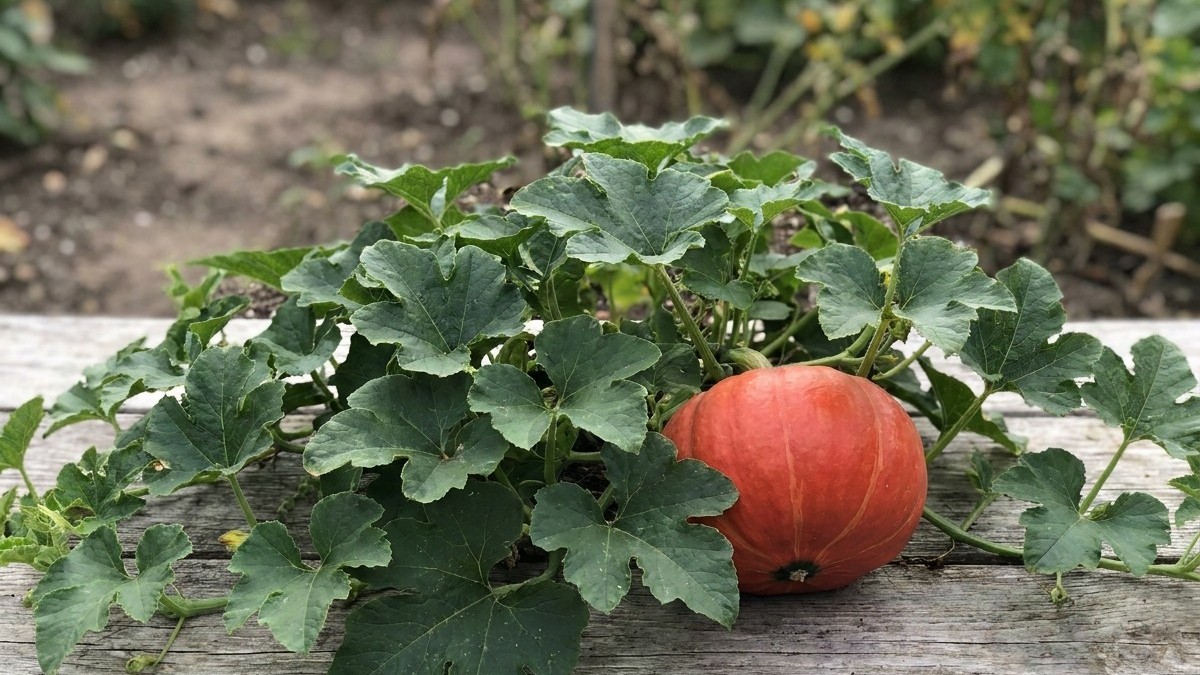

Mostly, the calendar. In Minnesota the thing that ends the most pumpkins is the first fall freeze, which arrives in the second half of October and stops any fruit that is still green. Insects such as squash bugs and cucumber beetles weaken vines and have their own pages on this site. This page covers the clock: which flowers still have time, when to plant, and what fails when time runs out.
The short answer
Counting back from the freeze
In the Twin Cities, the first fall freeze falls between October 11 and October 23. That window comes from the 32 F freeze probabilities (the 30 to 70 percent band) in the NOAA NCEI Climate Normals. It is a range of likelihood, not a promise, and any given year can land on either side of it.
Pumpkins take 45 to 55 days to mature after flowering, according to Utah State University Extension. Subtract that from each end of the frost window and you get the latest a flower can open and still give a ripe fruit. If frost comes on October 11, a flower must open between August 17 (55 days of ripening) and August 27 (45 days). If frost holds off until October 23, the flower can open between August 29 and September 8.
Stack those together and the deadline is a window too: roughly August 17 to September 8. The early end is for a frost-prone fall and a slow fruit. The late end is for a mild fall and a quick one. A flower that opens in the last days of August is already a gamble. One that opens after September 8 has no realistic chance, even in a late-frost year.
What the count starts from
The 45 to 55 days run from flowering. Not from seeding, and not from transplanting. A vine sown in May has not started the clock; the clock starts the day the flower that will become the fruit opens. Count from the seed packet date and you will think a pumpkin is safe when it is weeks behind.
The deadline also tells you something useful about the vine in late August. Fruit already set and sizing up by then is your crop. Flowers still opening after that are, for practical purposes, decoration. The related page on whether pumpkins ripen before frost in Minnesota works through what to do with fruit that is close but not done.
Northern Minnesota runs tighter
The Twin Cities are the mild south of the state. Northern Minnesota runs two to three weeks tighter at both ends of the season, so every date above moves earlier by that much once you leave the metro. A grower up north is looking at a flower deadline in early to mid August, which leaves far less room for slow varieties. The NOAA figures cited here describe the Twin Cities, and this page does not publish a separate northern table.
The last rule is the one that saves fruit at the finish line: harvest with the stem attached, and do it before frost. For a broader look at the crop from seed to harvest, see Growing Pumpkins in Minnesota.
When to sow here
Why the soil date is later than the frost date
Pumpkins are sown when the soil reaches 65 F. That is a soil reading, and it is not the last frost date. Air warms faster than ground does, so the soil trails the air by weeks. A garden can be frost-free on the first of May and still be too cold at root depth for a pumpkin seed to wake up.
Here is the arithmetic in words. The last spring frost in the Twin Cities falls between April 17 and April 30. Add the soil lag, which is weeks rather than days, and the sowing date moves into May. Row covers then buy about two weeks back. The steps below show how to run it for your own yard.
- Start with the last spring frost window. For the Twin Cities that is April 17 to April 30. Treat it as the earliest anything could happen, never as the planting date. North of the metro, expect it two to three weeks later.
- Add the soil lag. The soil runs weeks behind the air. Weeks past the April 17 to April 30 window puts the realistic sowing date in May, and in a cold spring, later.
- Wait for the reading. Sow when the soil actually measures 65 F. A calendar date only tells you when to start checking. The thermometer decides.
- Subtract two weeks if you use row covers. If your soil would normally reach 65 F on May 15, covers can move that to about May 1. The same covers help keep young vines through a late cold snap, but they only protect against the spring end. They do nothing for the October freeze.
- Check the result against the flower deadline. The days from seeding to first flower are not published here, so work backwards from the August 17 to September 8 window and make sure your sowing date leaves room for the vine to grow and flower well before it.
The practical effect is that a gardener who sows on the frost date has wasted seed and lost nothing in time, because the cold soil would have held the seed back anyway. A gardener who sows after the soil warms, and who uses covers to get that date two weeks earlier, gains real margin on the back end. For specific planting windows by region, see When to Sow Pumpkins in Minnesota.
What goes wrong here
A Minnesota growing season is long enough for a pumpkin, but only just. Most failures come from the same source: the crop ran out of days. These are the common ones, with a remedy for each.
- A late flower that never colors. A fruit set after the flower deadline stays green and small, because 45 to 55 days will not fit before frost. Remedy: stop counting on anything that opens after late August to early September. Many growers pinch off late flowers and tiny fruit so the vine puts its energy into fruit that can still finish.
- A fruit caught by frost. The first freeze can arrive as early as October 11, and a pumpkin still on the vine takes the hit. Remedy: watch the forecast from the first week of October, and harvest with the stem attached before the freeze. The sources used here do not say how a frosted pumpkin keeps, so use it first and do not store it with sound ones.
- A vine that dies back before the skin hardens. Insects, disease, or an early cold night can finish the vine while the fruit is still soft. Squash bugs and cucumber beetles are the usual insect culprits, and each has its own page on this site. Remedy: if the vine is gone and frost is near, bring the fruit in with the stem attached and keep it where it will not freeze. Expect it to keep for less time than a fully mature one.
- A good pumpkin stored in the wrong place. A whole pumpkin keeps three to six months in a cool, dark spot between 45 and 50 F. Remedy: keep it away from ripening fruit and vegetables such as apples, potatoes, and tomatoes. Ripening fruit gives off a gas that ages the pumpkin, which is why the porch next to the apple crate is the worst place for it.
Notice that three of the four failures trace back to the same two numbers: the days after flowering and the first freeze. Pests and storage matter, but they are easier to fix. The calendar is not.
Common questions
What is the latest a flower can open and still give a ripe pumpkin in Minnesota?
In the Twin Cities, between about August 17 and September 8. The range comes from counting 45 to 55 days after flowering back from a first fall freeze that falls between October 11 and October 23. Treat late August as the practical cutoff in a normal year.
Do the 45 to 55 days count from seeding?
No. They count from flowering. The day you sow, and the day the soil hits 65 F, only decide how early the vine can reach that first flower. The 65 F soil reading is also not the last frost date; the soil lags the air by weeks.
Do these dates apply to northern Minnesota?
Not directly. The dates here are for the Twin Cities, the mild south of the state. Northern Minnesota runs two to three weeks tighter at both ends, so move the frost window, the spring window, and the flower deadline earlier by that amount.
How long does a pumpkin keep after harvest?
A whole pumpkin keeps three to six months in a cool, dark place between 45 and 50 F, away from apples, potatoes, and tomatoes. That figure is for a whole pumpkin only. The source says nothing about a carved one, so no keeping time is given here for jack-o’-lanterns.