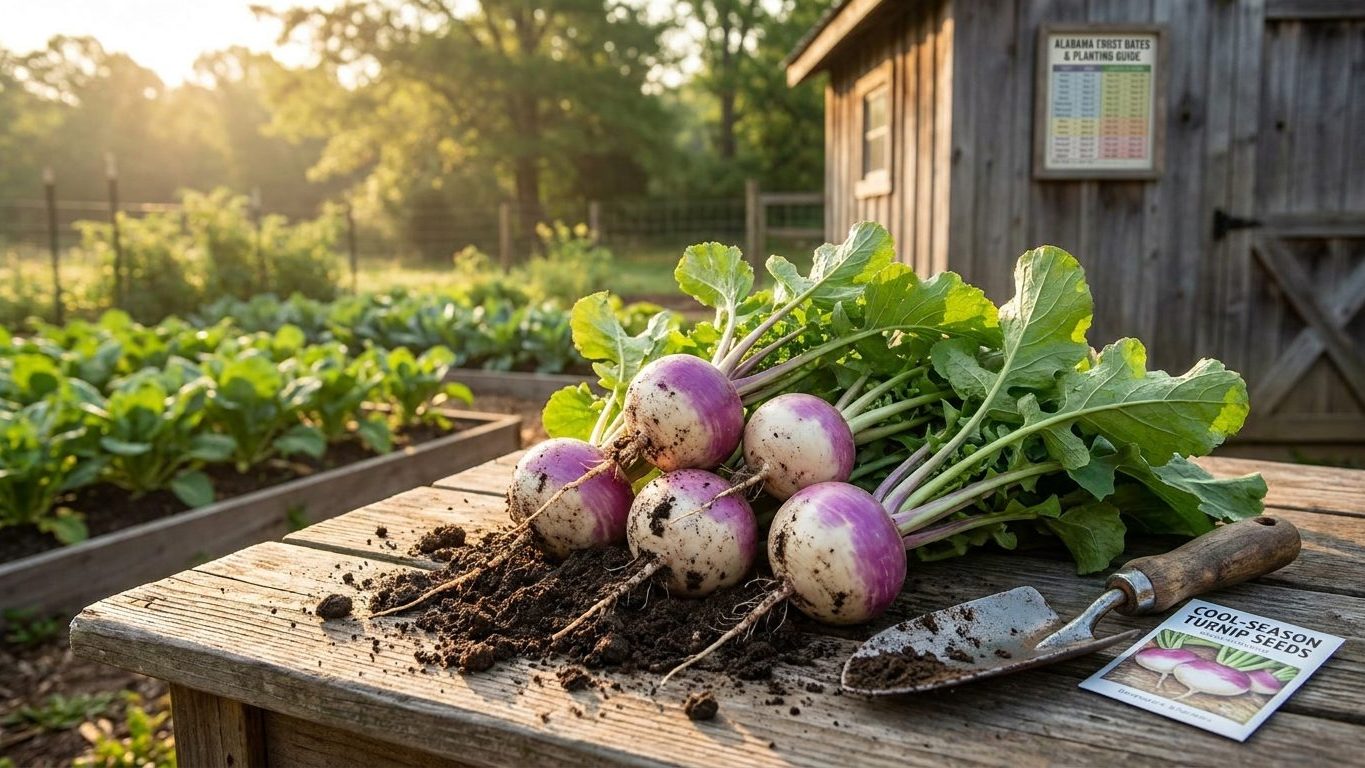

Sow turnips in Oklahoma twice: in late winter to early spring, ahead of the March 28 to April 10 last-frost range for Oklahoma City, and again in late summer to early fall, so the roots size up before the October 29 to November 8 first-frost range. Skip midsummer. Those dates come from one airport weather station, so a suburban or rural yard may run a week or two off.
The short answer for Oklahoma
The two frost ranges are the anchors. According to the NOAA NCEI U.S. Climate Normals 1991-2020, the last spring frost at the Oklahoma City reference station falls between March 28 and April 10, and the first fall frost between October 29 and November 8. Both are probabilities of a 32°F freeze, the 30 to 70 percent band, not calendar promises. A date inside the band means a freeze is still plausible, not guaranteed.
Turnips shrug off light frost, which is why they suit a state with swings like these. The practical question is less about frost and more about heat, which is why the plan below counts toward the frost dates from the other side of summer.
Spring window
Get seed in as soon as the soil can be worked, in the weeks leading up to the March 28 to April 10 range. Treat the first half of April as the tail end. A late freeze can nip young seedlings, but established turnip greens usually tolerate it. Sowing later than that sends the crop into the heat that the next section explains.
Fall window
Count back from October 29. Late August through September gives roots roughly two months before the first-frost range opens, and fall is the stronger season for most Oklahoma gardeners because cooling nights sweeten the roots. Rutabaga, which takes longer than turnips, belongs at the early end of that window. The Growing Turnips and Rutabaga in Oklahoma page covers the crop from seed to harvest.
| Season | Sow | Anchor date (Oklahoma City) |
|---|---|---|
| Spring | Soon as soil can be worked, through early April | Last frost, March 28 to April 10 |
| Fall | Late August through September | First frost, October 29 to November 8 |
One caution travels with every date here. Airport stations run warmer than open country, so out in the suburbs or the country the last spring frost typically comes later and the first fall frost earlier, often by one to two weeks, and more at elevation.
What will not work here
A single spring sowing in May fails. By then the soil is warm and the days are lengthening, and turnips respond by bolting or turning woody and hot-flavored before the roots fatten. The last-frost range of March 28 to April 10 leaves a narrow runway, and gardeners who wait for the weather to feel like gardening weather have usually missed it.
Slow crops in a spring slot
Rutabaga is the clearest casualty. It needs a long, cool stretch to finish, and a spring planting in Oklahoma runs out of cool weather before it gets there. Sown in late summer, though, it has the fall and the cold nights it wants. If you want rutabaga, plan on the fall window only. Our guide to The Best Turnips and Rutabaga for Oklahoma sorts out which types finish fastest.
Weekly watering and midsummer seed
Seed sown in August heat needs the top inch of soil kept consistently moist until it sprouts, and a once-a-week soak does not do that on a hot, windy day. Seedlings dry out between waterings, stand thin, and the survivors stall. Fall sowing works when you can water lightly every day or two for the first week or so, then back off. Shading the row with a board or a layer of straw helps in the first days.
Winter is the other edge. The mean daily minimum of the coldest month is 27.0°F at the reference station, which means the average night in the coldest month is already below freezing, and many nights are lower. A fall turnip left in the ground through January is a gamble. Plan to harvest roots in the weeks after the first-frost range, or cover them heavily with mulch if you want to stretch the harvest.
What changes across Oklahoma
Oklahoma is not one garden. The USDA Plant Hardiness Zone Map (2023, built on 1991-2020 normals) runs from 6a to 8a across the state. Because each half-zone step is 5°F in the average annual extreme minimum, that is a spread of roughly 20°F between the coldest and mildest corners. There is no single answer for the whole state, and the Oklahoma City figures on this page sit in the middle of that spread, not at either end.
North and higher ground
If you garden in the colder northern tier or at elevation, shift both windows. The spring sowing moves later, since the last frost arrives after the reference range, and the fall sowing moves earlier, since the first frost arrives ahead of it. A reasonable habit is to push the fall seeding toward the front of the late August to September window and to pick a fast-maturing turnip over a slow one. The one-to-two-week offset noted earlier is a floor for elevation, not a ceiling.
South and milder corners
In the warmer south and southeast, the fall window opens a little later and runs later, and spring ends sooner because heat arrives sooner. Winter-hardy roots have more margin there. The trade-off is that the late-summer seedbed is hotter and drier, so the watering advice above matters more.
Which zone your own garden falls in is something to read off the USDA map directly, using your ZIP code, rather than guessing from the state range.
Where to check this for your own county
Your state extension service is the next stop. Oklahoma State University Extension is the land-grant extension service for Oklahoma, and its county offices see local frost patterns and soil problems that no statewide page can.
Look for two things. First, a planting calendar written for your area, with spring and fall sowing windows for cool-season vegetables. Second, the varieties that have been trialled in or near your county, because a turnip that finishes in the central part of the state may not suit the Panhandle or the southeast. If the site does not list turnips specifically, the cool-season vegetable calendar is the closest match, and a county office can answer by phone or email.
A county recommendation beats a state one, every time. This page is the state one: it uses a single airport station in Oklahoma City, and the dates and ranges above should be read as a starting point to adjust, not a rule to follow to the day.
Checking this against your own garden
Your own observations outrank every date on this page. Three are worth the effort, and none needs a gadget.
- Soil warmth by feel. In spring, a handful of soil that feels cool and workable, not cold and sticky, means the bed is ready. In late summer, soil that still feels hot a few inches down means wait a week. Beds that warm early are your sunny, sheltered spots.
- First true leaves. Turnip seedlings show their rounded seed leaves first, then the rough-edged true leaves. If they take noticeably longer than expected, the bed is cooler or drier than you assumed, and your window should shift.
- Frost on the low spot. Note where frost shows up first in the yard. That cold pocket tells you how much earlier your own first frost may arrive than the airport’s range.
Write the dates down for a year or two. A scribbled note on the calendar, such as the day of the first frost in your yard, is worth more than any reference station.
Some gardeners also time this by the Moon: when to plant turnips by the moon, as almanac tradition rather than fact.
Common questions
Can I sow turnips before the last frost in Oklahoma?
Yes. Turnips handle light frost, so seed can go in during the weeks before the March 28 to April 10 range. A hard freeze can still set back young seedlings, so keep a cover handy.
Is spring or fall better for turnips in Oklahoma?
Fall is the more dependable season for most gardeners, since roots mature in cooling weather. Spring works only if you sow early enough to finish before the heat arrives.
When should I sow rutabaga?
Plan on the fall window only, at the early end, in late summer. It takes longer than turnips and does not fit the short cool spell of an Oklahoma spring.
Do the frost dates on this page apply to my county?
Treat them as the Oklahoma City airport reference. Suburban and rural gardens typically see a later last frost and an earlier first frost, often by one to two weeks, so check with your county extension office.