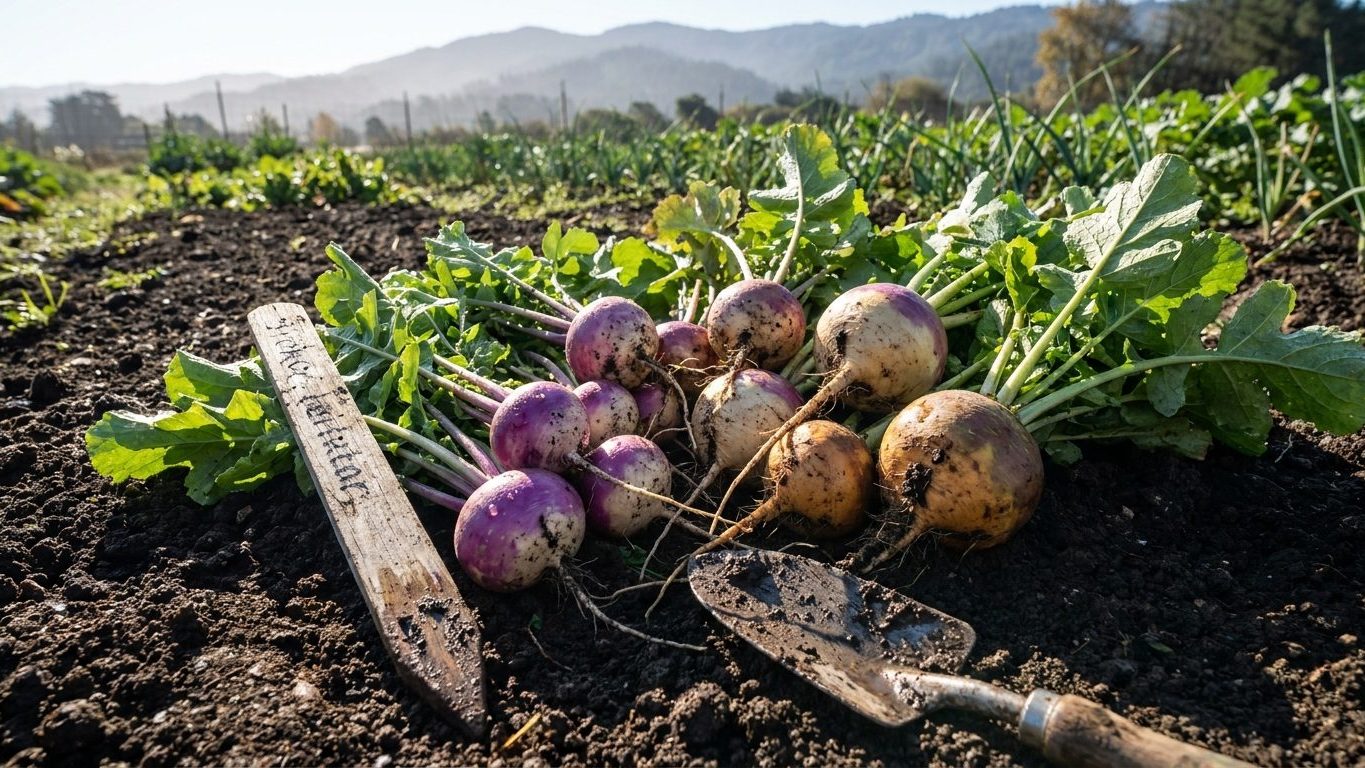

In western Washington, the best bets are fast, small-rooted turnips for spring and fall, plus rutabaga grown as a long, cool fall crop. East of the Cascades the season is far shorter, so quick turnips win and rutabaga becomes a gamble. Sorting by type matters more than hunting for a perfect seed-packet name, and the sections below show how.
The short answer for Washington
Choose quick, small turnips first, standard globe turnips second, and rutabaga only where the season is long enough to finish it. West of the Cascades that means all three. East of them, the page leans on the first type, because the long-season root is the one a short summer defeats.
The numbers behind that come from the Seattle reference station. Its 1991-2020 NOAA Climate Normals put the last spring frost between February 27 and March 18. That is the band where the chance of a 32°F freeze sits between 30 and 70 percent, so it is a probability and not a promise. The first fall frost falls between November 13 and November 30, by the same measure. Between those windows lies a long, mild stretch, and the coldest month’s average daily minimum is only 37.1°F. That climate suits cool-season roots well.
| Type | Where it fits | Why |
|---|---|---|
| Quick, small salad turnips | Statewide | Finish fast, before heat or hard cold arrives |
| Standard globe turnips | Western Washington in spring and fall; east of the Cascades with attention | Bigger roots, but they need steady moisture |
| Rutabaga | Western Washington as a fall crop; uncertain east of the Cascades | Slowest root, wants a long cool season |
A mild frost date does not mean an early planting date, though. Soil stays cold and wet well past the last freeze, and winter light is thin. Sowing on March 1 because the frost risk has dropped is how a lot of western Washington gardeners lose a first sowing. For actual sowing dates, see When to Sow Turnips in Washington, and for the bigger picture, Growing Turnips and Rutabaga in Washington.
This page does not have frost dates for eastern Washington. The Seattle figures describe a maritime climate and should not be carried over the mountains.
What will not work here
Sowing rutabaga in spring and hoping for the best fails in the dry-summer pattern west of the Cascades. A slow root started in cold spring soil spends its early weeks barely growing, then meets a dry summer that leaves it woody and prone to splitting when rain returns. Rutabaga does better sown for fall, where it grows into the cool, damp weather it prefers.
Watering weekly does not work either. Turnips sown in summer need even moisture because a dry spell followed by a soaking produces cracked, bitter, pithy roots. A once-a-week soak on a well-drained slope will not keep up in July or August. A thin mulch and shorter intervals between waterings do far more than a bigger dose every seven days.
Planting by the frost calendar alone also fails. The February 27 to March 18 window tells you when a freeze stops being a real threat, but cold, saturated soil is what rots seed and stalls seedlings. Early sowings in heavy ground often sit and sulk, then bolt when the days finally lengthen. A small test row is cheaper than a full bed.
Close spacing is a quiet mistake in western Washington’s damp fall. Crowded leaves stay wet, hold slugs, and invite rot at the crown. Thin turnips to full spacing even when the seedlings look healthy, and give rutabaga more room than you think it needs.
East of the Cascades the problem flips. The season is far shorter, and the high-desert climate does not give a slow rutabaga the long runway it needs. The page does not have a number for that season, but the direction is plain: quick turnips, sown early and again late, are the safer choice, while the slowest long-keeper types are the first to fail. Leaving roots in the ground all winter, a routine move in mild western gardens, is not safe where winters are much colder.
What changes across Washington
Washington does not have one garden. The USDA Plant Hardiness Zone Map (2023 edition, built on 1991-2020 normals) spans zones 4a through 9a inside the state’s borders. That is a spread of several zones, from some of the coldest places in the lower 48 to a mild, maritime coast. No single answer is honest. The zone is built on one variable, the average annual extreme minimum temperature, so it tells you about winter survival, not about how fast a turnip sizes up in May.
Use the Seattle figures as a reference point only. Everything on this page about frost dates, including the late February to mid-March window and the mid to late November window, describes that station’s climate. Other parts of the state differ, sometimes by weeks.
If you garden in the north, at altitude, or on the east side of the Cascades, shift in three directions. Start spring sowings later, since the soil warms and dries later. Finish fall plantings earlier, since the first hard freeze comes sooner. And lean toward the quickest types, putting rutabaga in only if you are confident the season will let it finish. In the mildest western areas the opposite holds. You can stretch sowings later into fall and leave roots in the ground longer.
Do not guess which zone you are in. Look up your location on the USDA Plant Hardiness Zone Map by ZIP code, and treat the result as the starting point for the shifts above.
Where to check this for your own county
A county recommendation beats a state one, and this page is the state one. Washington is too varied for a single set of dates to be right everywhere, so use what follows here as a frame and let local sources overrule it.
Your first stop should be Washington State University Extension, the state’s land-grant extension service. Find your county office and look for two things in particular. The first is a local planting calendar for cool-season root crops, which will give sowing windows tuned to your area’s frost dates and not Seattle’s. The second is any list of varieties trialled in your county, ideally with notes on root size, bolting, and storage.
Extension offices often run Master Gardener programs, and these are a good way to ask a person who knows local soil and weather. Ask which turnip and rutabaga types do well in your county, when the local fall sowing deadline falls, and whether the east or west side of your own county behaves differently. In a state with mountains in the middle, that last question can matter more than any date.
If the local calendar and this page disagree, trust the local calendar. If the county has no calendar for root crops, ask for the nearest county with similar elevation and rainfall, and borrow from there.
Checking this against your own garden
Your own observations outrank every date on this page. Three are worth watching, and none needs equipment.
- Soil warmth by feel. Dig a handful from a few inches down in the bed. If it is cold to the hand and clumps into a wet ball that does not crumble, it is too early however the calendar reads. Beds that warm and drain first are your early microclimate.
- First true leaves on a test sowing. Sow a short row of a quick turnip and note how long it takes to get past the seed leaves. A slow start tells you the spot is cool or shaded. A fast one tells you it is a good place for earlier sowings.
- The first frost nip. Watch tender plants, such as basil or squash, in the fall. If the damage shows up in low corners before the rest of the yard, you have a frost pocket, and rutabaga there needs to be sown sooner.
Write the dates down for a season or two. A notebook of when the soil warmed and when the first frost arrived will tell you more about your own plot than any statewide window.
Common questions
Which turnip is best for western Washington?
Quick, small-rooted types are the most reliable choice for both spring and fall sowings. Standard globe turnips also do well in the cool, long season. Check your county’s extension list for trialled varieties.
Can I grow rutabaga in Washington?
Yes, mostly in western Washington, where a long, cool fall suits it. East of the Cascades the shorter season makes it a gamble, and the slowest types are the first to fail.
Is the Seattle frost window good for all of Washington?
No. February 27 to March 18 for the last spring frost and November 13 to November 30 for the first fall frost describe the Seattle reference station. Eastern Washington is high desert with a far shorter season, and this page does not have its dates.
Do I sow right after the last frost date?
Not necessarily. Cold, wet soil and low light hold spring crops back well past the last freeze in western Washington, so wait for workable, warming soil and use a local calendar.