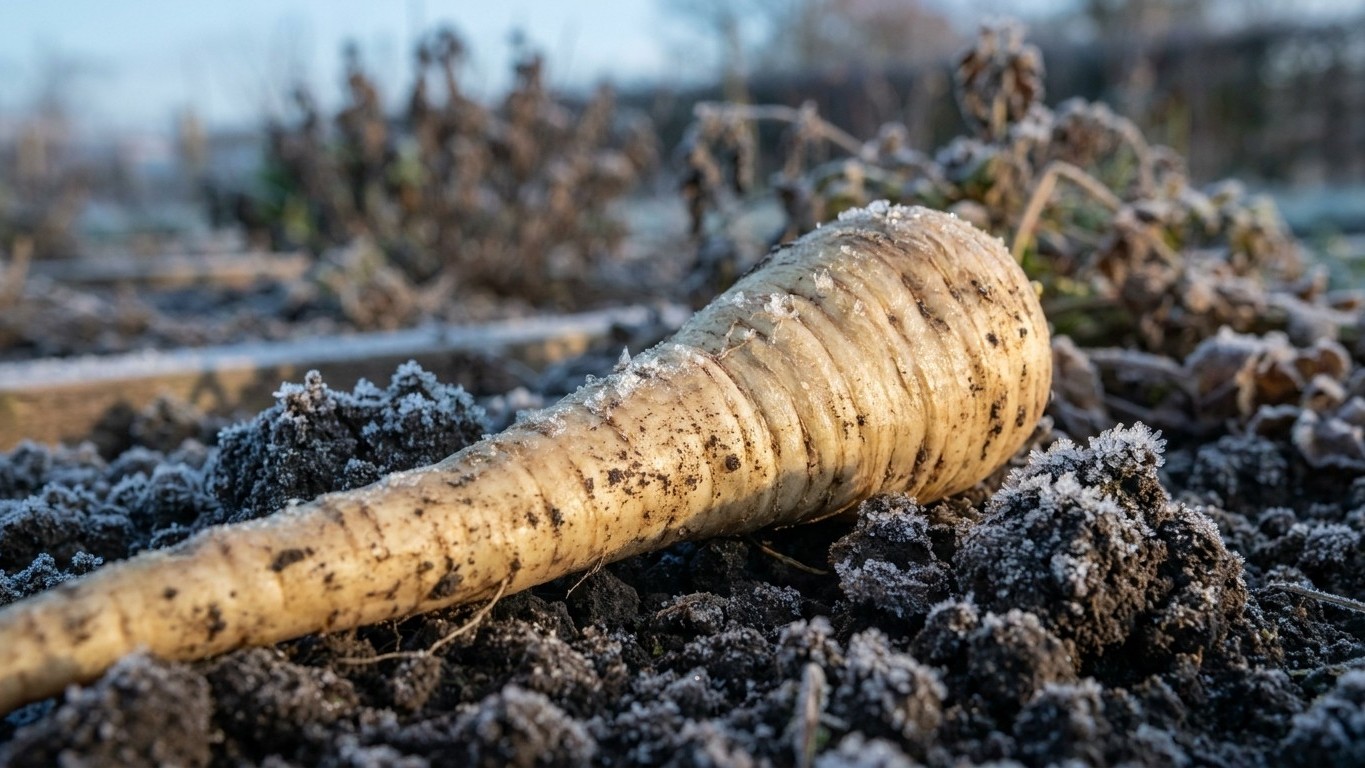

Along the South Carolina coast, spring-sown parsnips are ready to lift from mid-May to early July, once the roots reach a usable size, and they will be mild rather than sweet. Stored well, they keep four to six months, but only under conditions most kitchens can’t hold. Inland and Upstate, winter bites harder and the calendar tightens. The figures below come from NOAA climate normals for Charleston, Utah State University Extension, and the USDA’s storage handbook. For the wider crop picture, start with Growing Parsnips in South Carolina.
The short answer
The question that decides everything here is whether South Carolina delivers several frosty weeks. On the coast, mostly not. The mean daily minimum of the coldest month at the Charleston reference station is 38.9°F, according to NOAA NCEI Climate Normals. That is the average night in the dead of winter, and it sits above freezing.
Frost does show up. At the airport station, the last spring freeze falls between February 28 and March 17, and the first fall freeze between November 20 and December 5 (the 30 to 70 percent probability band). But a scattering of frosty nights is not several frosty weeks. Utah State University Extension says parsnips taste best after several weeks of cool, frosty weather, which converts stored starch to sugar. Without that exposure, a parsnip grown near Charleston will grow into a perfectly good root that never turns sweet. The peninsula itself runs milder than the airport, and Upstate runs several weeks tighter at both ends of the season, so the odds improve as you move inland. The full mechanism is in Will Parsnips Sweeten in South Carolina?
A comfortable hardiness zone does not stand in for this. Parsnips survive South Carolina winters easily. Surviving is not the same as being sweetened, and only frost exposure does the sweetening.
So when do you lift? On the coast, when the roots reach a size worth eating, which is roughly 100 to 120 days after seeding. Waiting in the ground for a frost that may not come gains you little. Seed takes 14 to 21 days to germinate, and the count starts at seeding because parsnips are sown in place, so don’t dig up what looks like bare soil in week two.
Storage is where lifted roots most often go wrong. The USDA’s Agricultural Handbook 66 says parsnip roots can be stored 4 to 6 months at 32 to 34°F with 98 percent relative humidity. That assumes the temperature and humidity hold steady, which almost no house manages. The handbook also says parsnips are not chilling sensitive, so cold is not the danger. Ethylene is. Even low levels in cold storage cause bitterness, and ripening fruit (apples above all) gives it off, so keep parsnips well away from the fruit bowl and the crisper drawer where it lives. Top the roots after harvest, but do not trim into the crown.
Does the season fit?
It fits with room to spare on the calendar. The arithmetic runs in five steps, using the Charleston airport dates.
- Find the sowing window. The crop wants seed in the ground 2 to 3 weeks before the last frost. With that frost falling between February 28 and March 17, the window runs from about February 7 (three weeks before the early date) to about March 3 (two weeks before the late one).
- Remember what the clock measures. The 100 to 120 days run from seeding, not from the day seedlings appear. Germination alone eats 14 to 21 days of that span, and nothing visible happens above ground during it.
- Add the growing time. Seed sown February 7 reaches 100 days around May 18 and 120 days around June 7. Seed sown March 3 reaches 100 days around June 11 and 120 days around July 1. The lifting window for a spring sowing is therefore roughly mid-May to early July.
- Set that against the fall. The first freeze arrives November 20 to December 5, months after the roots finish. The season fits comfortably. The catch is that the roots finish in warm weather, long before any cold could sweeten them, which is why a spring sowing here gives a mild parsnip.
- Count backward for a fall crop. To reach 100 to 120 days by the first freeze, seed would have to go in between about July 23 (120 days before November 20) and about August 27 (100 days before December 5). That fits tightly, and Upstate, with its earlier fall frost, leaves even less room. These sources don’t cover how well seed germinates in late-summer heat, so treat a fall sowing as an experiment. They also give no count of frost days for the winter that follows, so whether it delivers several frosty weeks is not published here.
Near the coast, then, the season is not the obstacle. Winter is.
What goes wrong here
Most failures trace back to soil, water, timing, or the way the harvest is stored. Each has its own remedy.
- Forked roots from heavy or stony ground: Utah State recommends deep sandy soil and says heavy soil must be double dug. The coastal plain leans sandier and much of the Upstate is clay, but the state soil is only a starting point, not a diagnosis. Dig a test hole where the row will go. If the spade meets clay or stones, double dig the bed and pick out the stones before sowing.
- Forked roots from overwatering: a separate cause, and heavy ground does not explain it. A bed with perfect soil can still produce forks if it stays soggy. Let the soil dry slightly between waterings rather than keeping it wet, and hold off irrigation after a soaking rain.
- Bare soil and an unnecessary re-sowing: seed takes 14 to 21 days to germinate. Mark the row, wait the full three weeks, and only then decide the sowing failed.
- A season that runs out: a late spring sowing pushes the harvest into early July, and a fall sowing leaves almost no slack before the first freeze. Count the days from seeding against your own frost dates, not the statewide average, and remember that Upstate gardeners have a shorter frost-free stretch than the coast.
- A winter too mild to sweeten: roots grown on the coast will often reach full size and still taste plain, because the cold never came in sufficient weeks. Lift them when they are ready instead of leaving them in the ground in hope, and treat them as a mild root vegetable.
- Bitterness in storage: the cause is ethylene from nearby apples or other ripening fruit, not the temperature. Store parsnips away from fruit, top them after harvest, and do not cut into the crown.
Pests are the other thing that can spoil a row before harvest. What Eats Parsnip in South Carolina, and When covers what to watch for and when.
Common questions
How long do parsnips really keep?
The USDA handbook gives 4 to 6 months at 32 to 34°F and 98 percent humidity. That figure depends on holding those conditions steadily, and a typical house does not. Expect shorter keeping without a cold, humid, fruit-free space.
Can I store parsnips next to apples?
No. Parsnips produce very little ethylene themselves, but low levels of it in cold storage make them bitter, and apples and other ripening fruit give it off. Even at the right temperature, fruit nearby can ruin a batch.
Will parsnips sweeten in the Upstate?
The Upstate is colder and has a tighter season at both ends, so several frosty weeks are more likely there than on the coast. These figures don’t publish an Upstate frost-day count, so it remains a better chance, not a promise.
Does my hardiness zone tell me whether parsnips will sweeten?
No. The zone describes whether a plant survives winter, and parsnips do. Sweetening comes from exposure to several weeks of cool, frosty weather, which is a different measure. On the Charleston side of the state, the coldest month’s mean minimum of 38.9°F points to a parsnip that grows fine and stays mild.