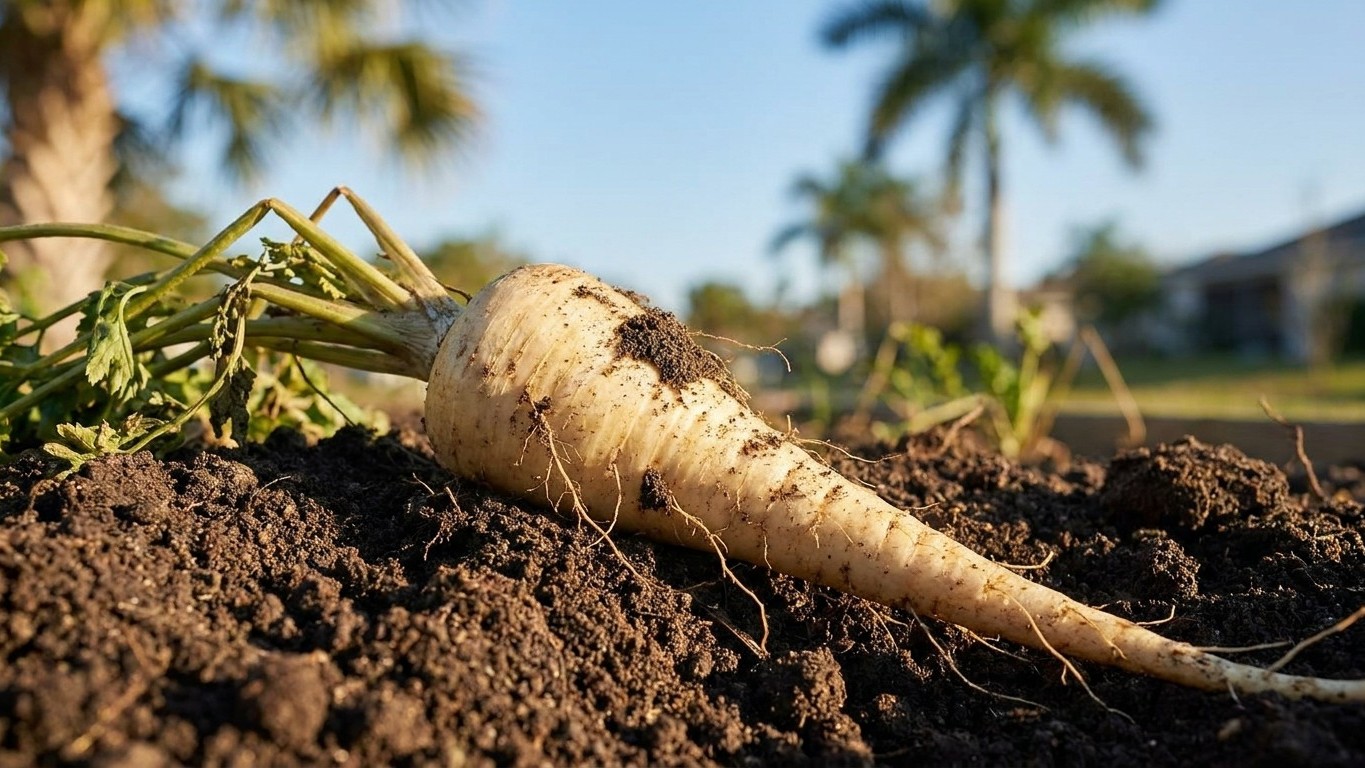

Lift Utah parsnips after several weeks of frost. In the Salt Lake valley that means mid-November at the earliest, then any day the ground stays workable, and before spring warmth wakes the roots. Once they’re out, parsnips keep four to six months, but only at 32 to 34 °F with 98% humidity, and never beside apples. Most of Utah is higher and colder than the valley, so your dates will shift. The arithmetic below shows how.
The short answer
Does this territory deliver several frosty weeks? Along the Wasatch Front, it does. The NOAA NCEI Climate Normals for the Salt Lake City reference station put the mean daily minimum of the coldest month at 24.2 °F. That is nearly 8 degrees below freezing on an average night in midwinter, and an average hides colder ones. A parsnip grown here will sweeten, not merely grow.
The frost window backs that up. At the same station, the first fall frost lands between October 18 and October 29, and the last spring frost between April 12 and April 29. Those ranges reflect the 30 to 70 percent band of freeze probability. Between them sit about six months in which the roots can be exposed to the cold. Utah State University Extension says parsnips taste best after several weeks of cool, frosty weather, which converts stored starch to sugar. The full mechanism is in Will Parsnips Sweeten in Utah?, and the broader crop plan is in Growing Parsnips in Utah.
Frost exposure, not the hardiness zone
A hardiness zone tells you whether a plant survives the winter. Parsnips survive almost anywhere, so the zone settles nothing here. Sweetness comes from the roots sitting in cold ground for weeks, and a comfortable zone is not the same thing as several frosty weeks. Count the frost your own garden gets.
When to lift, and how long they keep
Extension gives no exact number of days for “several weeks.” My reading is to add a few weeks to the late-October first frost, which puts the first digging in mid-November. Pull one root and taste it before you commit the row. Then lift as the ground allows through winter, finishing before the soil warms in spring. A thick mulch over the row helps keep the ground diggable in the coldest stretch.
Four to six months is a long keeper by any standard. That figure comes from USDA Agricultural Handbook 66, and it assumes 32 to 34 °F at 98% relative humidity held steady, which almost no house manages. The handbook notes that parsnips are not chilling sensitive, so cold is not the danger. Ethylene is. Parsnips give off very little of it, but low levels in cold storage make them bitter. A bag of parsnips parked next to apples or other ripening fruit will turn, even at the right temperature. Top the roots after harvest, but do not trim into the crown.
Does the season fit?
Parsnips are sown in place, and the 100 to 120 days run from seeding, not from the day seedlings show. Here is the calendar for the valley, step by step.
- Find the sowing window. Sow 2 to 3 weeks before the last spring frost. With that frost falling between April 12 and April 29, three weeks ahead of the earlier date is March 22. Two weeks ahead of the later date is April 15. That is your span, provided the soil is workable.
- Allow for germination. Seed takes 14 to 21 days to come up. March 22 plus 14 days is April 5, and April 15 plus 21 days is May 6. Expect bare-looking soil for up to three weeks, so mark the row and leave it alone.
- Count 100 to 120 days. From a March 22 sowing, that lands between June 30 and July 20. From an April 15 sowing, it lands between July 24 and August 13. Even the slowest case is a full-size root by mid-August.
- Compare with the first fall frost. The first fall frost arrives October 18 to October 29. From August 13 to October 18 is 66 days, about nine and a half weeks of slack. In the valley the season fits comfortably, with room for a late sowing or a slow summer.
- Add the frost weeks. The extra weeks of cold come after the root is already grown. Mature in summer, sweeten from late October, lift from mid-November. The crop spends more time waiting than growing.
That margin belongs to the valley floor. Salt Lake sits in a mild valley, and most of Utah is higher and colder. At elevation the last frost comes later and the first fall frost earlier, so the slack shrinks from both ends. I have no frost-date figures for those places here, and I won’t guess at them. Find your own local dates and run the same five steps. If the gap closes to a few weeks, sow at the very start of your window.
What goes wrong here
Utah ground and Utah winters each cause their own failures, and the remedies differ. Insect damage is a separate list, covered in What Eats Parsnip in Utah, and When. The state’s soils vary a lot from one county to the next, so treat any general soil description as a starting point. Dig a test hole before you trust it.
Ground and water
- Forked roots from heavy or stony ground. A root that meets clay or a rock splits around it. Extension recommends deep sandy soil, and heavy soil must be double dug. Loosen the bed to well below the depth of the root and pull out stones before you sow.
- Forked roots from overwatering. This is a different cause and it needs a different fix. Soil kept constantly wet can fork roots even when the bed is loose. Water evenly and let the bed drain between soakings, rather than keeping it soggy to protect the row while the seed sits.
Calendar and climate
- A season that runs out. A late sowing, or a high-elevation garden with a short window, may leave too few days before hard cold. Sow at the front of your window, and use the five-step arithmetic above with your own frost dates to see whether the plan holds.
- Digging up bare soil. Germination takes 14 to 21 days, and gardeners who see nothing after ten days often re-sow or tear up the row. Keep the surface evenly moist and wait the full three weeks before deciding the seed failed.
- A winter too mild to sweeten. Southern Utah is warmer than the Salt Lake reference station, and a mild-winter garden grows a fine parsnip that never becomes sweet. If your winters give few frosty weeks, leave the roots in the ground as long as they will stay sound, and expect a plainer flavor.
- Bitterness in storage. The cause is ethylene from nearby fruit, not cold. Store parsnips well away from apples, and top them without cutting into the crown.
Common questions
Can I leave parsnips in the ground all winter?
In the valley, yes, as long as you can get a fork into the soil. The roots are not chilling sensitive, and the frost is what sweetens them. The limit is spring. Plan to lift everything by the last spring frost window, April 12 to April 29 at the Salt Lake station, before the ground warms.
How long do lifted parsnips keep?
Four to six months at 32 to 34 °F and 98% relative humidity, according to USDA Agricultural Handbook 66. That figure describes steady commercial conditions. A kitchen drawer will not hold them exactly, so check stored roots now and then and use the softest first.
Is it safe to store parsnips with apples?
No. Parsnips produce very little ethylene themselves, but exposure to even low levels in cold storage makes them bitter. Keep them in a separate spot from apples, pears, and any ripening fruit.
How soon should I expect seedlings?
Between 14 and 21 days after seeding. The 100 to 120 day clock runs from the day you sow, so a row that looks empty at two weeks is on schedule. Chilly March soil tends toward the slow end of that range.