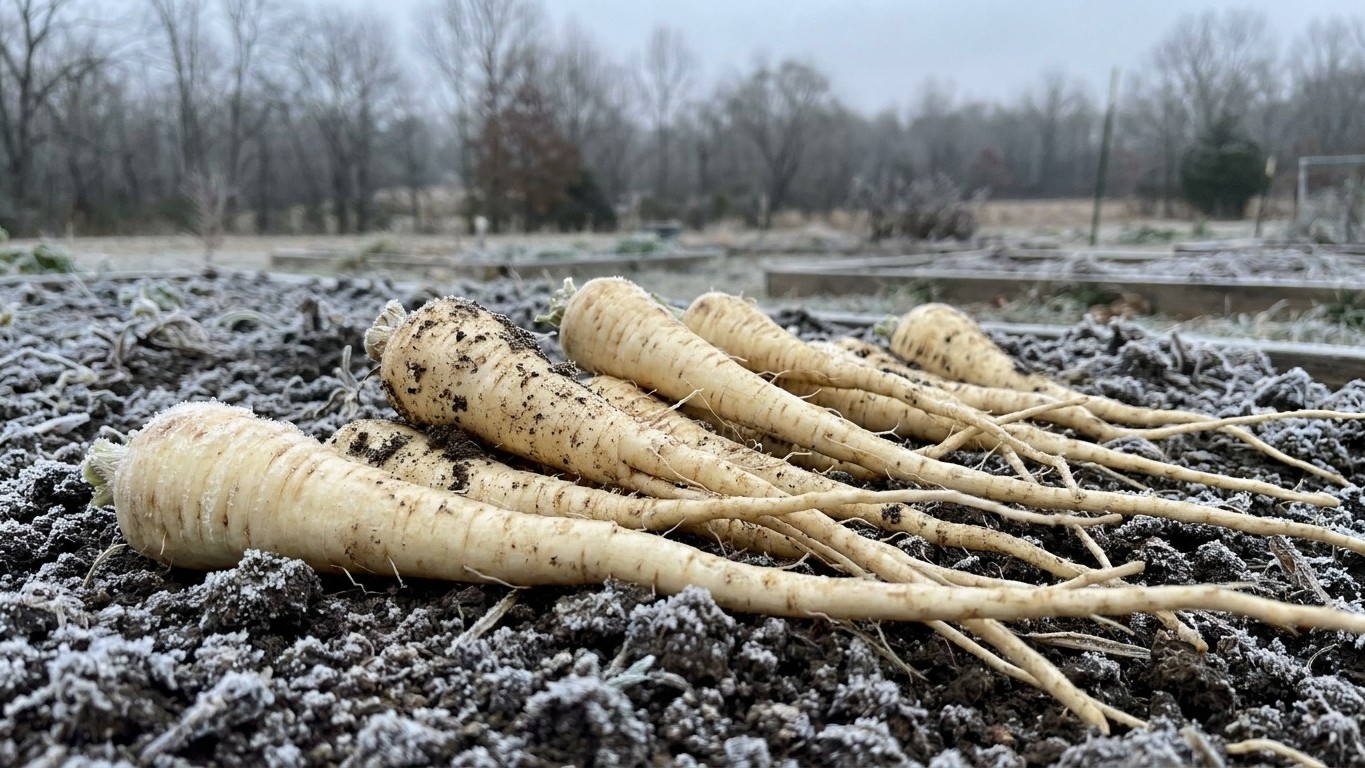

In the Salt Lake Valley, the numbers say yes: parsnips left in the ground here get enough cold to sweeten, not just to grow. The coldest month averages a 24.2°F low, well below the freezing point parsnips need for that starch-to-sugar conversion. Higher, colder parts of Utah do even better on this score. Warmer pockets of southern Utah are the ones to watch.
The short answer
The question that settles everything for a parsnip grower isn’t “how cold does it get once, in January.” It’s “how many weeks in a row does the ground stay cold.” Sweetening in this root vegetable isn’t triggered by a single hard freeze. It’s a slow chemical shift that happens across repeated frosty exposure, week after week, while the root sits in the soil doing nothing but converting stored starch into sugar.
The reference figure for this territory, drawn from NOAA’s 1991-2020 Climate Normals at the Salt Lake City station, puts the mean daily minimum of the coldest month at 24.2°F. That’s not a record low and it’s not a single overnight dip. It’s the average low across the whole coldest month, which means most nights in that stretch dip well below freezing. For a parsnip left in the ground through that period, that’s exactly the kind of sustained cold exposure the sweetening process depends on.
So for a garden sitting in or near the Salt Lake Valley, the answer is: yes, this parsnip will sweeten, not merely survive. A 24.2°F average minimum across an entire month means multiple weeks of frost exposure, not an isolated cold snap. That’s the difference between a parsnip that’s technically edible and one that’s actually sweet.
Two caveats matter here, and they cut in opposite directions. Salt Lake City sits in a mild valley by Utah standards. Most of the state sits at higher elevation and runs colder, which if anything makes the sweetening more reliable, not less, in those areas. Southern Utah runs the other way. Warmer winters there mean fewer sustained frosty stretches, and a gardener in St. George or Cedar City shouldn’t assume the same outcome without checking local conditions. The 24.2°F figure is specific to the Salt Lake City reference station. It’s a useful benchmark for the valley and similar elevations, not a statewide guarantee.
Does the season fit?
- Start with the sowing window. Parsnip seed goes into the ground directly, 2 to 3 weeks before the last spring frost. For this territory, the last spring frost falls between April 12 and April 29, depending on exact location and elevation within the reference band. That puts a realistic sowing date somewhere between late March and mid-April.
- Add the germination lag. Parsnip seed is famously slow. Germination takes 14 to 21 days, sometimes longer in cool soil. A gardener sowing in late March won’t see seedlings until mid-to-late April. That’s not a failed sowing, it’s just how this seed behaves, and digging up the row to resow because “nothing came up” after ten days is the single most avoidable mistake at this stage.
- Count forward 100 to 120 days from seeding. That’s the full span this crop needs to reach harvestable size, measured from the day the seed goes in, not from germination. Sowing at the early end of the window (late March) puts maturity somewhere around early to mid-July. Sowing later, closer to mid-April, pushes maturity into late July or early August.
- Check that against the fall frost date. The first fall frost in this reference territory lands between October 18 and October 29. Either sowing scenario above reaches full maturity two to three months before that first frost arrives.
- Read the margin. A two-to-three-month cushion between “root is mature” and “first frost hits” is a comfortable fit, not a tight one. It leaves room for a late sowing, a slow germination, or a cool spring without threatening the harvest. The tighter the local growing season runs (higher elevation, shorter frost-free stretch), the more that cushion shrinks, so a gardener at higher elevation than the Salt Lake reference station should lean toward the earlier end of the sowing window rather than the later one.
What goes wrong here
- Forked roots from heavy or stony ground. Parsnips send a single taproot straight down, and anything that blocks that path (compacted clay, rocks, an old subsoil layer) splits the root into forks instead of one straight column. Utah State University Extension’s guidance on this crop points to deep, sandy soil as the ideal, and specifically calls for double digging where the soil runs heavy. That means turning the bed a full spade deep, sometimes two, before sowing, not amending the surface and hoping the root finds its way around whatever’s underneath.
- Forked roots from overwatering. This is a separate cause from heavy soil, not a variation on it. Even in loose, well-worked ground, keeping the bed consistently soggy encourages the root to branch rather than drive straight down. The fix is even, moderate moisture rather than heavy watering followed by dry stretches, which stresses the root and can trigger the same forking.
- A season that runs out before the root finishes. This shows up mainly at higher elevation within Utah, where the frost-free window runs shorter than the Salt Lake Valley reference. The remedy is sowing at the earlier end of the recommended window (as close to 3 weeks before last frost as the soil allows) rather than the later end, buying back the days a shorter season takes away.
- A winter too mild to sweeten. This is a real risk in the warmer pockets of southern Utah, and it’s a different failure than the two above: the root grows fine, it just never gets sweet. The remedy is patience rather than technique. Leave the roots in the ground through several freezing spells rather than harvesting at the first frost, and if the local winter genuinely doesn’t deliver sustained cold, treat the crop as a good-tasting vegetable rather than expecting the sugar-sweet result the frost exposure is supposed to produce.
Every part of this plant carries a compound that reacts with sunlight on exposed skin, and it’s a warning almost no garden page mentions. North Carolina State Extension states it plainly: “All parts of this plant contain furocoumarins which can make skin sensitive to light causing burns so be sure to wear gloves, long sleeves and long pants when dealing with it.”
The mechanism is what makes this surprising rather than obvious. The burn doesn’t come from the sap alone. It takes sap on the skin plus sunlight hitting that same skin. That’s why it tends to show up after a bright afternoon spent pulling tops or harvesting roots, why the reaction often doesn’t appear until hours later, and why washing the skin afterward doesn’t undo the exposure the way it would with a simple irritant. The sap has already reacted with the sunlight by the time anyone notices redness.
That also explains why the protection is clothing, not aftercare. Gloves, long sleeves, and long pants block the sap from ever reaching skin that sunlight can then act on. Once the exposure has happened on a sunny day, there’s no equivalent fix after the fact. This applies to the roots, the foliage, and everything in between, since the source specifies all parts of the plant, not just the tops.
Checking this against your own county
The figures above come from a single reference station in the Salt Lake Valley, and Utah’s geography swings wide enough that a garden thirty miles away, or two thousand feet higher, can run on a noticeably different frost calendar. Before committing a full row to parsnips, it’s worth confirming the local last-frost and first-frost dates rather than assuming the Salt Lake numbers travel unchanged across the state.
Utah State University Extension is the authority for this crop statewide, and its county offices track local planting windows and soil conditions than any statewide average can. The main extension site, extension.usu.edu, links out to county-level offices where a gardener can check frost timing and get soil guidance specific to their elevation and valley position. That’s the more reliable check for anyone gardening outside the immediate Salt Lake reference area, especially at higher elevation or in the warmer southern part of the state.
Common questions
Can parsnips be sown in a container instead of the garden bed?
Utah State University Extension’s guidance describes parsnips as a crop that wants deep, sandy soil, with heavy ground double dug before sowing. That points to an in-ground bed rather than a shallow container, since the taproot needs room to run straight down without hitting a container wall or a compacted layer.
How long after the first fall frost should parsnips stay in the ground?
The published guidance calls for several weeks of cool, frosty weather to convert the stored starch to sugar. That points toward leaving the roots in place through multiple frost events rather than pulling them at the very first one, though no specific week count is published for this territory.
Does mulching help protect parsnips through winter in Utah?
The sourced guidance for this page covers soil type, season length, and frost sweetening, but doesn’t address mulching directly. A gardener wanting mulch guidance for overwintering roots should check with their county extension office rather than assume a technique not covered here.
Is the sap risk worse when handling parsnip foliage versus the roots?
No. The source is explicit that all parts of the plant contain the compound that reacts with sunlight, not just the leaves. Gloves, long sleeves, and long pants apply whether the task is pulling tops or handling harvested roots.