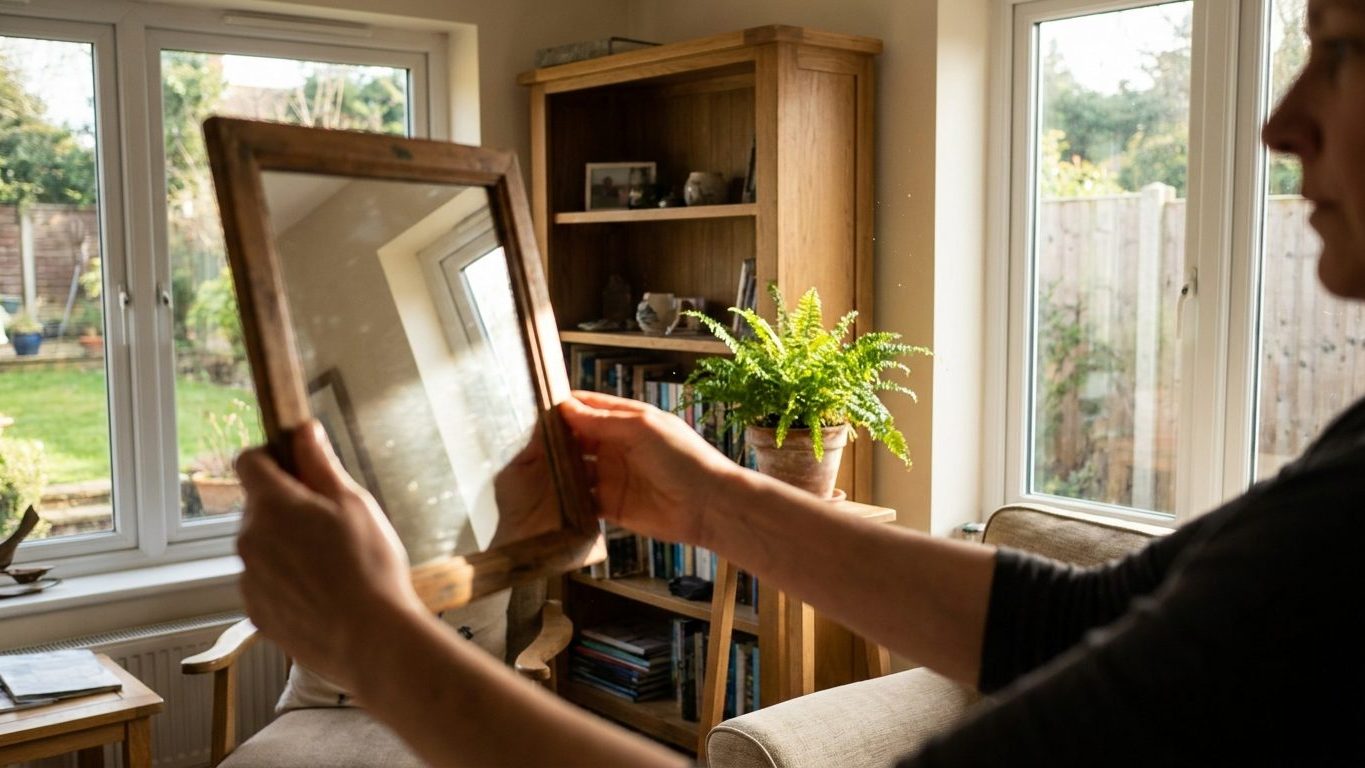

A mirror facing a blank wall wastes the whole point of hanging one: it reflects paint, not light, and the room stays exactly as dim as before. A mirror facing a window or a doorway that lets in daylight throws that light back across the room instead. Hang it on the wall that looks toward the light, not on the wall across the room from it.
What is actually going on

The thing to understand here is reflection: a mirror does not manufacture light, it returns whatever is standing opposite it. Face it toward a window and it bounces daylight back into the room. Face it toward a wall painted a dark color, and it bounces back a rectangle of dark paint. The mirror is neutral. Its effect depends entirely on what it’s pointed at, not on the mirror itself.
This is why two identical mirrors can produce completely different results in the same house. One hung across from a window catches the changing light through the day and throws it onto the ceiling and opposite wall, making the room feel bigger and brighter as the light shifts. The other, hung on an interior wall with no sightline to a window, just shows whatever is across from it: a sideboard, a doorframe, another mirror. It’s decorative at best and does nothing for the light in the room.
The angle matters as much as the position. A mirror hung flat against the wall reflects whatever is directly opposite it at eye level, roughly the same width away as its own distance from the wall. Tilt it slightly and the reflection shifts: a mirror tilted forward at the top throws its reflected light and view down toward the floor, while one tilted forward at the bottom throws it up toward the ceiling. Most household mirrors are hung flat on purpose, because a flat mirror gives a predictable, undistorted reflection of what’s across from it.
Size and finish change how much this effect actually reads in a room. A large mirror captures a wider slice of the window or light source and reflects a bigger patch of brightness. A small mirror, even hung in a bright spot, only ever returns a small rectangle of light and reads as a shiny object rather than a light source. A frameless or thin-framed mirror tends to disappear into the wall and lets the reflection do the work. A heavy, ornate frame draws the eye to itself before the reflection registers, which is a legitimate look on its own terms but works against the goal of moving light around a room.
None of this is really about the mirror. It’s about what’s opposite it, at what height, and at what angle. Get those three things right and a plain, inexpensive mirror will out-perform an expensive one hung badly. And because a mirror large enough to change the light in a room is also heavy enough to hurt someone if it comes off the wall, everything below assumes the fixing holding it there matters as much as where you decide to point it.
- It’s about what’s opposite it
- At what height
- At what angle
Doing it
Placement decides almost everything here, and it’s worth working through in order rather than picking a spot because it looks even on the wall.
- Track the light before you touch a tape measure. Spend a day watching where daylight actually reaches in the room, not just where the window is. A window on a shaded side of the house, or one partly blocked outside, sends far less usable light than the size of the glass suggests. Skip this and the mirror ends up reflecting a window that wasn’t doing much work to begin with.
- Hang the mirror on the wall that faces the light, never on the same wall as it. A mirror mounted right beside or above the window only reflects the room back at itself. It needs to sit on the opposite or an adjoining wall so the glass actually looks toward the window and can throw that light back across the space.
- Check what the mirror will show before committing to a spot. Stand where it will hang and look at what’s directly across from it. A cluttered desk, an open closet, or the back of a door reflect right back as clutter, not light. A doorway opening onto a second window can work well, since it doubles the sense of daylight coming from two directions.
- Set the height by what needs reflecting, not by a fixed rule. The usual convention is to center a mirror roughly at eye level for an adult standing in the room, but the height that matters here is whichever one lines the glass up with the window or fixture you’re trying to bounce around. In a room with a low window, a mirror centered at the conventional height might reflect mostly wall above the sill.
- In a small room, resist covering most of one wall with glass. A single large mirror placed to catch the light works better than several small ones scattered around, which break the reflection into fragments and make the room read as busier rather than larger. Restraint matters more than quantity here, which is one of the points making a small room work depends on.
- Prop the mirror in place before fixing it permanently. Lean it against the wall at the intended height for a day and check the reflection at different times, especially the evening if that’s when the room gets used. Moving a mirror after it’s drilled and fixed means patching holes, so this step saves the wall as much as it saves the redo.
- If the mirror is going on a mantel, console, or floating shelf rather than straight onto the wall, check what that surface can actually carry first. A lightweight floating shelf can look sturdy and still flex under a mirror’s weight over months, which is exactly the failure covered in why shelves sag, and how far they can span.
One placement reliably backfires: a large mirror hung directly across from another mirror. Instead of doubling the light, the two reflect each other back and forth. That reads as a visual tunnel rather than a brighter room, and it can feel disorienting in a hallway or narrow space. A mirror facing a heavily patterned wall or a wall crowded with framed art has a milder version of the same problem, since it reflects clutter and busyness rather than light, which is the opposite of what the whole exercise is meant to achieve.
What it looks like when it goes wrong
Most mirror placement problems are cosmetic and easy to correct, but one category is not, and it’s worth separating the two clearly.
Cosmetic failures
The most common failure is a mirror that reflects the wrong thing: a dark hallway, a cluttered shelf, the back of a door. This doesn’t damage anything, it just means the mirror isn’t doing the job it was hung for. The fix is to move it, which usually means patching a couple of holes and re-hanging on an adjoining or opposite wall rather than any structural work. A mirror hung at a conventional height that ends up reflecting mostly ceiling or floor, because the window in that particular room sits unusually high or low, is the same kind of problem. Reposition it to the height that actually lines up with the light, not the height a convention suggests.
Glare is a milder but real complaint. A mirror angled to catch a low sun directly can throw a hard reflection across a room at certain times of day, uncomfortable to look at or work near. This is usually solved by a small change in tilt rather than moving the mirror entirely, since even a few degrees changes where the reflected light lands.
The one that isn’t cosmetic
A mirror that has started to tilt forward at the top, or feels loose when nudged, is a sign the fixing is failing. That can mean a screw pulling out of a wall that can’t support it, an anchor that was undersized for the wall type, or a hook slowly bending under the mirror’s weight. A large mirror is heavy enough that a fall from wall height can cause a real injury as well as break the glass, so this is not something to leave and monitor. Take it down, check the wall and the fixing, and refix properly rather than waiting to see if it gets worse. A fixing that’s already in doubt should be treated as one to replace, not one to test by leaving the mirror up a little longer.
Black spots or a cloudy patch appearing in the reflective surface itself, sometimes called desilvering, is a sign the mirror’s backing is degrading, usually from moisture. It’s a fault in the glass rather than a hanging fault, and it can’t be corrected. The mirror needs replacing, though the fixing and the wall are usually fine to reuse for the new one.
What to settle first
Before any of the placement advice above matters, settle what the wall itself can take. A mirror large enough to change the light in a room is also large enough that its fixing needs to match the wall, not just the hanging wire or clips on the back of the frame.
Start with what kind of wall it is: solid masonry or plaster, or a stud or drywall partition with cavities behind it. The wall type decides what fixing is appropriate, not the other way around, and it’s worth checking this before falling in love with a particular spot on the wall. A masonry or solid plaster wall generally offers more to fix into across most of its surface. A stud or drywall partition only gives full strength where there’s a stud or noggin behind the board, and a fixing driven into the board alone, away from any framing, holds far less than one landing on timber or masonry.
What’s inside the wall
Check what’s behind the surface before drilling anything, not just what kind of wall it is. Cables and pipes often run at predictable heights and near switches or sockets, but they aren’t always where you’d guess, and a cable and pipe detector is the reliable way to check rather than assuming. This matters as much for a mirror as for any other wall fixing.
Match the fixing to both the wall and the mirror’s actual weight and depth, using the fixing manufacturer’s own rating for that wall type rather than a number remembered from another job. The packaging for wall plugs, toggle fixings, and mirror-hanging kits states what that particular fixing is rated for in that particular wall material, and that’s the figure to use. A heavier or larger mirror, or one going onto a partition wall rather than masonry, usually needs a fixing rated for cavities, or needs to land on the stud itself, and it’s worth confirming this before the mirror is on the wall rather than after.
If any of this is unfamiliar, the broader question of what a wall can carry and how to fix into it is covered in hanging, shelving and fixing: the wall decides, and it’s worth reading before buying a mirror bigger than the wall was ever going to support comfortably.
Common questions
Can a mirror actually make a dark room brighter?
Only if it’s facing a real source of light, such as a window, glazed door, or a well-lit part of the room. A mirror facing an interior wall or a shaded corner has nothing to reflect and won’t add brightness no matter how large it is or where it’s hung.
Will hanging a mirror facing a sunny window damage it over time?
Direct sun mostly affects the frame rather than the glass, fading wood finishes or paint faster than elsewhere in the room. The reflective backing itself is fairly stable, though prolonged heat and humidity together, such as above a radiator or in a steamy bathroom, are more likely to cause the backing to degrade over the years than sunlight alone.
Can I lean a large mirror against the wall instead of fixing it?
You can, but a leaning mirror is not a fixed one, and it can be knocked forward if bumped, or pulled over by a child or pet leaning on it. If a mirror is going to stand rather than hang, it needs an anti-tip fixing securing the top of the frame to the wall, not just its own weight and the floor to hold it upright.
Does a round mirror move light differently than a rectangular one?
Shape doesn’t change the mechanism, only how much of the opposite wall or window gets reflected. A round mirror of a given diameter generally shows less of the room than a rectangular mirror of similar overall size, simply because it has less reflective area at the edges, so a rectangular or oval shape is usually more effective when the goal is specifically to move as much light as possible.