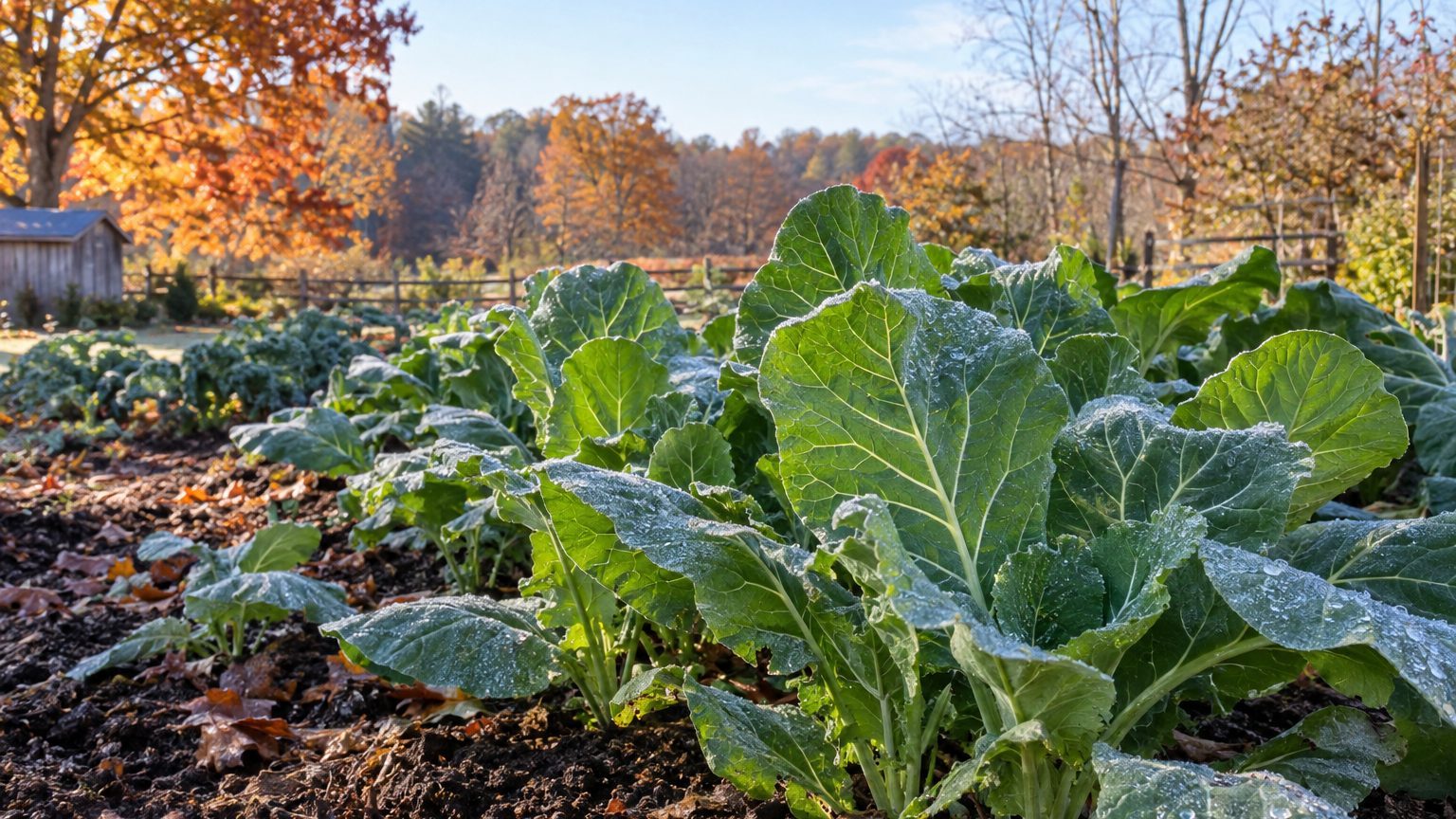

Start collards indoors from mid-March to early April, then set hardened transplants in the garden from late April through May. A second sowing in early July gives a fall crop. Those dates hang on two averages from the Charlottetown airport station: the last spring frost falls on average May 16, and the first fall frost on average October 17.
The short answer for Prince Edward Island
What the frost dates actually say
Both dates are means drawn from Environment and Climate Change Canada’s 1981-2010 normals. They are midpoints, not guarantees. In one spring out of two, frost still arrives after May 16. In one fall out of two, it shows up before October 17. Treat May 16 as the middle of a window, never as the day it becomes safe to plant tender things.
Count from one average to the other and you get about 154 days. That is the stretch collards have to work with, and much of it is cool. Most varieties need a good stretch from transplanting to a decent harvest, so there is room for one good crop and a second timed to ripen late. Collards also shrug off light frost, and the leaves taste better after a few cold nights.
A working calendar
| Task | Window |
|---|---|
| Sow seed indoors | Mid-March to early April |
| Transplant hardened seedlings | Late April to late May, with row cover early on |
| Direct-sow in the garden | Mid-May to early June, once soil has warmed |
| Sow or transplant for fall | Early July |
| Harvest | Midsummer through late fall |
Seedlings need hardening off, a few hours outdoors at first, before they go in the ground. For a broader look at the crop, see Growing Collards in Prince Edward Island.
What will not work here
A late sowing is the first casualty. Collards seeded in late July or August have too little time before the first fall frost, which comes before October 17 in half of years. The plants stay small, and small plants freeze in cold weather whatever you do. Early July is about the last comfortable date.
Planting by the May 16 average also fails. Since half of years have frost after that date, a gardener who plants on May 16 as if it were a safe date will, in some years, lose seedlings. A cold snap right after transplanting stalls growth even when it does not kill the plants. Keep a sheet of row cover handy through the end of May.
Sowing seed outdoors in early April is another mistake. The soil is cold and wet, germination is slow and patchy, and seedlings sit exposed while they crawl along. Starting indoors skips that stage. Row cover over young plants also keeps out flying pests in spring.
Slow, long-season types bred for the Deep South are a poor bet. They are built for months of warm weather, and 154 days between frost averages does not give them that. Pick varieties known to mature reasonably fast; The Best Collards and Greens for Prince Edward Island covers which ones suit a short season.
Counting on winter survival is the last trap. The mean daily minimum of the coldest month is -12.1 °C (10.3 °F), and that is an average. Individual nights run colder, and wind off the water makes it worse. A plant left standing unprotected should not be expected to resprout in spring. Treat collards here as an annual that happens to enjoy frost.
What changes across Prince Edward Island
Charlottetown is one reference point. It sits in Canadian hardiness zone 5b by Natural Resources Canada’s 1991-2020 map. That is the Canadian system, built from seven climate variables, and it does not convert to a USDA zone. Natural Resources Canada says plainly that no simple conversion exists between the two.
The province is not one climate. The island is long and narrow, and districts away from the Charlottetown station, particularly northern and upland ones, run weeks behind its frost dates. A gardener there should push every date on the calendar later: indoor sowing, transplanting and the July sowing too. In a cooler district, the margin before the first fall frost shrinks, and so does the room for error on a second crop.
Sites near the water behave differently from inland ones. The sea moderates temperature swings, which can delay spring warmth but soften the first fall frost. A sheltered, south-facing bed warms earlier than an open field, and low spots where cold air pools can keep frost days after the neighborhood has thawed.
Which zone applies to your own garden is something to look up, not guess. The Canada’s Plant Hardiness Site lets you search by municipality. Use that result to decide how far to move the dates in the table above.
Where to check this for your own county
Start with Prince Edward Island’s agriculture pages, the provincial government’s farm and food information. Look there for a local planting calendar, and for any list of varieties tested in your part of the island. Anything that names your district rather than the whole province is worth more than a general rule.
A county or district recommendation beats a provincial one, and the dates here are the provincial kind. They cover the whole island with one set of averages. Local advice reflects the soil, the wind, the nearest frost record and which varieties actually finished a season nearby.
When you call or visit, ask three things. What is the usual last frost date for my area, and how much does it swing? Which collard or kale varieties have grown well locally? And what are the local pest pressures, such as root maggot or flea beetle timing, that would change when I plant?
Local garden clubs and farm stands are good second opinions. A grower who sells greens into October knows when the season really ends in that district, and that is worth more than any average.
Checking this against your own garden
Your own observations outrank every date above. Three are easy to make without buying anything.
First, soil warmth by feel. Push your hand a few inches into the bed in the morning. If it feels cold and sticks in clumps, wait. A bed that warms and crumbles weeks ahead of a neighbor’s tells you it is a warm microclimate, and you can plant earlier there. Weeds sprouting in numbers confirm it.
Second, the first true leaves. A seedling’s first leaves are simple; the true leaves that follow look like small collard leaves. When the true leaves have opened, the seedling is ready for hardening off. If your seedlings take much longer than the packet suggests, the indoor spot is too cool or too dim.
Third, frost on the grass. Walk the yard on a cold spring or fall morning and note where frost lingers. Those low pockets will see the last frost later and the first one earlier, so give them the later spring planting. The spots that clear first are where fall collards will last longest.
The Moon calendar is a separate, older custom: see when to plant collard greens by the moon, written as tradition rather than fact.
Common questions
Can I direct-sow collards in Prince Edward Island?
Yes, from mid-May to early June, once the soil has warmed. Transplants give a head start, though, and they matter more where the season is short.
Is May 16 safe for transplanting?
Not by itself. May 16 is the average last frost date, so in about half of years frost comes later. Hardened collards survive light frost, but keep row cover available through the end of May.
Will collards survive the winter?
Don’t count on it. The mean daily minimum of the coldest month is -12.1 °C (10.3 °F), and individual nights are colder. Plan on harvesting through fall and starting new plants in spring.
When is the last safe time to start a fall crop?
Early July. The first fall frost arrives on average October 17, and in half of years it comes sooner, so later sowings risk running out of time. In a cooler northern or upland district, aim for the early end of that window.