
Collards in Prince Edward Island go into the ground once the soil itself warms, not on a single calendar date. The frost-free window runs roughly 154 days, from mid-May to mid-October, and the province’s cold winters rule out the leaf-by-leaf winter harvest possible further south. Expect one autumn crop, chosen for disease resistance more than heat tolerance, with the actual variety left to the local extension service rather than a name on a seed rack.
When the soil is warm enough in Prince Edward Island

Every gardener wants one day circled on the calendar, but collards do not read calendars. They wait for warm soil, and soil warms on its own schedule, not on the same morning the frost risk lifts.
The nearest fixed point is the average last spring frost recorded at Charlottetown A, the reference station Environment and Climate Change Canada uses for Prince Edward Island: May 16, based on the 1981-2010 Climate Normals. That figure is a mean, not a promise. In roughly half the years on record, frost showed up after that date, so treat May 16 as the middle of a window rather than a green light.
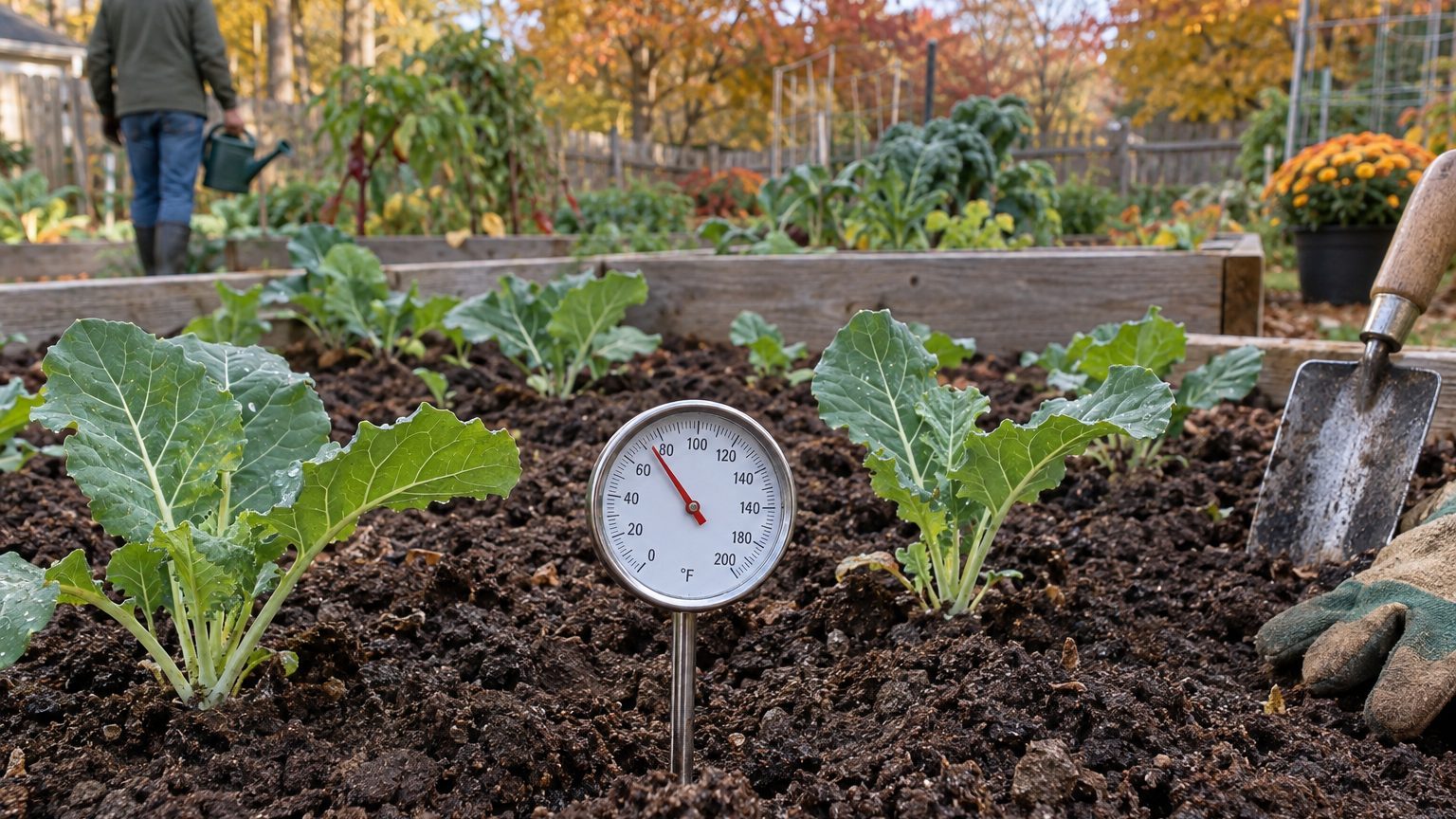
Frost itself is only a stand-in for the number that actually matters: soil temperature. Air can clear of frost risk while the top few inches of ground are still cold and slow to release nutrients, and collard roots sitting in that cold soil simply stall. The practical fix costs nothing but a soil thermometer pushed a few inches down at midmorning for several days running. Once that reading holds steady, rather than dipping back overnight, the bed is ready, typically a week or two after the frost-free date itself, not on it.
The Charlottetown A station sits on the coast near the capital, and it describes one point on the map, not the whole province. Inland and upland districts, along with more exposed pockets on the north shore, often run behind that date by a week or more, so a gardener in a colder corner of the Island does well to push any planting decision later rather than earlier.
Starting seedlings indoors gives collards a head start that a short northern season rewards. Counting back four to six weeks from the frost-free window puts most sowings indoors in early April, with the trays hardened off gradually before they ever meet open ground. Direct-seeding is possible too, but in a province where the soil itself is the limiting factor, transplants already carrying a few true leaves handle a late cold snap far better than seed sitting in ground still working through winter.
Cool, damp spring soil across the Maritimes also favors slugs before seedlings even get established, so a barrier of coarse grit or diatomaceous earth around new transplants, checked and refreshed after rain, does more good early on than any spray applied later.
How long the season lasts here
Subtract one average frost date from the other and Prince Edward Island’s frost-free window comes out to roughly 154 days, running from May 16 to October 17 at the Charlottetown A station. That is a modest window by North American standards, and it shapes almost every decision that follows.
| Marker | Average date |
|---|---|
| Last spring frost | May 16 |
| First fall frost | October 17 |
| Frost-free window | about 154 days |
A 154-day window is enough for one full collard crop, planted after the soil has warmed and harvested well before the ground freezes hard in mid-October, but it rules out the two full sowings a longer season allows elsewhere. Growers working the same crop in Indiana stretch across a season long enough to support a spring sowing and a second one behind it. Just across the Northumberland Strait, growers in New Brunswick work a season close enough to PEI’s own that the same single-sowing logic applies there too.
What a 154-day window does allow is a staggered start rather than a staggered season: sowing part of the bed as soon as the soil is workable and a second portion two to three weeks later, so the harvest spreads out even though the growing window itself does not stretch. That logic, along with the broader approach to timing plantings against a fixed frost window, is covered in more depth on the collards growing guide for this crop.
Transplanting matters more here than in a longer season, because every week spent waiting on direct-seeded plants to germinate in cool soil is a week subtracted from a harvest window that was never generous to begin with. A gardener who transplants rather than direct-seeds effectively buys back two to three weeks of that total, which in a short-season province is not a marginal gain.
The October date carries the same caution as its spring counterpart: it is a mean, so in roughly half the years on record the first fall frost arrives earlier than October 17, not later. Treating the season as a fixed 154 days, rather than a range that can run shorter, is the mistake that catches gardeners who plant a second round too late and lose it to an early cold snap.
Heat and water in Prince Edward Island

The facts available for this territory don’t include a count of days above 90°F at a reference station, and that absence is itself informative: Prince Edward Island’s maritime climate rarely produces the kind of extended heat that shapes collard growing further south. Summer here is defined less by heat stress than by what a cool, damp season brings instead.
- Slower leaf development through a cool summer, rather than the rapid growth a hot climate forces
- Higher risk of powdery mildew and related fungal issues on leaves that stay damp longer
- Greater value placed on spacing and airflow than on shade, since heat stress is rarely the limiting factor
None of that calls for a fungicide reflex. Spacing plants generously and watering at the soil line rather than overhead does more to keep leaves dry than any product applied after mildew shows up.
What actually decides how a collard bed gets planned in Prince Edward Island is not summer at all, but the coldest month of winter. The mean daily minimum of the coldest month at Charlottetown sits at -12.1°C (10.3°F), well below what collards can survive standing in open ground. In territories where the coldest month stays mild, collards become a standing crop, picked leaf by leaf from November into March. Here, with winter minimums that far below freezing, that option does not exist: collards in Prince Edward Island are strictly an autumn crop, planted for a single harvest that ends at the first hard freeze rather than one that carries through winter.
Prince Edward Island sits in Canadian hardiness zone 5b, based on Natural Resources Canada’s 1991-2020 normals for the reference city. That is the Canadian system, built from seven climate variables rather than the single-variable USDA scale used on the American pages of this site, and the two numbers do not convert directly from one to the other. The zone label matters less for collards than the coldest-month figure above, since it is winter severity, not a zone number, that decides whether the crop is grown as a standing bed or a single autumn harvest.
Summer rainfall figures specific to this station are not part of the record available here, but the general Maritime pattern of frequent, light rainfall rather than long dry stretches means irrigation is rarely the limiting factor for collards in this province. Drainage, not water supply, is the more common problem in a wet spring, and a bed that puddles after rain costs a collard crop more than a week of dry weather ever would.
Which collards suit Prince Edward Island
None of this points to a single variety, and that is deliberate. A 154-day season, a cool damp summer, and a Canadian zone 5b winter together sketch the type of collard that suits this province, not the name printed on a seed packet.
The short season favors the earliest-maturing types available, since a plant that reaches usable leaf size quickly leaves more of the autumn harvest window intact even after a slow, cool spring start. The damp summer makes disease resistance, particularly to the fungal issues that thrive on leaves that stay wet, a more useful selection criterion here than heat tolerance ever would be. And because this is not a standing-crop climate, there is little reason to weight a variety’s cold-hardiness rating as heavily as a gardener two provinces south of the Canadian border might.
- Earliest-maturing types, to make the most of a five-month window
- Disease resistance as the first filter, given a cool and often damp growing season
- Cold tolerance as a secondary factor only, since this is an autumn crop rather than a standing one
Turning any of that into an actual variety name is where this page stops, on purpose. Collards belong to the same brassica family as cabbage, kale and mustard, and the varieties that perform well in one Island garden this season may not be what a trial recommends next year as new lines are tested. The Prince Edward Island Department of Agriculture tracks which types actually hold up under Island conditions, and that trial data outranks any recommendation printed on this page.
The family connection matters for more than variety choice. Because collards share their pests and diseases with cabbage, kale and mustard, following any of those crops with collards in the same bed carries over the same club root and cabbage worm pressure rather than breaking it. The full rotation logic, along with planting guidance for the wider collards and southern greens family, is laid out on the collards growing hub, worth reading before the bed goes in rather than after a problem shows up.
Gardeners comparing notes with growers elsewhere in the cocon will find useful contrast rather than a shortcut: the Indiana growing guide deals with a heat load Prince Edward Island never sees, while the New Brunswick guide covers a climate close enough to this one that most of its timing advice translates directly across the strait.