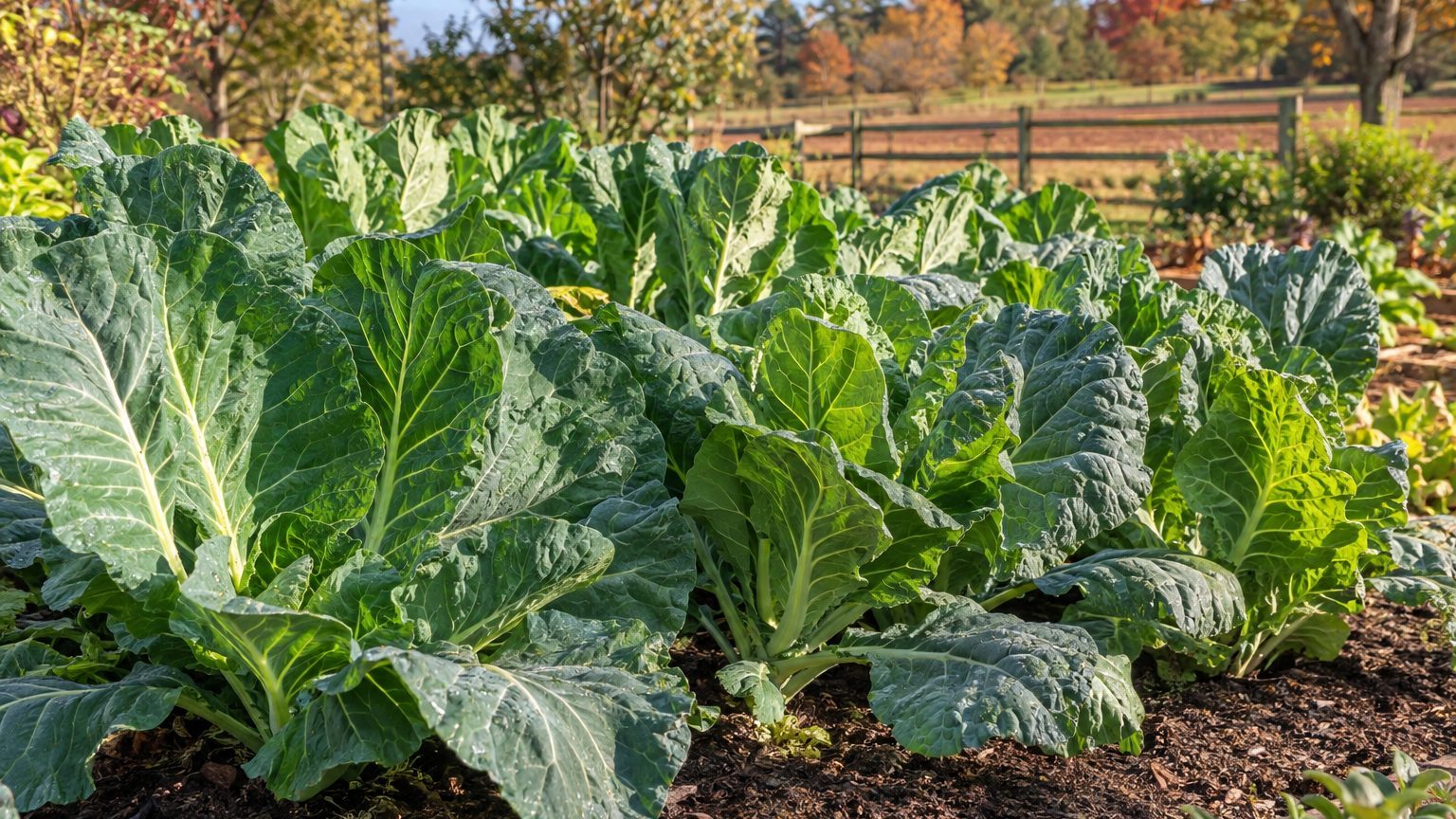

Plant a standard non-heading collard such as Georgia or Vates and you will be right across most of North Carolina. Both take frost well, shrug off heat, and keep producing for months. Heading types and fast early hybrids have their uses, but a season bracketed by a late-March to early-April spring freeze and an early-November fall freeze rewards dependable, open-pollinated workhorses.
The short answer for North Carolina
Choose by type before you choose by name. A non-heading, open-pollinated collard should be the main crop. A compact, bolt-tolerant selection fits small beds and containers. A smooth-leaved early type gives a quick spring cutting. Around Charlotte, a 32°F freeze has a 30 to 70 percent probability between March 23 and April 5 in spring, and again between October 30 and November 8 in fall (NOAA U.S. Climate Normals, 1991-2020). That is a probability band, not a deadline. A freeze inside those windows is close to a coin flip, and a freeze outside them still happens in some years.
Matching type to season
Collards grow best in cool weather and get sweeter after frost, which turns the fall crop into the main event. The coldest month here has a mean daily minimum of 31.8°F. That means winter nights hover right around freezing, so established plants in the Piedmont often keep their leaves through the cold months and can be picked on and off. The table lays out how the main types fit.
| Type | Best use | Watch for |
|---|---|---|
| Non-heading, open-pollinated (Georgia-style) | Main fall crop, long picking season, overwintering | Large plants that need room |
| Compact, bolt-tolerant (Vates-style) | Small beds, tighter rows, spring planting | Smaller leaves per plant |
| Smooth-leaf early types | Quick spring cutting, tender leaves | Heat and bolting once summer arrives |
| Cabbage-type or loose-heading | Gardeners who like a milder, tender leaf | Needs cool weather to form well |
Where the calendar fits
The stretch between the last spring freeze and the first fall freeze runs close to seven months at the short end, which is plenty for two plantings. A spring crop goes in as the freeze window closes. A fall crop is started in summer so plants are sizable when cool nights arrive. Exact sowing and transplanting dates are worked out in When to Plant Collards in North Carolina. Variety choice matters less than hitting those two windows.
What will not work here
Starting collards late in spring fails more often than anything else. A transplant set out in May has only weeks before summer heat arrives, and the plant reaches that heat small and stressed. Leaves turn tough and bitter, and the center sends up a flower stalk. Slow, long-season types suffer most, because they need the full cool stretch to fill out. If the spring crop is not in the ground shortly after the late-March to early-April freeze window, skip it and put the effort into fall.
Heading types in the wrong season
Cabbage-type collards and loose-heading selections form their best centers while nights are cool. Planted for a summer harvest, they mostly produce loose, leafy rosettes and little else. Gardeners who buy them for a tight head are usually disappointed unless the crop matures in October and November.
Humidity, crowding, and a false sense of mildness
Summers here are humid, and humid air plus close spacing is a bad pairing. Plants set under a foot apart keep their leaves wet for hours after rain or dew. That invites leaf spot and gives cabbage worms and loopers a sheltered place to feed unnoticed. Spacing of 18 to 24 inches for full-size types lets air move and lets you see the caterpillars. Compact types can go a little closer, but never shoulder to shoulder.
The 31.8°F figure can also mislead. It is an average of the daily lows in the coldest month, so many winter nights run colder than that. Mature collards take those nights easily. Small transplants set out late in fall, with only a few leaves and thin roots, often do not. A hard freeze can set them back or kill them, and a light row cover is cheap insurance for a late planting.
Last, weekly watering cannot cover for shallow roots in a hot spell. Collards need about an inch of water a week as a general rule, and more when the weather is hot and dry. A few inches of mulch keeps the soil cooler and steadier, which helps during the summer start of a fall crop.
What changes across North Carolina
The USDA Plant Hardiness Zone Map (2023 edition) spans zones 5b to 8b across the state. That is a wide spread, and there is no single answer for the whole state. The system is built on one number, the average annual extreme minimum temperature, so it says how cold the worst nights get. It does not say when spring warms up or how hot summer runs. The dates above come from Charlotte, which sits in the Piedmont. The Blue Ridge mountains to the west run several weeks later in spring, and the coastal plain runs earlier.
Readers in the mountains should shift in a few directions. Spring planting goes later, tied to when their own freezes taper off, not to Piedmont dates. Fall transplants should go in earlier in summer, so plants have size before hard cold arrives. The colder zones also make overwintering far less certain, so treat the crop as a fall harvest to enjoy in the cold, with mulch or row cover on hand. Compact, cold-hardy selections have an edge there. Our overview, Growing Collards in North Carolina, goes deeper on regional growing.
Along the coast and the eastern plain, the shift runs the other way. Spring starts earlier, winter harvests are routine, and the spring crop may bolt sooner as heat builds. Gardeners there can lean on non-heading types for steady winter picking and sow the fall crop a bit later without much risk.
Nobody should guess their own zone from a state average. The USDA map lets you search by ZIP code, and the result is more reliable than any statewide range.
Where to check this for your own county
The best next stop is NC State Extension, which runs a center in every county. Start by finding your county center and looking for two things. The first is a local vegetable planting calendar, which is more precise than a statewide window because it reflects your county’s frost patterns. The second is any information on varieties trialled nearby. Extension trials show which collards held up under local disease pressure, heat, and soil, so they are worth more than a seed catalog description.
County agents and Master Gardener volunteers are also worth a phone call or email. They know whether a given neighborhood has a frost pocket, whether cabbage worms have been unusually bad, and which planting dates have worked recently. Most centers also offer soil testing, which tells you whether lime or fertilizer is needed before you plant.
A county recommendation beats a state one, plain and simple. General guidance for the whole state, like the dates and types above, is the broad view. It gets you started in the right season with the right type. Your county’s calendar and trial results tighten that to the week and to the variety.
Checking this against your own garden
Your own yard outranks every date in print. Three things are worth watching, and none needs equipment.
- Soil warmth by feel. Push a hand a couple of inches into the bed in the morning. Soil that feels cold and clammy means spring transplants will sit still. Soil that feels comfortably cool and crumbles in your fingers is ready. A south-facing bed near a wall will warm up days ahead of a shaded corner, and that difference tells you where to start first.
- The first true leaves. On seedlings, the first pair of leaves are seed leaves. The next ones are true leaves. Transplants with several true leaves and a firm stem handle the move far better than spindly ones. If your seedlings take longer than expected to get there, your indoor spot is too dim or too cool.
- The first frost on your own ground. Notice which spots whiten first on a cold morning. Low corners collect cold air and freeze early. Raised or sheltered spots stay clear. That map of your yard tells you where fall plants will finish earliest and where late transplants will need cover.
Write down what you see for a season or two. A simple notebook of when the soil warmed, when seedlings were ready, and when the first frost hit your low spot will beat any regional table.
Common questions
Which collard variety is best for a first-time North Carolina gardener?
A non-heading, open-pollinated type such as Georgia or Vates is the safest bet. Both tolerate heat and frost, forgive uneven timing, and keep producing for months. Plant them for fall first, since that is when collards perform best here.
Can collards survive the winter in North Carolina?
In much of the Piedmont and the coastal plain, established plants often do, since the coldest month’s average low is 31.8°F. In the mountains, where the hardiness zone drops as low as 5b, winters are far harsher and survival is less certain. Mulch and row cover improve the odds anywhere.
Should I save my own collard seed?
Collards cross readily with kale, broccoli, cabbage, and other brassicas that flower nearby, so saved seed may not come true. Open-pollinated types can be saved if your garden is isolated from other flowering brassicas. Otherwise, buying fresh seed each year is simpler.
What other greens grow well alongside collards?
Kale handles cold much like collards. Mustard and turnip greens grow faster but bolt more quickly in warm weather, so they suit early spring and late fall. Planting a few of each stretches the harvest, and the same advice on spacing and timing applies to all of them.