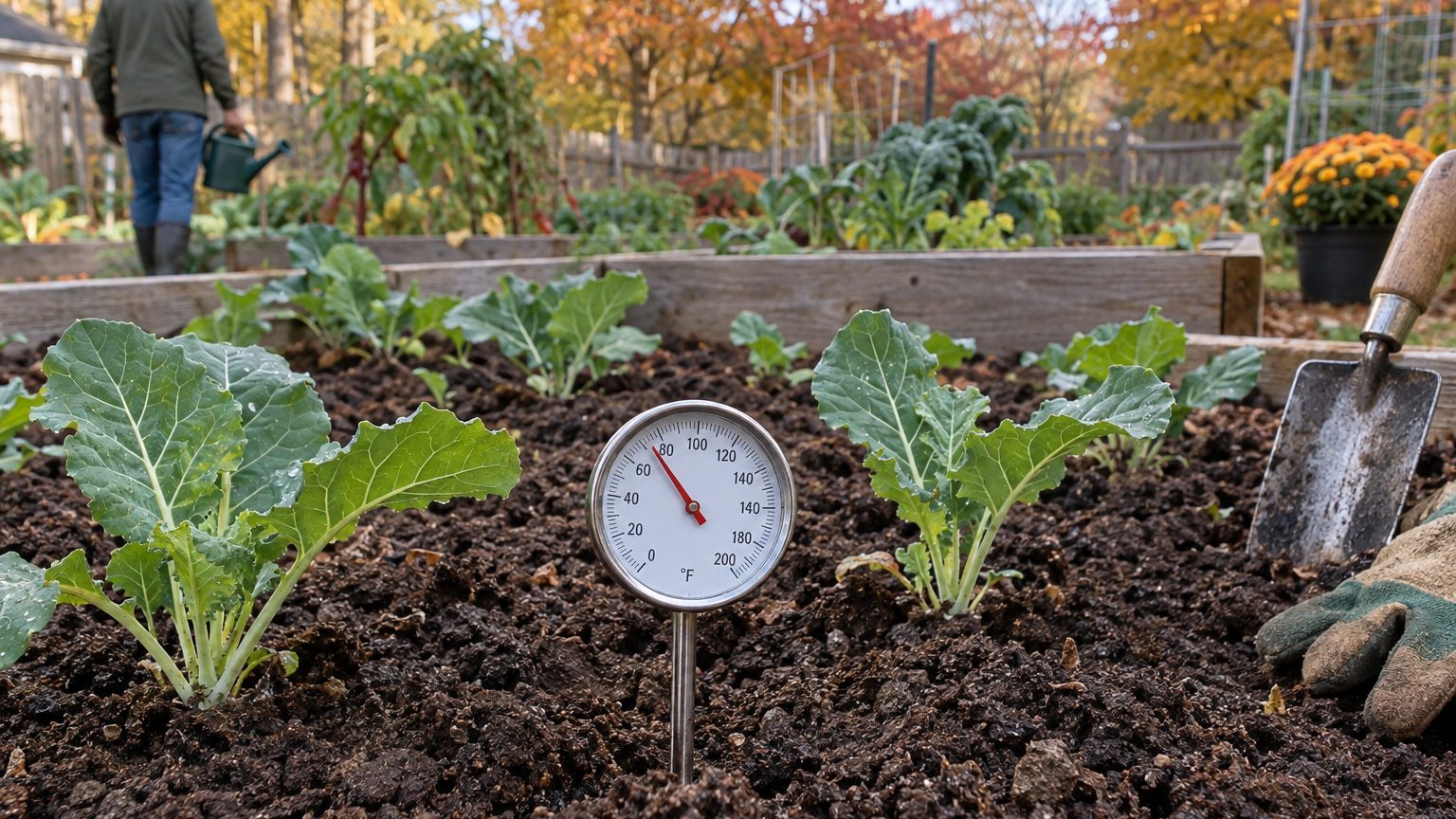

Collards go into North Carolina ground at two very different moments: a spring window that opens once the soil itself has warmed, and a summer sowing aimed at a fall-and-winter standing crop. Which one matters most here depends on where you garden, since the state runs from coastal plain to Blue Ridge peaks.
When the soil is warm enough in North Carolina

Frost dates get quoted as if they were a starting gun, but they’re a proxy for something slower: the ground shedding its winter chill. At the Charlotte reference station (USW00013881), NOAA’s 1991-2020 Climate Normals put the last spring freeze at 32°F somewhere in the March 23 to April 5 window, using the 30-70% probability band. That’s a range built from thirty years of history, not a date you can circle and trust in any single year.
The soil lags behind the air. A morning that clears the freeze risk doesn’t mean the top few inches of a garden bed have warmed enough for collard seed to germinate evenly or for transplants to push new roots instead of sitting still. Gardeners who sow the week the frost date passes are often sowing into cold, slow ground. Waiting for a run of mild, sunny days after that window, rather than the calendar date itself, is what actually gets seedlings moving.
Piedmont, coast, and mountains don’t share a calendar
The Charlotte numbers describe the Piedmont. North Carolina’s coastal plain typically clears frost risk earlier than that band, while the Blue Ridge counties to the west can run several weeks behind it. A planting date that works in Charlotte can be too early for Boone and too late for Wilmington. Anyone gardening outside the immediate Piedmont should treat the March 23 to April 5 window as a reference point to adjust from, not a fixed target.
Bed choice matters before the seed does
Collards are brassicas, in the same family as cabbage, kale, mustard, and turnip. A bed that grew any of those crops last season carries the same soil-borne troubles collards are prone to, so putting collards there again isn’t a rotation, it’s a repeat. Choosing a bed that skipped the brassica family for at least a couple of seasons is worth doing before worrying about the exact sowing week.
For the actual choice of collard type suited to a short or long window, and for varieties trialled in North Carolina specifically, the state’s extension service keeps that information current: North Carolina Cooperative Extension. This page sticks to timing and mechanism, since a variety name invented here would be worse than no name at all.
How long the season lasts here
Run the two Charlotte frost windows against each other and the growing season stretches from the March 23 to April 5 spring window out to the first fall freeze, dated at October 30 to November 8 by the same NOAA Climate Normals dataset. That’s roughly seven months between the two 30-70% probability bands, though the true frost-free stretch for any given year lands somewhere inside those windows rather than at their outer edges.
Seven months is generous by collard standards. A spring-sown crop can mature, get harvested through early summer, and leave enough calendar behind it for a second sowing timed to mature through fall and into the mild-winter months. That second sowing is where most of the crop’s real value sits in this state, since a fall-sown bed of collards can be picked leaf by leaf for months rather than cut once. Anyone planning that second round should work from a proper succession sowing guide rather than guessing at spacing between sowings.
What a short mountain season changes
In the Blue Ridge counties, where spring frost risk clears weeks later than the Charlotte date and fall freeze can arrive earlier too, that seven-month window shrinks. A shortened season makes the first sowing the one that has to count, since there may not be enough calendar left afterward for a second round to mature before hard frost ends outdoor growth. It also changes whether transplants are worth the trouble: with less slack in the calendar, a transplant that needs its roots checked and straightened before going in the ground buys valuable weeks that direct-seeding can’t.
The October 30 to November 8 fall freeze date is the number worth writing down for planning backward from, whether the goal is one harvest or two, because it marks the point past which a standing crop stops adding new growth even in a mild winter.
Heat and water in North Carolina

Summer in the Piedmont and coastal plain runs hot and humid enough that collards planted too early into it tend to bolt or struggle rather than thrive, which is exactly why the fall sowing carries more weight here than the spring one. Humidity, more than heat alone, is what pushes fungal disease into a collard bed during a wet stretch: a garden that stays damp under thick leaf cover for days at a time is set up for the same mildew and leaf spot problems that hit any brassica crop in similar conditions.
What decides whether collards behave as a standing winter crop or an autumn-only one isn’t the summer at all. It’s the coldest month. Charlotte’s Climate Normals put the mean daily minimum of the coldest month at 31.8°F, a temperature that sits right at the edge of what collards tolerate without real damage. That figure, not the average for the month and not a record low, is the one that decides the plant’s fate through winter.
Standing crop or autumn crop: the winter low decides
Where the coldest month’s mean minimum stays close to or above freezing, as it does in much of the Piedmont and coastal plain, collards behave as a standing crop: sown for fall, picked leaf by leaf from November into March, with cold weather actually sweetening the flavor rather than ending the harvest. Further west and at elevation, where winter minimums run colder than that 31.8°F figure, the same planting becomes an autumn crop instead, one that produces its harvest before the hard freeze and doesn’t reliably survive past it.
That distinction should shape how a bed gets planned, not the summer heat. A gardener expecting months of picking needs to know which category their own microclimate falls into before committing bed space, since the two scenarios call for different sowing dates and different expectations about how long the crop will keep giving.
Which collards suit North Carolina
North Carolina’s range, USDA hardiness zones 5b through 8b on the 2023 Plant Hardiness Zone Map (built on 1991-2020 normals), covers enough climate variation that no single collard type fits the whole state. A short mountain season favors the earliest-maturing types, since there’s less calendar to spare before fall freeze. A hot, humid Piedmont or coastal summer favors types known for holding up under heat, and rewards giving plants airflow between rows and some shade at the root zone during the worst stretches. A humid climate generally, regardless of temperature, makes disease resistance the first thing worth checking before anything else, since mildew and leaf spot don’t wait for a specific zone number.
What this page won’t do is name a cultivar. Naming a specific collard variety without knowing which North Carolina county a reader gardens in, and without current local trial data, is the fastest way to hand out bad advice dressed up as a recommendation. Hardiness zone alone doesn’t capture humidity, soil type, or how a particular season ran hot or cold against the ten-year average.
Where the real answer lives
North Carolina State’s Cooperative Extension runs collard variety trials and adjusts recommendations to match what’s actually performing well in the state’s counties that year, through NC State Extension. That’s the source with the standing to name a type by name, because it’s testing plants against this year’s actual weather rather than a thirty-year average.
Anyone deciding between an early type for a short mountain season and a disease-resistant type for a humid coastal one should call or check with their county extension office before buying seed, since the varieties trialled locally change from year to year in ways a general guide can’t track.