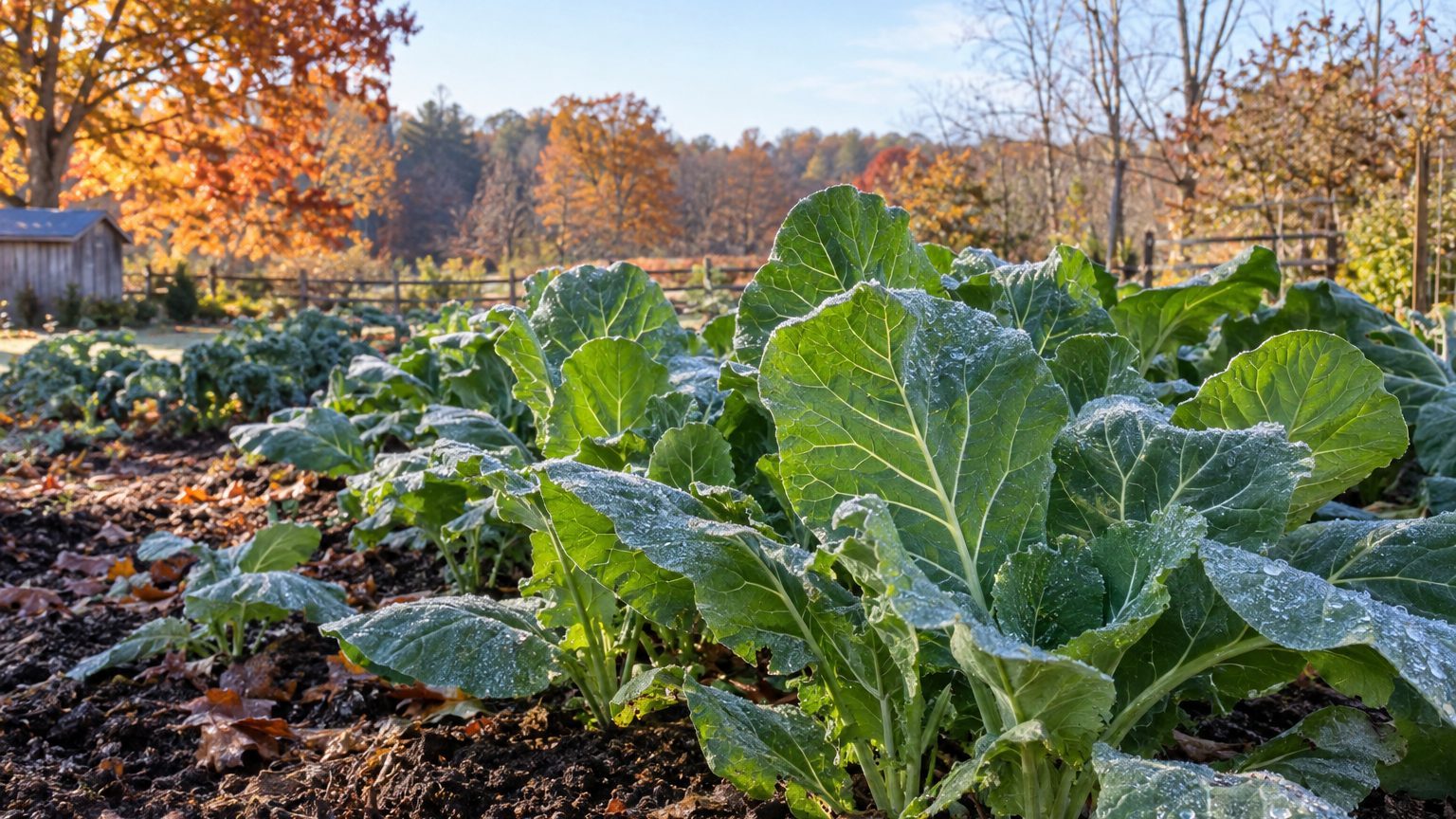

Collards go in the ground twice a year in North Carolina: transplants in late winter to early spring, and a second planting started in midsummer to mature in the cool of fall. Charlotte’s last spring freeze falls between March 23 and April 5, and its first fall freeze between October 30 and November 8. Those two windows frame the calendar, though the mountains and the coast move them.
The short answer for North Carolina
Those dates are odds, not promises. They come from NOAA’s 1991-2020 U.S. Climate Normals for Charlotte, and each one marks the band where the probability of a 32°F freeze runs from 30 to 70 percent. In any single year the final spring freeze can land before March 23 or after April 5, and the same goes for the fall.
Collards are among the hardiest vegetables in the garden, so the last-frost date is a reference point, not a starting gun. Spring transplants can go in a few weeks ahead of that window, with a sheet or row cover ready for the occasional hard night. Seed started indoors in late winter will give sturdy transplants right on time. The goal is a crop well along before summer heat arrives, because heat is what ends the spring season, not cold.
The fall planting does the heavy lifting
Many Southern gardeners count the fall crop as the real one. Starting seed or setting transplants from July into August gives plants weeks to establish before the first fall freeze arrives in the October 30 to November 8 window. A collard picked after frost tastes milder and sweeter than one picked in September.
Winter is gentle enough to let the plants keep working. The mean daily minimum in the coldest month at the Charlotte reference station is 31.8°F, which means typical January nights hover right around freezing. That average is not the record low, and a freak cold snap well below it can burn leaf edges. Still, a healthy fall planting often keeps producing leaves through much of the winter in the Piedmont and farther east.
For a plant-by-plant walk through soil, spacing and feeding, see Growing Collards in North Carolina. Variety choice affects timing too, since some types stand heat and cold longer than others. The Best Collards and Greens for North Carolina sorts them out.
What will not work here
Waiting for April is the classic mistake. A gardener who holds off until the last freeze is behind has already given up weeks of cool weather, and collards set out in mid-April face summer heat before the plants have built much leaf. Heat in the Southeast arrives early and stays long, and stressed plants turn bitter, tough and prone to bolting.
Planting the fall crop too early fails for a different reason. Seed sown in the hottest stretch of July dries out fast, and seedlings cooked by afternoon sun need shade cloth and daily watering to survive. Gardeners who water once a week, as they might in spring, lose those stands. Planting too late is the opposite error: with the first freeze arriving as late as early November, plants set out in October still look small when the days shorten and growth slows to a crawl.
Humidity punishes tight spacing. Summers across the state are muggy, and crowded collards stay wet after every storm or heavy dew. Leaf spot and other fungal problems move through packed rows quickly, and cabbage worms hide in the dense foliage until the leaves are lace. Giving each plant generous room, and harvesting lower leaves so air moves through, matters more here than in a dry climate.
Expecting a spring planting to last through the summer is another common letdown. Spring collards can hang on into July, but they often turn bitter, bolt, and attract worms and aphids. Treat them as a spring crop, pull them when they decline, and replant for fall.
Finally, the winter average is no guarantee. A mean minimum just under freezing is easy on collards, but a hard freeze can damage even mature plants, especially young transplants that have not hardened off. Keep a frost cloth within reach in late fall and late winter.
What changes across North Carolina
The state does not have one planting date. The USDA Plant Hardiness Zone Map (2023 edition, built on 1991-2020 normals) runs from 5b to 8b across North Carolina. Zone 5b describes the coldest high mountain terrain, and 8b the warmest coastal strips. The zone rating rests on one number, the average annual extreme minimum temperature, so it says nothing about frost dates or summer heat.
The frost windows above belong to Charlotte, which sits in the Piedmont. Nearby gardens are close to them, but regions farther west or east are not. The Blue Ridge runs several weeks later in spring, while the coastal plain runs earlier.
| Region | Spring planting | Fall planting |
|---|---|---|
| Blue Ridge and high mountains | Several weeks later than the Piedmont | Start earlier, because fall freezes come sooner at elevation |
| Piedmont (Charlotte reference) | Around the March 23 to April 5 window, or a few weeks ahead | Midsummer into August, ahead of October 30 to November 8 |
| Coastal plain | Earlier than the Piedmont | Later start is workable; winter harvest runs longer |
A reader in the mountains should move spring planting later by weeks and the fall sowing earlier, since the growing season is shorter at both ends. Someone on the coast can plant sooner in spring and has more room to stretch a fall crop deep into winter.
The USDA Plant Hardiness Zone Map lets any reader look up their own zone by ZIP code. It is better to check it than to assume, since zones can change within a few miles in hilly country.
Where to check this for your own county
A statewide window like this one is a starting point. Your county’s recommendation beats a state one, because it accounts for local frost patterns, elevation and soil. NC State Extension runs an office in every county, and its staff and Master Gardener volunteers answer exactly these questions.
Two items are worth finding there. The first is the local planting calendar, which gives vegetable dates tied to your area instead of the whole state. The second is the list of varieties trialed in your county, since a collard that performs well on the coast is not guaranteed to do as well in a cold mountain valley.
If the website does not spell out collard timing for your county, call or visit the county office. Ask when local growers set out spring transplants, when the fall crop typically goes in, and which varieties have held up through recent summers. Extension staff watch local conditions year after year, and that experience is hard to get from any chart.
Checking this against your own garden
Your own observations outrank every date above. A garden on a south-facing slope, a low spot where cold air pools, and a bed against a brick wall can differ by weeks within one yard. Three things are worth watching.
- Soil warmth by feel. Push a hand into the bed in the morning. If the soil feels cold and sticks in clumps, wait for seed. If it crumbles and feels cool but not chilly, it is ready, and a bed that reaches that point first marks your warmest microclimate.
- The first true leaves. Seedlings open their first leaves before the true collard leaves appear. When those appear, a seedling can be hardened off and set out, so the date tells you whether your starts are running ahead of or behind the calendar.
- Frost on the grass. Check the lawn and the beds on the first frosty mornings. White frost that lingers in one corner, while the rest of the yard stays clear, shows you where the cold settles and where fall plantings should go.
Jot down these dates each year. Over time, they tell you more about your garden than any county map.
The Moon calendar is a separate, older custom: see when to plant collard greens by the moon, written as tradition rather than fact.
Common questions
Can I plant collards in North Carolina in winter?
In much of the Piedmont and farther east, a fall planting often keeps growing and producing through winter. In the mountains, hard freezes are more frequent and protection such as row cover helps. Sowing seed outdoors in midwinter is slow, so most gardeners start transplants indoors instead.
What is the last spring frost date in Charlotte?
Between March 23 and April 5, based on NOAA’s 1991-2020 normals. That window marks where the chance of a 32°F freeze runs from 30 to 70 percent, so a freeze after April 5 is possible. Mountain gardens run several weeks later, and coastal ones earlier.
When should I plant collards for fall?
Start seed or set transplants in midsummer, July into August, so plants are established before the first freeze, which at Charlotte falls between October 30 and November 8. Mountain gardeners should start earlier because fall freezes come sooner there.
Why do my spring collards turn bitter?
Heat stress is the usual cause. Collards planted too late reach summer before they have grown much, and the leaves turn tough and bitter. Planting earlier in spring, giving plants room, and watering through dry spells all help.