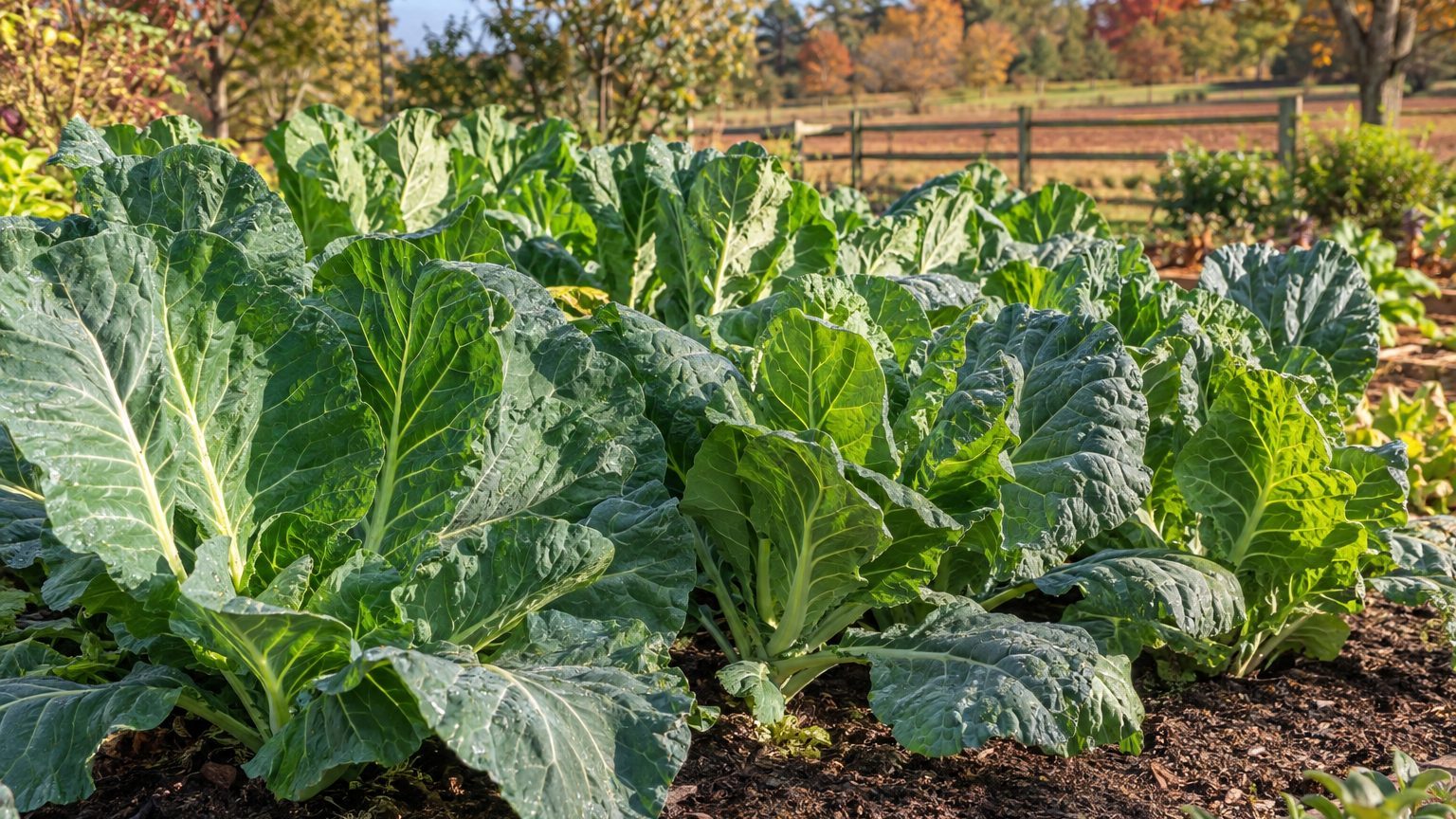

Early, compact, cold-hardy collards started indoors are the best bet in Northwest Territories, with kale as the safety net. The frost-free stretch around Yellowknife is short, and winter is far too harsh for any collard to survive in the ground. Variety matters less here than speed and cold tolerance. The right plant matures quickly, takes a late frost in stride, and stays small enough to shelter.
The short answer for Northwest Territories
Choose a compact, cold-hardy open-pollinated collard such as Vates, start it indoors, and transplant it once the worst frosts have passed. Grow kale alongside it, because kale outlasts every collard in cold weather.
The reasoning starts with the calendar. At the Yellowknife A station, the last spring frost falls on average on May 25 and the first fall frost on average on September 18. That leaves about 116 days between the two dates. Both are midpoints, not guarantees. In one year out of two the last frost arrives later than May 25, and the first frost averages September 18. The window in any given summer can be noticeably shorter than 116 days.
Collards are transplanted, so the “days to maturity” on a seed packet counts from the day the seedling goes into the garden. Read that number first and pick among the shortest. A plant that needs most of 116 days to size up leaves no margin for a cold June or an early September freeze. Leaves can be picked from the bottom as the plant grows, so a fast variety starts feeding you well before it reaches full size.
| Type | Fit for a short, cold season | How to use it |
|---|---|---|
| Compact, cold-hardy collards (Vates, for example) | Best collard choice | Start indoors, transplant after frost danger, harvest outer leaves |
| Large Southern strains (Georgia types, for example) | Poor | Bred for long seasons; expect small leaves at best before freeze-up |
| Kale (Siberian, Red Russian) | Excellent | Hardier than collards; plant beside them as insurance |
| Mustard and turnip greens | Good | Quick crops that fill gaps and can be sown in succession |
Summer daylight works in your favor. Around the solstice, Yellowknife gets very long days, which push leaf growth hard once the soil has warmed. The sowing dates that follow from the frost window are laid out in When to Plant Collards in Northwest Territories.
What will not work here
Direct-seeding collards in the garden is the first thing to drop. Soil that has just thawed stays cold for a while, and a seed sown around May 25 spends weeks getting to the size an indoor-raised transplant already has on planting day. With roughly 116 days between mean frost dates, those lost weeks are the harvest.
Big, slow Southern collards fail for the same reason. Strains bred for long seasons spend the best part of a short summer building a tall plant, then meet a September freeze before the leaves have size. You can still eat them as baby greens, but that is a poor return for a bed’s worth of space.
Overwintering is out entirely. The mean daily minimum of the coldest month at Yellowknife is -29.5 °C (-21.1 °F, for readers comparing with American charts). That is far below what a collard stem and crown tolerate, and a mulch pile will not change it. Gardeners in milder places carry collards through winter, but here they are a one-season crop, and so is everything else in this group.
Planting out on May 25 on faith is another mistake. Because that date is a mean, a frost after it is as likely as not. Collard seedlings handle a light frost better than most garden transplants, but a hard overnight freeze on tender, just-hardened plants can set them back or kill them. Keep a row cover or a few upturned buckets ready for the first two weeks, and hold a spare tray of seedlings back for replacements.
The last trap is waiting for frost to sweeten the leaves. By then the cold is ending the season, not adding a bonus month. Harvest steadily from midsummer and treat any post-frost picking as a late extra.
What changes across Northwest Territories
Northwest Territories is not one garden. It runs from the Alberta border to the Arctic coast, and the climate shifts a long way over that distance. Yellowknife, the reference city, sits in Canadian hardiness zone 1b (1991-2020 normals from Natural Resources Canada). That is the Canadian system, built on seven climate variables, and it does not convert to a USDA zone. There is no single answer for the whole territory, and a grower in the south Mackenzie Valley and one near the Arctic coast are working with different seasons.
The frost dates come from the Yellowknife A station and cover 1981-2010. The US figures on this site cover 1991-2020, so a direct comparison is rough. Northern and upland districts run weeks behind Yellowknife, which means the 116-day window shrinks the farther north or higher you go.
A reader in the north should shift three things. Lean harder on kale and quick mustard or turnip greens, and treat collards as the experiment rather than the staple. Choose the smallest, fastest collard on offer. Protect more: low tunnels, row cover, a south-facing bed against a wall, or large containers that can be moved indoors on a cold night. Growers closer to the southern border can plant collards earlier and expect more from them, though the same variety rules apply.
To see where your own community sits, check Natural Resources Canada’s Plant Hardiness Site and look up your municipality instead of assuming Yellowknife’s numbers apply. The full growing approach, from soil to harvest, is covered in Growing Collards in Northwest Territories.
Where to check this for your own county
Northwest Territories has no county system, so the closest local source is the territorial government’s agriculture program, run through Northwest Territories Industry, Tourism and Investment. Contact them for what they hold on your region and ask two things.
- A planting calendar for your community or the nearest one with comparable conditions, including typical transplant dates.
- Which collard, kale and other brassica varieties have been grown successfully near you, and which failed.
A recommendation from someone growing in your region outranks a territory-wide one, because frost timing and wind exposure can differ a lot between communities. Everything above is the territory-wide view. It is a sound starting point for choosing types and setting expectations, but a local grower’s record of what actually survived a June frost is worth more than any average. Community gardens and greenhouse groups are often the best source of that kind of detail.
Checking this against your own garden
Your own observations outrank every date here, and three are easy to track without any equipment.
Soil warmth by feel. Push a bare hand into the bed a few inches down in the morning. If it still feels cold enough to ache, the soil is not ready for transplants. Note which beds warm first. A raised bed against a south wall can be ahead of open ground, and that tells you where to put collards.
The first male flowers on local trees. Birch, aspen and willow catkins open when spring has truly arrived in your spot. Write down the date each year. After two or three seasons it becomes a local marker that tracks your own microclimate better than a regional average.
The first true leaves on your seedlings. Collard seedlings first show seed leaves, then the true leaves with their familiar shape. If the true leaves are slow or the seedlings stretch and go pale, your indoor spot is too dark or too cool. Move the tray to a brighter, warmer window before the transplant date, not after.
Common questions
Can collards survive winter in Northwest Territories?
No. The coldest month at Yellowknife averages a daily minimum of -29.5 °C, well below what collards tolerate. Grow them as an annual and start fresh each spring.
Is kale a better choice than collards?
For reliability, yes. Kale handles cold better in most cases. Collards are still worth a bed if you want their leaf, but plant kale next to them.
Should I buy transplants or start seed indoors?
Either works. Starting seed indoors before transplanting gives you control over variety, and you can pick fast ones. Local transplants save time but may not be a short-season type, so check the variety name.
How do I know it is safe to transplant?
The mean last frost is May 25, so frost after that date is as likely as not. Watch the forecast, harden seedlings for several days, and keep cover on hand for the first two weeks.