
Sweet potatoes can be grown in North Dakota, but the crop is a short-season project, not a routine one. Fargo’s last spring freeze falls between May 4 and May 15, the first fall freeze between September 25 and October 5, and summers bring only 11.7 days at 90°F or higher. Plant late, warm the soil with plastic, choose an early type, and dig before the first hard freeze.
When the soil is warm enough in North Dakota

The date most gardeners want is the one when slips can go outside. At the Fargo reference station, NOAA’s 1991-2020 Climate Normals put the last spring freeze (32°F) between May 4 and May 15, the band where the chance of a freeze sits between 30 and 70 percent. That is a probability, not a promise. Some springs the final freeze arrives earlier, some years it comes later, and a gardener has to be ready for both.
Frost is a proxy, soil is the test
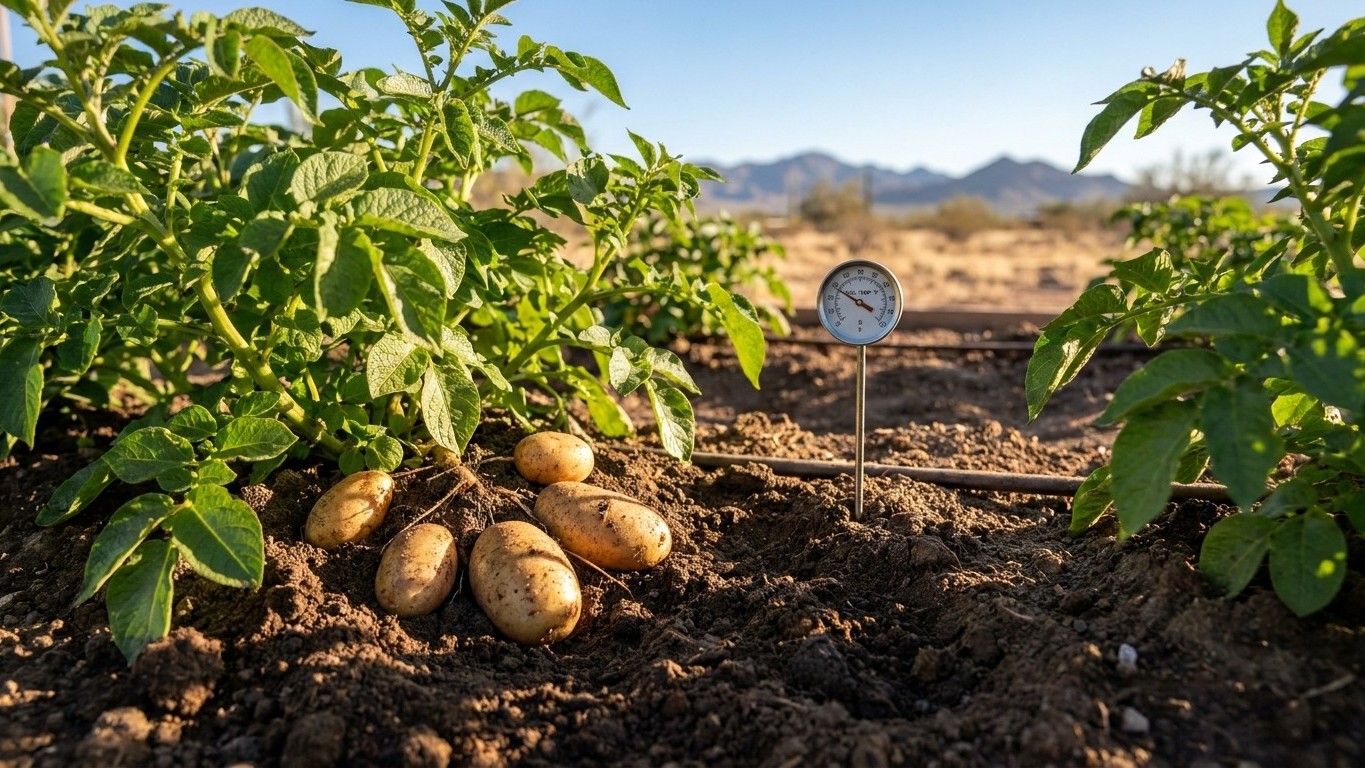
Even if the date holds, it is the wrong thing to plant by. Sweet potatoes are tropical in origin and they wait for warm soil, which heats up after the freeze risk ends, not at the same moment. Cold, wet ground stalls a slip, and a stalled slip in saturated soil is a candidate for rot. The practical test is a soil thermometer pushed a few inches deep each morning. Plant when the readings hold steady and climb for several days running, and when nights have stopped dropping back toward freezing. North Dakota State University Extension can give the soil temperature it recommends for transplanting.
Black plastic laid over the bed ahead of planting speeds this up. It warms the top layer of soil and, just as usefully, holds some of that warmth through the night, which is when northern beds lose it. Gardeners who skip it often find their slips sitting still through the first weeks of June.
Your garden is not the airport
Those dates come from the airport weather station in Fargo. Suburban and rural gardens typically see the last spring frost one to two weeks later than the reference city, and the first fall frost one to two weeks earlier, with more of a gap at elevation. Check your own county’s pattern before you mark a calendar. The USDA Plant Hardiness Zone Map (2023) places the state at 3a to 4b, but that system rests on winter minimum temperatures alone. It says almost nothing about whether July is warm enough for a tropical root, so it matters less here than the frost and soil readings.
One more thing worth settling early: a sweet potato is not a potato, and the “yam” on a supermarket label is wrong. It is a relative of morning glory, not a nightshade, so it does not share a rotation with potatoes, tomatoes or peppers. Treat it as its own crop in the bed plan.
How long the season lasts here
Subtracting the Fargo reference dates gives the window between the last spring freeze and the first fall freeze. The shortest case runs from May 15 to September 25, which is 133 days. The longest runs from May 4 to October 5, which is 154 days.
| Case | Last spring freeze | First fall freeze | Days between |
|---|---|---|---|
| Shortest | May 15 | September 25 | 133 |
| Longest | May 4 | October 5 | 154 |
Those are generous numbers for a garden outside the city. Take a week or two off each end for a rural plot, then take off the weeks it takes the soil to warm after the freeze risk ends. What is left is the real growing time for a root that cannot be planted on the frost date and cannot stay out past a hard freeze.
What does a window that size allow? One planting. A long season in the South leaves room for a second round after the first is dug, and the succession sowing guide on this site shows how that logic works for quick crops. For sweet potatoes in North Dakota the first planting is the only planting. A failed one cannot be redone in July with any hope of a harvest.
That changes how much care a slip deserves on planting day. Sweet potatoes are started from slips, which are rooted sprouts, not seed, and a slip that sulks after transplanting can eat the weeks you do not have. Inspect each one before it goes in: sturdy stem, healthy leaves, and a few roots already forming or ready to form once it touches moist soil. Set them out in the evening or under cloud, water them in, and shelter them from wind on the first days. A slip that arrives wilted from a long trip is worth reviving in water for a short while before planting.
The other end of the window matters just as much. Dig before the first hard freeze, not after, and handle the roots gently, because skin damage invites rot later. The Growing Sweet Potatoes: Slips, Heat, and a Careful Cure guide covers the slip and harvest sequence in more detail.
Heat and water in North Dakota

Sweet potatoes want accumulated warmth, and warm nights count as much as warm days. Fargo, the reference station for the normals, averages 11.7 days a year at 90°F or higher. That is a small number. In a territory with many such days the crop is routine, as in the hot-summer conditions described in Growing Sweet Potatoes in California. Where they are scarce, it becomes a project of plastic, ridges and an early type. North Dakota sits in the second group, and it is not the hot-climate case; the gardener supplies the warmth the summer does not.
Gardeners in other cool-summer territories use the same toolkit, as in Growing Sweet Potatoes in Washington. Raised ridges drain faster and warm sooner than flat ground. Plastic holds heat at the root. Pulling it back or mulching over it during a rare hot spell keeps roots from baking, though with so few 90°F days that is the lesser worry.
A cool, damp stretch brings the opposite set of troubles: mildew on foliage, slow ripening, and rot in the soil. These are the failures to plan against. Give plants room so air moves through the vines, keep leaves from staying wet into the evening, and buy slips from a source that certifies them disease-free instead of saving your own.
Summer rainfall at the Fargo station totals about 10.0 inches across June, July and August, out of 23.9 inches for the year. June brings 4.29 inches, July 3.07, and August, the driest month, 2.6. The pattern lines up awkwardly with the crop. Early summer is wettest, when young plants are establishing and cold, soggy soil is the risk. Late summer is driest, when roots are swelling and need steady moisture.
That matters because roots swell evenly on a consistent supply of water and tend to split when a long dry spell ends in a soaking. A gardener who waters deeply and regularly through August avoids most of the trouble. How often depends on the soil: rain soaks through sand within the day, while clay holds it for a week. Summer storms that dump rain fast also tend to run off hard, dry ground instead of soaking in. These are 1991-2020 normals for the reference station, not a forecast for your plot. A rain gauge in your own bed will tell you what the roots are really getting.
Which sweet potatoes suit North Dakota
A short season favors the earliest-maturing types, so that is the first filter. A compact or short-vined habit is the second: it puts the plant’s energy into roots near the crown and suits ridges and plastic better than a sprawling vine. A cool, damp stretch makes disease resistance the next criterion, so favor slips sold as certified disease-free, then check the grower’s description for tolerance of soil rots.
The only recommendation that means anything for a northern garden is a variety that has been trialled locally, and those trial results sit with North Dakota State University Extension and your county office. A name that thrives in a hotter state can fail in Fargo, and any list copied from elsewhere is a guess. Ask the county office which early types have performed in your part of the state, and where slips are sold.
After the dig, the roots still need work. Curing means holding them somewhere warm and humid for a stretch so the skin toughens and small wounds heal; the Growing Sweet Potatoes: Slips, Heat, and a Careful Cure guide walks through the process. Then store them in a cool, dark place, such as an interior closet.
Never store sweet potatoes in a refrigerator or a cold cellar. Cold injury below their storage range is a common way a good harvest is ruined at home. Inspect the roots regularly. A soft patch or a weeping spot ends the question: that root is not worth eating, and it should not sit beside the others. A sound-looking skin is not proof that a root is safe.
Common questions
Can sweet potatoes survive a North Dakota winter in the ground?
No. They are tender and cold soil damages them, so treat them as an annual even though the hardiness zone (3a-4b on the USDA system) says little about summer. Dig the roots before the first hard freeze, then cure and store them indoors.
Can I plant slips on the last frost date?
Rarely. The Fargo window of May 4 to May 15 marks only when freeze risk fades, and rural gardens often see it later. Soil warms after that, so wait for steady readings at planting depth and for warm nights.
Is black plastic worth the trouble?
In a territory with few days at or above 90°F, yes. It warms the soil ahead of planting and holds heat overnight. Pull it back or mulch over it if a hot spell arrives.
Can I keep the harvest in a cold cellar?
No. Chilled roots can look fine until they break down later. Keep cured roots at ordinary indoor temperatures and throw out any root that turns soft or weeps.