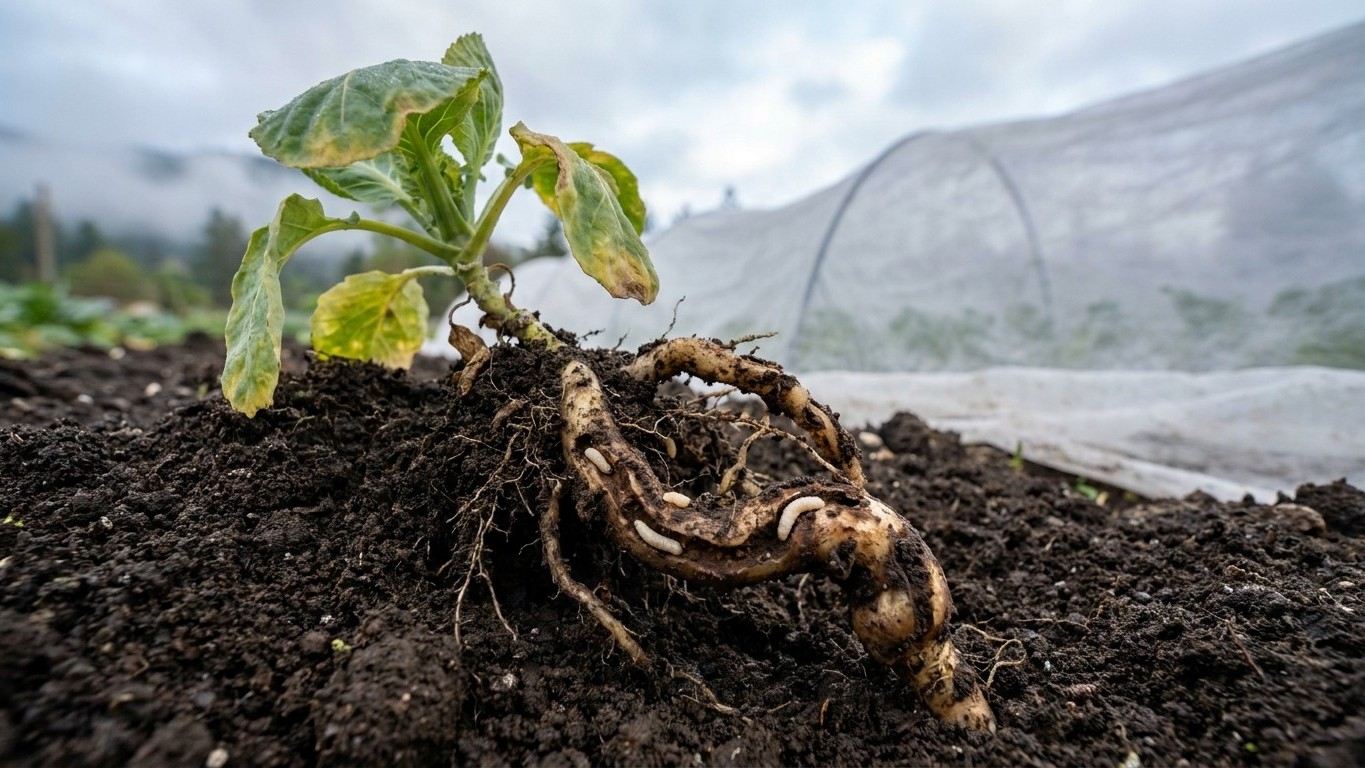

Sweet potatoes can be grown in Nova Scotia, but the calendar is tight and the planting date comes from the soil, not from the frost date. Slips go out once the ground has warmed, usually well into June. Most gardeners lean on black plastic, raised ridges and an early type to make up for cool maritime summers. Halifax has a frost-free stretch long enough on paper. What you do with it decides the harvest.
When the soil is warm enough in Nova Scotia

The last spring frost at Halifax Stanfield Int’l A falls on average on May 7, according to Environment and Climate Change Canada’s Canadian Climate Normals for 1981-2010. That is a mean date, the midpoint of a window. In one year out of two, the last frost comes later than May 7, and a cold snap in the third week of May is an ordinary event, not a freak one.
Treat that date as a proxy and nothing more. Sweet potatoes do not wait for the frost to end. They wait for warm soil, and soil warms after the frost risk has passed, sometimes by weeks. The Atlantic keeps the ground cold well into spring, which is why slips usually go out in June, even though the frost date says early May. Northern and upland districts run weeks behind the Halifax airport station, so a garden in the Cape Breton Highlands faces a later start than one near the Annapolis Valley or the South Shore.
Reading the soil instead of the calendar
A soil thermometer set a few inches down tells you more than any almanac. You want soil that holds its warmth through the night, not one that peaks in the afternoon and drops by dawn. Slips set into cold ground sit and sulk, and some never recover. Growth stalls for weeks, and the plant reaches September without the time it needed to bulk up roots. Your provincial agriculture department can tell you the soil temperature it considers safe for transplanting.
Black plastic laid on the bed two weeks or so ahead of planting warms the soil faster than bare ground. A low tunnel of row cover over the first couple of weeks buys a few more degrees on cold nights. Harden the slips off for several days before they go out, the way you would tomato seedlings, so the first sunny afternoon does not scorch them.
A different plant than the potato
A sweet potato is not a potato, and it is not a yam, whatever the supermarket label says. It belongs to the morning glory family, not the nightshades, so the rotation rules that apply to potatoes, tomatoes and peppers do not apply to it. It also does not share the potato’s tolerance for cool soil. Potatoes go in early, while the ground is still cold. Sweet potatoes go in last, after the tomatoes, once the soil has truly turned.
For reference, Natural Resources Canada places Halifax in Canadian plant hardiness zone 6b. That system does not convert to a USDA zone, and it describes winter survival of perennials, which matters little for an annual crop. Frost-free days and summer warmth are the numbers that count here.
How long the season lasts here
Between the mean last spring frost on May 7 and the mean first fall frost on October 18, both at Halifax Stanfield Int’l A, the frost-free window is at its midpoint. That is generous for the Maritimes, but it is the gap between two midpoints, not the growing window for sweet potatoes. The first frost arrives earlier than October 18 in one year out of two, and the sweet potato’s own clock starts weeks after May 7, when the soil warms.
Take away the weeks spent waiting on the ground in spring, and leave a margin in the fall for harvesting before a hard frost, and the usable season is much shorter than 164 days. Nova Scotia’s window comfortably allows one planting of slips, not two. A second batch set out in July would start roots in cooling nights and meet the frost with little to show for it.
That shapes how you treat the slips. With a short window, you cannot spare a week lost to a poor transplant. Root the slips in a jar of water until short white roots appear along the stem, and only then set them out. A slip that already has roots recovers from transplanting in days instead of weeks. Spare slips can serve as insurance for ones that fail, or as an early batch of greens, since the young leaves are edible. For the full method of growing slips from start to finish, see Growing Sweet Potatoes: Slips, Heat, and a Careful Cure.
The end of the season matters as much as the start. Frost blackens the vines, and cold, wet soil can injure the roots underneath, so watch the forecast in early October and harvest before a hard frost where you can. Dig gently, because the skin bruises at a touch. Cure the roots somewhere warm and humid before storing them. Never put sweet potatoes in the refrigerator or in a cold cellar, since cold injury is irreversible and is the most common way a good home crop is ruined after harvest. Keep them at room temperature in a dry spot and check them often. A soft patch or a weeping spot ends the question for that root, and a root that has gone bad should not be eaten.
Heat and water in Nova Scotia

Halifax Stanfield International A averages 0.6 days a year reaching 32 °C, and 2.8 days a year above 30 °C (Environment and Climate Change Canada normals, 1981-2010). Those numbers say plainly that Nova Scotia is not a place of scorching summers. They count extreme days at one airport station, though, and do not measure the growing season. What a sweet potato needs is accumulated warmth over a long enough season, and warm nights, not a few hot afternoons.
That makes the crop a project more than a routine. The Atlantic moderates the heat, so nights cool quickly and the soil gives back what it gained during the day. Growers in the region work around this with black plastic to hold soil warmth, ridges of loose soil that heat faster than flat ground, and a type bred to size up early. Each adds a bit of warmth or time, and together they can be enough. Gardeners in other cool-summer territories do the same, as described in Growing Sweet Potatoes in Minnesota and Growing Sweet Potatoes in Connecticut.
A cool, damp summer brings its own troubles. Humid, overcast weeks favor mildew on the foliage and rots in the soil, and ripening slows, so the roots stay small. Airflow around the vines and a bed that drains well count for more here than extra fertilizer, and too much nitrogen only pushes leaf at the expense of roots.
What the rainfall means for the roots
The station records about 284 mm (11.2 inches) of rain across June, July and August, and 1397 mm (55.0 inches) over the full year. August is the driest summer month, at 93 mm (3.68 inches). That is a fairly wet climate, and in most summers the crop will not go thirsty for long. These are normals for one station, though, and a slope, a rain shadow or a coastal fog belt changes them. A rain gauge in your own plot settles the question better than any station.
Soil decides how that rain behaves. On sand, a downpour passes through within the day, and a sandy bed in a wet summer can still need watering every couple of days. On clay, the same rain sits for a week, which invites rot if the bed is flat. This is why ridges earn their keep in Nova Scotia: they shed excess water from heavy ground and warm up faster at the same time.
For the roots themselves, steadiness is the goal. Swings from dry to soaking late in the season split the skins as the roots swell. Even moisture through summer, with watering tapered off as the harvest nears, gives a better shape and fewer cracks.
Which sweet potatoes suit Nova Scotia
Choose by type, using the climate as the guide. A short, cool season favors the earliest-maturing types, the ones bred to size up before the nights turn cold. A humid summer makes disease resistance the first criterion, ahead of flavor or flesh color. Where heat is limited, a compact or semi-bush habit can help too, because vines that stay in a tidy mass hold warmth and dry faster after rain than a sprawling type that mats the ground.
| Condition in Nova Scotia | Type to look for | Practice that goes with it |
|---|---|---|
| Short, cool season | Earliest-maturing types | Black plastic, pre-rooted slips, planting only once soil is warm |
| Humid, damp summer | Types with documented disease resistance | Ridged beds, airflow between plants, no excess nitrogen |
| Cold nights near the coast | Compact or semi-bush habit | Low tunnel for the first weeks, careful hardening off |
| Heavy clay soil | Types that tolerate wetter ground | Tall ridges that shed water |
A cultivar that performs in a Carolina field says little about how it handles a cool Atlantic June. The only advice that means anything is from trials run in Nova Scotia soil and weather. The Nova Scotia Department of Agriculture is the place to ask which early types growers in the province have actually brought to harvest, and local garden centers and farm markets often know which slips sold well and which flopped.
Ask how a variety did in a cool or wet year, not only a good one, because Nova Scotia will hand you a poor summer sooner or later. Ask too about the source of the slips. Healthy, disease-free planting stock matters more than any cultivar, and slips from a reputable grower beat a bag of sprouting grocery-store roots, which can carry disease and are sometimes treated to resist sprouting.
Common questions
Can I plant slips on May 7 because that is the average last frost?
Not safely. May 7 at Halifax Stanfield Int’l A is a mean date, so in half of years frost comes later. More to the point, the soil is still cold on that date. Wait until it has warmed and holds that warmth overnight, which usually means well into June.
Is it worth growing sweet potatoes in Nova Scotia at all?
Yes, for a gardener willing to treat it as a project. The stretch between the mean last and first frosts at the Halifax station gives room for one planting. Plastic, ridges, pre-rooted slips and an early type make up much of the shortfall in warmth. Expect modest roots in a cool summer, not a Southern harvest.
Do I rotate sweet potatoes with my potatoes and tomatoes?
No. Sweet potatoes are not nightshades and are not related to potatoes, so the rotation concerns for blight and similar diseases do not carry over. Give them a bed that drains well and has not been heavily fed with nitrogen.
Can I keep the harvest in the cellar over winter?
Not a cold one, and not the refrigerator. Cold injury below their storage range is irreversible and often invisible until the roots are cooked or rot. Cure them warm after digging, store them somewhere dry at room temperature, and check them often. A soft patch or a weeping spot means that root is finished.