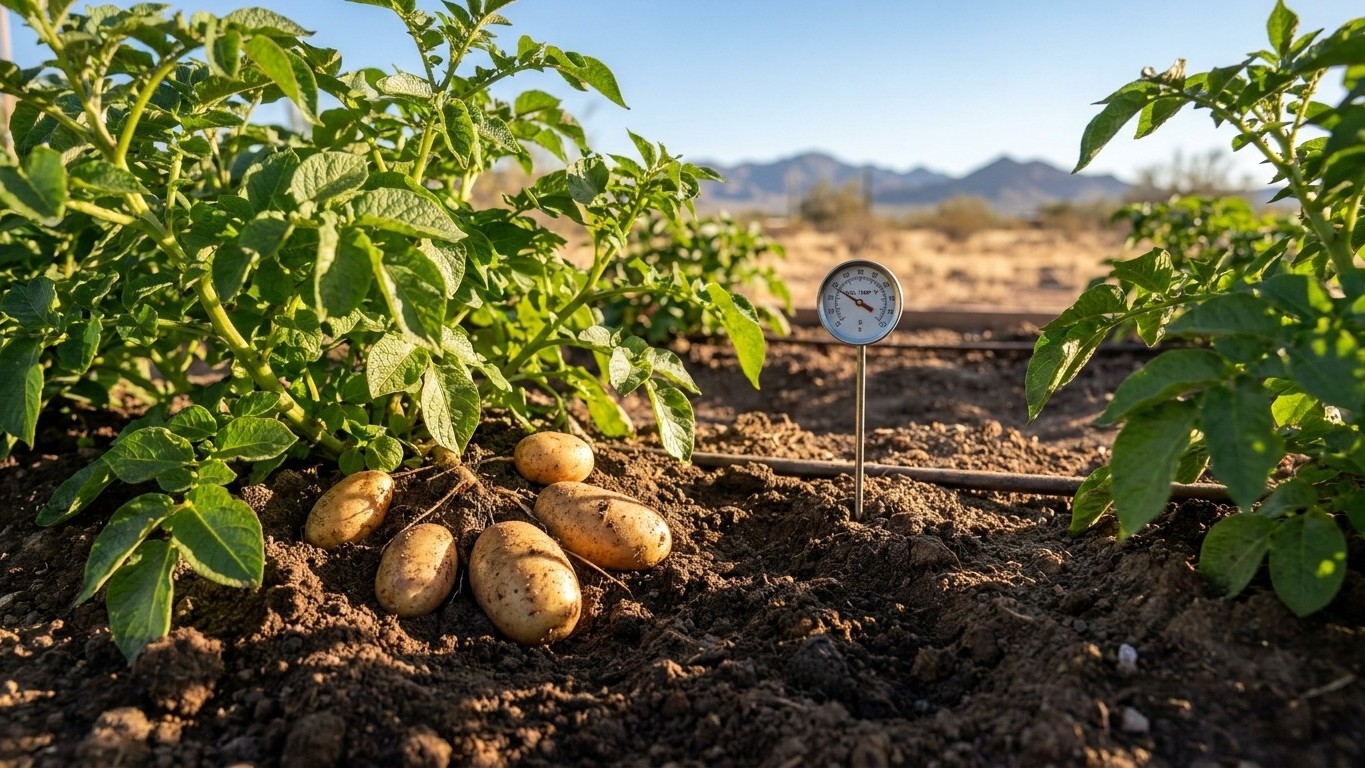

On the south coast, set sweet potato slips outside in late May to early June, once the soil has warmed and nights have stopped biting. Start the slips indoors in spring and dig the crop in October, before the first fall frost. Treat every date as the middle of a range. Inland, in the north and at altitude, the whole calendar slides later.
The short answer for British Columbia
Plant slips in late May to early June and harvest in October. Both ends of that window fall inside the frost-free season at Vancouver International Airport, the reference station, where the mean last spring frost is March 18 and the mean first fall frost is November 10. Those dates come from Environment and Climate Change Canada’s 1981-2010 normals. They are averages, so in one year out of two the last frost falls later than March 18, and in one year out of two the first frost arrives before November 10. Each date marks the middle of a window, never a safe date.
The reference station has about 237 frost-free days between the mean last spring frost and the mean first fall frost. That is a generous stretch on paper. Sweet potatoes are a tropical root crop, though, and an absence of frost does not mean they are comfortable. Wait until the soil feels warm to the hand and the nights have eased. In March the ground is cold and wet even when the frost has gone, and slips set out then sit without growing. Late May to early June gives the roots warm soil and leaves the whole summer for the vines to run. For the wider picture of the crop, see Growing Sweet Potatoes in British Columbia.
When should you start sweet potato slips in BC?
Slips are the leafy sprouts that grow from a mature sweet potato root, and nearly everyone plants slips rather than seed. Start them indoors in early spring, in a warm, bright spot, so they are rooted and leafy by the time the garden soil warms. Many gardeners buy slips from a nursery or mail-order supplier in May instead. Either way, harden them off for several days outdoors before they go in the ground.
When do you harvest sweet potatoes in BC?
Dig in October on the south coast. Because the first frost arrives before November 10 in half of all years, waiting for November is a gamble. A frost that blackens the vines can pass trouble down to the roots. When nights turn cold in the fall, get the fork out. Cure the roots somewhere warm afterward so they sweeten and keep.
What will not work here
Planting on the average last frost date will not work. March 18 is the midpoint of a range, and even in a year when frost has finished, the soil stays cold and wet through April. Sweet potato slips in that soil stall, and the cold can rot them. Late May and early June are the safer bet.
Summer heat is the second thing people get wrong. At Vancouver International Airport the normals show 0.29 days a year above 30 °C and 0.07 days a year above 32 °C. Those are counts of scorching days, and they do not measure the growing season. They do tell you that coastal summers are mild, so a sweet potato here lives on a long frost-free stretch and steady warmth, with few heat waves to lean on. That favors early-maturing varieties and warm spots, such as a south-facing bed or ground under black plastic. Slow, long-season types are a poor bet. The choices are laid out in The Best Sweet Potatoes to Grow in British Columbia.
What does the rain pattern do to sweet potatoes?
Only about 127 mm (5.0 inches) of rain falls across June, July and August, out of 1189 mm (46.8 inches) over the year. July is the driest month, at 36 mm (1.4 inches). So the summer is dry, while the soil is wet at both ends of the season, in spring and again in fall. A dry July means new transplants need regular watering until the vines cover the ground. How often depends on the soil. Sand lets a rain through within the day and wants watering more often, while clay holds water for a week.
The wet fall causes the opposite problem. Roots left in saturated clay into November can split or rot. Plant on raised ridges or mounds so water drains away, and leave enough space between plants for air to move through the vines. These are normals for one station, so a plain straight-sided can left out in the garden will tell you what your own plot actually receives.
What changes across British Columbia
The reference city sits in Canadian hardiness zone 9a, from Natural Resources Canada’s 1991-2020 normals. That is the Canadian system, built on seven climate variables, and it does not convert to a USDA zone. Natural Resources Canada says plainly that no simple conversion exists between the two systems.
The province is far larger and more varied than one coastal airport. It runs from sheltered southern valleys to northern plateaus and mountain districts, and its hardiness zones spread widely across that range. There is no single planting date for British Columbia. The frost dates above come from the Vancouver station, and northern or upland districts run weeks behind it. Spring arrives later there and fall frost comes sooner, so the frost-free stretch shrinks from both ends.
A reader in the north or at altitude should shift in four ways. Plant later, once the soil is truly warm. Choose the earliest-maturing varieties. Warm the soil with black plastic or a low tunnel. Grow in containers or a south-facing bed against a wall that holds heat. Harvest sooner, too, because the first frost can arrive well before November. To find the zone for your own town, use the Canadian map at Natural Resources Canada’s plant hardiness site and look up your municipality there.
Where to check this for your own county
A local recommendation beats a provincial one, and what you have here is the provincial one, built around a single coastal station. Your district may have different frost dates, a rain shadow or a steep slope that changes everything.
Start with the British Columbia government’s agriculture and seafood pages. Look there for two things: a local planting calendar for warm-season vegetables, and any varieties trialled in your own region. If a variety has been grown successfully near you, that is better evidence than any provincewide list.
Local sources work the same way. A nearby farmers’ market grower, a community garden or a regional garden club will know when the soil warms in your valley, and which sweet potato varieties ripened in a short summer there. Ask what date they transplant, and how that has shifted from year to year.
Checking this against your own garden
Your own observations outrank every date above. Three are worth watching, and none needs a gadget.
- Soil warmth by feel. Push your hand a few inches into the bed in mid-morning. If the soil feels chilly, the slips will sit. A bed against a south wall or under black plastic warms first, and a shaded or low, wet bed warms last, so this shows you which spot suits the crop.
- The first new leaves on transplanted slips. Fresh growth says the roots took hold. Yellowing or stalled slips say the soil or nights were still too cool, and that your garden warms later than the average.
- The first cool nights in fall. When vine leaves darken or droop after a chilly night, frost is near. That date is your cue to harvest, and a few years of notes will show how your garden compares with the airport’s average.
Write the dates down each year. Your own notes will give a better calendar than a provincial average.
If you follow the almanac, here is when to plant sweet potatoes by the moon. It is a tradition, not a proven method.
Common questions
Can I plant sweet potatoes in April in British Columbia?
Not outdoors. Even on the south coast the soil is cold and wet in April, and slips stall. April is the time to be growing slips indoors.
Can I grow sweet potatoes in the Interior or the north?
Yes, with adjustments. Choose early-maturing varieties, plant later, warm the soil with black plastic or a low tunnel, and consider containers against a warm wall. Check local frost dates before you buy slips.
Do I need to start slips indoors?
No. You can buy slips from a nursery in May and plant them out once the soil warms. Starting your own from a mature root gives more choice of varieties, but it needs a warm, bright spot indoors in early spring.
When do I harvest sweet potatoes?
Dig in October on the south coast, before frost blackens the vines. In colder districts, harvest earlier, as soon as nights turn cold. Cure the roots in a warm place afterward so they sweeten and store well.