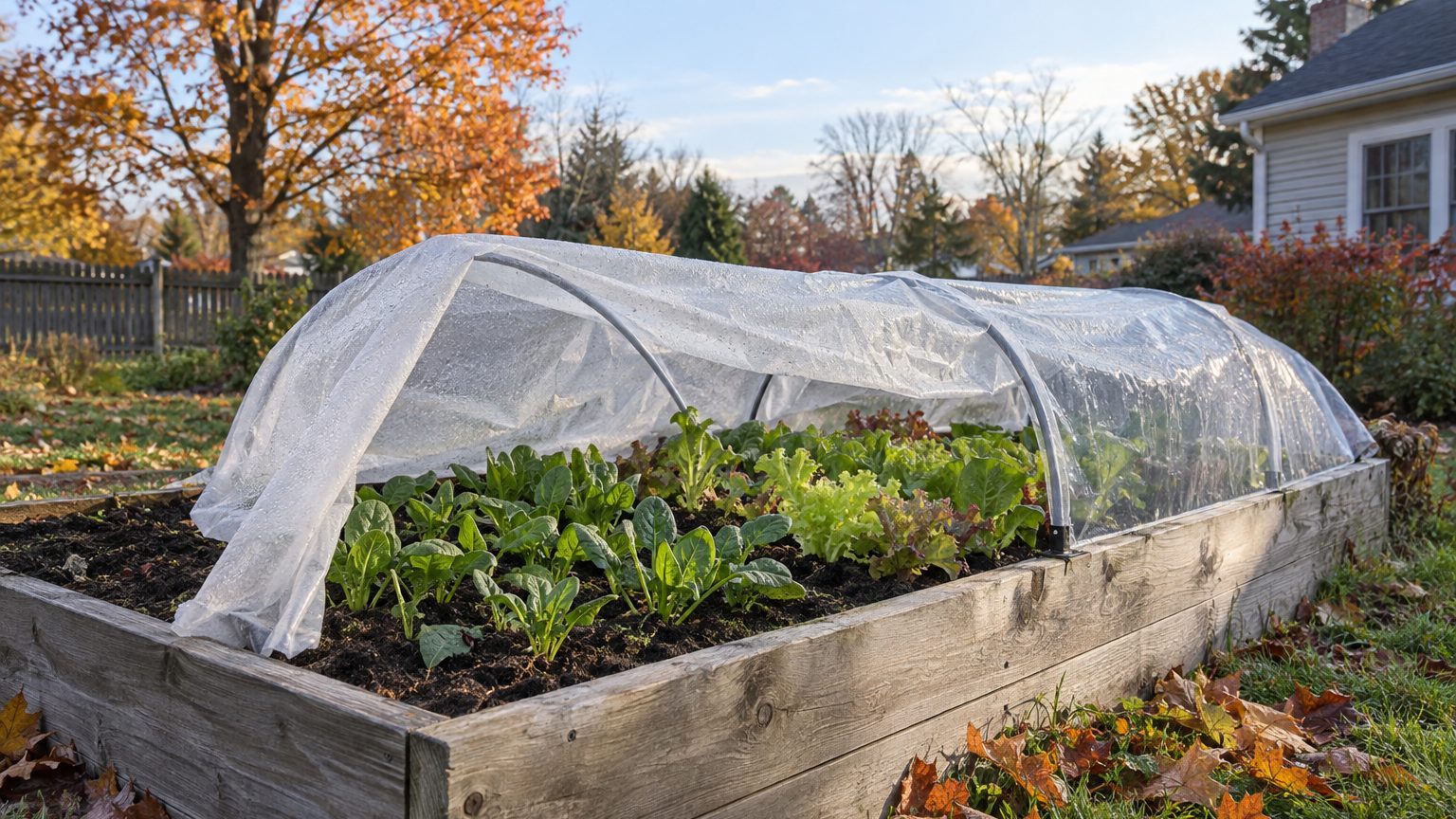

Season extension in Massachusetts buys real weeks at both ends of the year: earlier spring sowings, later fall harvests, and a thin winter supply of hardy greens. At the coastal reference station, the last spring frost falls April 1 to April 8 and the first fall frost arrives November 3 to November 14. Covers stretch those dates. Cold soil in spring and short days in late fall set limits that no cover removes.
When the soil is warm enough in Massachusetts
The date comes first, so here it is. At Boston’s Logan Airport station, the last spring frost falls April 1 to April 8, according to the NOAA NCEI 1991-2020 Climate Normals (the 30 to 70 percent band of 32 F freeze probabilities). Logan sits on the waterfront and is the mildest spot in the state. Inland suburbs and the Berkshires frost noticeably later in spring, so a gardener in Worcester County or near Pittsfield should expect a later date. Treat any frost date as odds. In some years a freeze still arrives after it.
The frost date also answers a slightly different question from the one a season-extension gardener is asking. It tells you when freezing air becomes unlikely. Seeds and roots respond to soil warmth, and soil warms after the frost risk ends, because wet ground takes far longer to heat than air does. A bed can be frost-free in early April and still too cold for beans or squash to sprout. Peas, spinach, radishes and lettuce tolerate cool soil. Beans, corn, squash and cucumbers do not.
Why does a cover change the soil, and by how much?
Soil soaks up sunlight all day and gives that heat back after dark. A cover traps part of it. Fabric, plastic or glass slows the air moving across the bed, so the still air under the cover stays warmer than the air outside. A second layer, such as fabric laid inside a hooped tunnel, adds another pocket of still air.
The gain is real but variable. It depends on the material, the night, the wind, and whether the ground was warm to begin with. A calm, clear night loses the most heat to the sky. A windy one can strip the benefit of a loose cover. A cover shifts the limit a crop can take. It never makes a crop frost-proof, and one hard clear night in April can still take a whole bed of tender seedlings. For the wider picture of what a cover buys, see Extending the Season: What a Cover Buys, and What It Cannot.
Closed structures bring a second risk. A closed cold frame or sealed plastic tunnel in spring sun can cook its contents in an hour, even when the air outside is cool. Ventilation is part of keeping the crop alive. Prop the lid or open the ends in the morning on any sunny day, and close up again in late afternoon. Everything here is passive: sun, soil and trapped air do the work. Nothing that burns or plugs in belongs inside a covered bed.
How do you know the soil is ready for planting?
Use a soil thermometer. Push it in to seed depth in the morning, when the bed is at its coolest, and take readings over several days. Compare them with the minimum soil temperature printed on the seed packet. A bed that crumbles in your hand instead of forming a wet ball is workable. Setting a cover over the bed one to two weeks before sowing lets it pre-warm the ground. That head start is where most of the early gain comes from.
How long the season lasts here
The reference station has a growing season that runs from the mean last spring frost (April 1 to April 8) to the mean first fall frost (November 3 to November 14). That is a long window by northern standards. Logan is the mildest station in the state, though. Inland suburbs frost noticeably earlier in fall and later in spring, and the Berkshires lose more. Gardeners away from the coast should check the dates for their own town with their county extension office.
Is the window long enough for a second sowing?
Near the coast, yes. A window this long allows a spring sowing of quick crops such as lettuce, radishes and spinach, followed by a second round in midsummer for fall harvest. Succession sowing, where you plant a little every couple of weeks, spreads the harvest and suits the cool shoulders of the season well. The practical limit comes in fall. Packet days to maturity are measured in warm, long days. Crops sown in August and September slow down as days shorten, so add a cushion of a week or two when counting back from your first fall frost.
A shorter window also changes whether transplanting is worth the root check. Tomatoes, peppers, broccoli and cabbage gain weeks as transplants, and the setback from disturbing the roots is small compared with that gain. Carrots, beets and parsnips resent root disturbance and do better sown directly, with a cover over the bed to speed early germination.
What does a longer window change about covers?
When the window is long, a cover is not what gets a crop to maturity. It improves quality at the edges: earlier spring salad, tender fall greens after the first light frosts, and a harvest that carries into December. Where the window is short, a cover can decide whether a warm-season crop finishes at all. The same hoops and fabric do different jobs depending on how many frost-free days you have to work with.
Heat and water in Massachusetts
Heat is rarely what limits a crop here. Days above 90 F do occur in summer, in short spells, but they are brief, and the coastal reference station does not describe the whole state. The Berkshires run noticeably cooler in summer. A northern, maritime climate with regular summer rain tends to bring a different set of problems: leaf mildew, slow ripening in cool, cloudy stretches, and fungal disease that spreads when foliage stays wet. Late blight on tomatoes and potatoes and powdery and downy mildews on squash and cucumbers are the usual troubles.
That has a direct consequence for covers. A tunnel or frame that is closed up through a damp week holds humidity against the leaves. Airflow matters as much in a wet summer as in a hot one. Open the ends, lift the sides, and water at the soil rather than overhead.
How does day length limit winter growing?
Latitude matters more than temperature for the cold half of the year. Boston sits at 42.36 degrees north. That is the latitude of the reference station, so gardeners in the far north of the state, or in the western hills, should check their own coordinates. At this latitude, daylight shrinks in late fall to the point where leaves stop adding new growth, in the weeks around the first fall frost dates. After that date a cover holds a crop alive rather than growing it. Spinach, kale and mâche planted in time to reach full size before the light fades can be picked from under cover all winter. Seed sown after that date mostly sits and waits.
Is a light row fabric enough in the coldest months?
It depends on how cold the coldest month runs. At Boston, the mean daily minimum in the coldest month is 23.1 F. That figure comes from the 1991-2020 NOAA climate normals, and it describes a typical night well below freezing, with colder ones in between. Light row fabric is enough for the shoulder seasons, when it only needs to turn away a light frost. A typical January night is a different matter. Winter crops generally need a framed structure that holds more still air, and often a second layer inside it. Inland and in the hills, the minimums run lower still.
The USDA Plant Hardiness Zone Map 2023 puts Massachusetts across zones 5a to 7b. That system is built on the average annual extreme minimum temperature, so it tells you what a perennial survives, not how long your growing window runs. Two gardeners in the same zone can have very different frost dates.
Which season extension suit Massachusetts
Choose by type, and let the local facts decide.
What type of cover works best in Massachusetts?
Match the structure to the job. The table compares the common passive options. Any gain in warmth depends on the material, the weather and the ground, and none of these makes a crop frost-proof.
| Cover type | Best use here | What to watch |
|---|---|---|
| Floating row fabric | Spring and fall shoulder seasons; light frost; insect screening | Weighs down in wet snow; too thin alone for midwinter |
| Hooped low tunnel | Early spring sowings, fall salad crops, a second layer over a bed | Humidity builds in damp weather; open ends on sunny days |
| Cold frame | Hardy greens through winter; hardening off seedlings | Overheats within an hour on a sunny day if closed; vent daily |
| Unheated hoop house | Longest extension in both directions; winter harvest | Needs ventilation from the first warm days of spring; snow load |
A short season inland favors the earliest types of any crop, meaning those with the fewest days to maturity, grown under row fabric or a low tunnel to bring spring forward. Damp summers make disease resistance the first criterion in choosing crops and in choosing varieties. Gardeners who want a comparison with a colder lake-effect climate can read Extending the Growing Season in Michigan. Those curious about the opposite problem, heat that cooks a covered bed, can read Extending the Growing Season in Texas.
Which varieties should you grow under a cover in Massachusetts?
No variety is named here on purpose. A cultivar that performs well on the coast may fail in the Berkshires, and only varieties trialed in local conditions give a recommendation worth following. UMass Extension runs the university’s agricultural programs and can point you to the crops and varieties that have been tested for Massachusetts soils, disease pressure and frost dates. Your county or regional office can also give frost dates closer to your town than the coastal figures above. Start there, then buy for your own bed.
Common questions
What is the last spring frost date in Massachusetts?
At Boston’s Logan Airport station, it is April 1 to April 8 (NOAA NCEI 1991-2020 Climate Normals, 30 to 70 percent freeze probability band). Logan is the mildest spot in the state, so inland suburbs and the Berkshires frost later in spring.
Does a cover make a crop frost-proof?
No. A cover shifts the limit a crop can tolerate by trapping heat from the soil and holding still air around the plants. The gain varies with the material, the night, the wind and the warmth of the ground. A hard, clear, windless night can still kill what is underneath.
How often should a cold frame be vented?
Every sunny day, including cold ones. A closed frame heats quickly in direct sun, and the crop can cook within an hour. Open it in the morning and close it again in late afternoon. Ventilation also lowers humidity, which cuts the mildew and fungal disease that damp New England weather encourages.
Should inland and Berkshire gardeners use the same dates?
No. The coastal figures are a starting point. Inland suburbs and the Berkshires frost noticeably earlier in fall and later in spring, and their windows run shorter. Check your own town’s dates and latitude with UMass Extension before you commit to a sowing calendar.