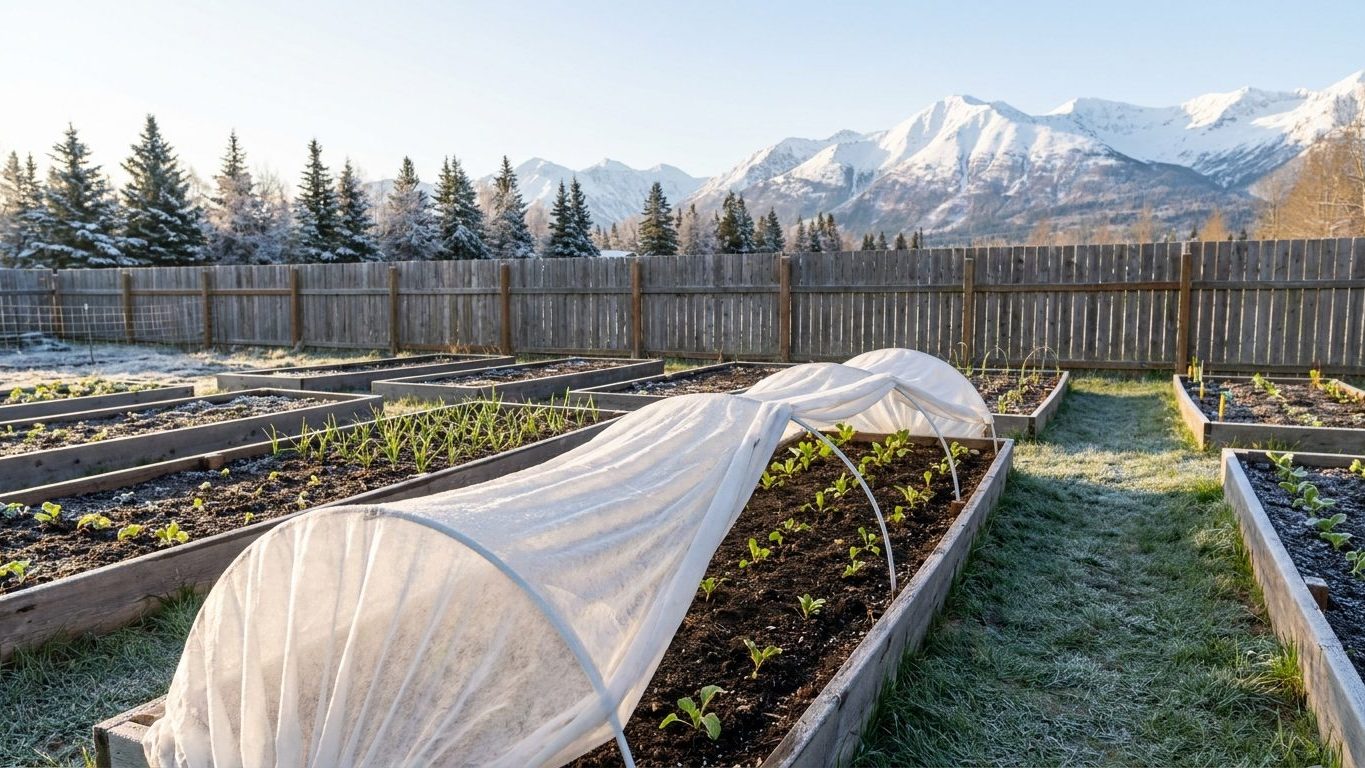

Cover the garden when the overnight forecast drops to about 32°F, or a few degrees above it on a clear, still night. In Texas the calendar behind that rule swings widely. Houston’s covering season runs from early December into late winter, while the Panhandle starts months earlier and ends months later. Here is how to read the dates and adjust them to your own ground.
The short answer for Texas
Frost forms when heat rises off the soil on a night with clear sky and little wind. A cover holds some of that ground heat around the plant, so it has to reach the soil or sit on a frame that does. Cloud cover, wind, and a nearby wall or driveway all change how cold a bed gets, which is why the forecast low is only the starting point.
For the Houston area, NOAA’s 1991-2020 Climate Normals for the Bush Intercontinental (IAH) station put the last spring freeze between February 4 and March 1. The first fall freeze falls between December 1 and December 19. Both are 32°F freeze probabilities: the dates mark the band where the chance of a freeze sits between 30 and 70 percent. Freezes can still arrive before or after the band, at lower odds. Hobby airport runs about two weeks milder than IAH, so a gardener on the south side of the city may start later and finish earlier.
The mean daily minimum of Houston’s coldest month is 43.7°F, so the average winter night stays well above freezing. The trouble comes from a handful of fast cold fronts that drop temperatures in a few hours. That is why the working rule is to keep covers handy from December 1 until March 1, then put them on whenever the forecast low reaches freezing.
What you cover changes the trigger. Tomatoes, peppers, basil, and young transplants set out early should be covered as the low approaches 32°F. Hardy crops such as kale, collards, broccoli, and carrots take a light frost without help, and a cover earns its place only on a hard freeze night. Put the cover on in late afternoon while the soil still holds the day’s warmth, and take it off the next morning once the air is above freezing.
These are Houston figures, the mild Gulf end of the state. Anywhere else in Texas, treat them as a pattern to adapt and not as a calendar to copy.
What will not work here
Waiting for a “safe” date fails first. A March 1 date marks a 30 to 70 percent band, so a freeze around the first of March is still possible. Gardeners who set tomatoes out in February by the calendar alone lose plants to a late norther often enough that keeping a sheet nearby is the cheaper habit.
Plastic left on in the sun fails next. On the Gulf Coast, a clear winter afternoon can push the air under plastic far above the outside temperature, and the plants cook. A cover left sealed through a sunny day can do more harm than the frost it was meant to stop, so vent or remove it by mid-morning. Row cover fabric is more forgiving, but it still needs to come off or be lifted once the day warms.
Humidity defeats long covering. Where winters are damp and air hangs wet for days, covers left on through a string of cloudy, mild days trap moisture against the leaves and invite fungal disease on lettuce, tomatoes, and brassicas. Houston’s average winter night is far from freezing, so most nights need no cover at all. Reserve it for the nights the forecast calls for it.
Heavy structures are often overbuilt for the Gulf end of the state. A heated greenhouse to get through a winter whose coldest-month nights average 43.7°F costs more than the few freeze nights justify. Low tunnels, frost cloth, and old sheets handle most of the work. The sorting of cheap covers from costly ones is laid out in Which Season Extenders Work in Texas.
The opposite problem shows up in the north. A bedsheet buys only a few degrees of protection, which is plenty for a light frost and useless in a Panhandle hard freeze. Loose covers also fail in wind, and Texas cold fronts arrive with it. Weigh the edges down with soil, bricks, or boards, because a cover that blows off at 2 a.m. protects nothing. Last, covers that hang in the air over the plants and never touch or sit near the ground lose the ground heat they were supposed to hold.
What changes across Texas
The USDA Plant Hardiness Zone Map, based on 1991-2020 normals, runs from zone 6a to zone 10a across Texas. That spread is built on one variable, the average annual extreme minimum temperature. There is no single Texas answer, only a spread from the Panhandle’s hard winters to the Gulf’s mild ones.
Houston sits at the mild end, at 29.98 degrees north latitude for the IAH station. Hill Country and North Texas each have their own freeze dates, and the Panhandle freezes months earlier in the fall and months later in spring than Houston does. A reader far north of Houston or well above it in elevation should shift three things: begin watching the forecast earlier in fall, keep covers within reach well past the spring dates above, and plan for sturdier protection than a sheet, such as double layers or a low tunnel with a cold frame for the hardest stretches.
Even inside one metro area the dates move. Hobby airport runs two weeks milder than IAH, and a low corner of a yard collects cold air that slides off a slope. A reader near the edge of the state, east, west, north or south, should treat Houston’s latitude as a reference point only.
To find your zone, use the USDA map itself and enter your ZIP code. The map’s zone is a winter-hardiness guide for perennials. Frost-cover timing for your annual vegetables comes from freeze dates, which your county extension office can supply. The broader strategy is in Extending the Growing Season in Texas.
Where to check this for your own county
The best source for a covering schedule is your county office of Texas A&M AgriLife Extension. County agents work with local weather records and the soil and microclimate of the area, and they know when freezes actually arrive in each corner of the state.
Look for two things there. The first is the local planting calendar, which gives dates for setting out tomatoes, peppers, and cool-season crops in your part of Texas, and so tells you when covers are most likely to matter. The second is the list of varieties trialled in your county. A variety that performs on the Gulf Coast may sulk in the Panhandle, and a variety that tolerates cold may bolt in a warm winter, so the county list saves a season of guessing.
A county recommendation beats a state one. Statewide dates are the broad version, useful for seeing the pattern and for planning supplies. When your county office gives a different date for your area, follow the county. If a cold front is in the forecast, the county or local National Weather Service forecast beats any calendar too.
Checking this against your own garden
Your own observations outrank every date above. Three things are worth watching, and none need an instrument.
- Soil warmth by feel. Push your hand into the bed in the morning. If it still feels cold and damp, warm-season seed will sit and rot. A bed that warms early, usually one against a south-facing wall or raised above its surroundings, tells you where tender transplants can go first.
- The first flush of male flowers. On squash, cucumbers, and melons, male flowers open before the female ones. When they appear, the plants have found enough warmth and daylight to move toward fruit. If they appear in one bed and not another, you have found a warmer corner.
- The first true leaves. The seed leaves come first, and the true leaves show up after. Seedlings that hold the first true leaves without yellowing or stalling are comfortable. If they stall under a cover, the bed is cold or too damp.
Keep notes across a few winters. The date of the last frost you saw on your own roof or lawn will tell you more than any statewide figure.
Common questions
What temperature should I cover plants in Texas?
Cover when the forecast low reaches 32°F. On a clear, calm night, begin a few degrees above that for tender plants such as tomatoes and peppers. Hardy greens can wait for a harder freeze.
Can I leave a row cover on all day?
On a cold, cloudy day, yes. On a sunny day, lift it or vent it by mid-morning, because the air underneath heats quickly. Plastic needs more attention than fabric.
Do Houston’s frost dates apply to Dallas or Amarillo?
No. Houston’s dates, February 4 to March 1 in spring and December 1 to December 19 in fall, belong to the IAH station on the mild Gulf end. North Texas and the Panhandle freeze earlier in fall and later in spring.
Do cool-season vegetables need covering?
Most take light frost without protection. Cover them for a hard freeze, and check with your county extension office for the hardiness of the varieties you grow.