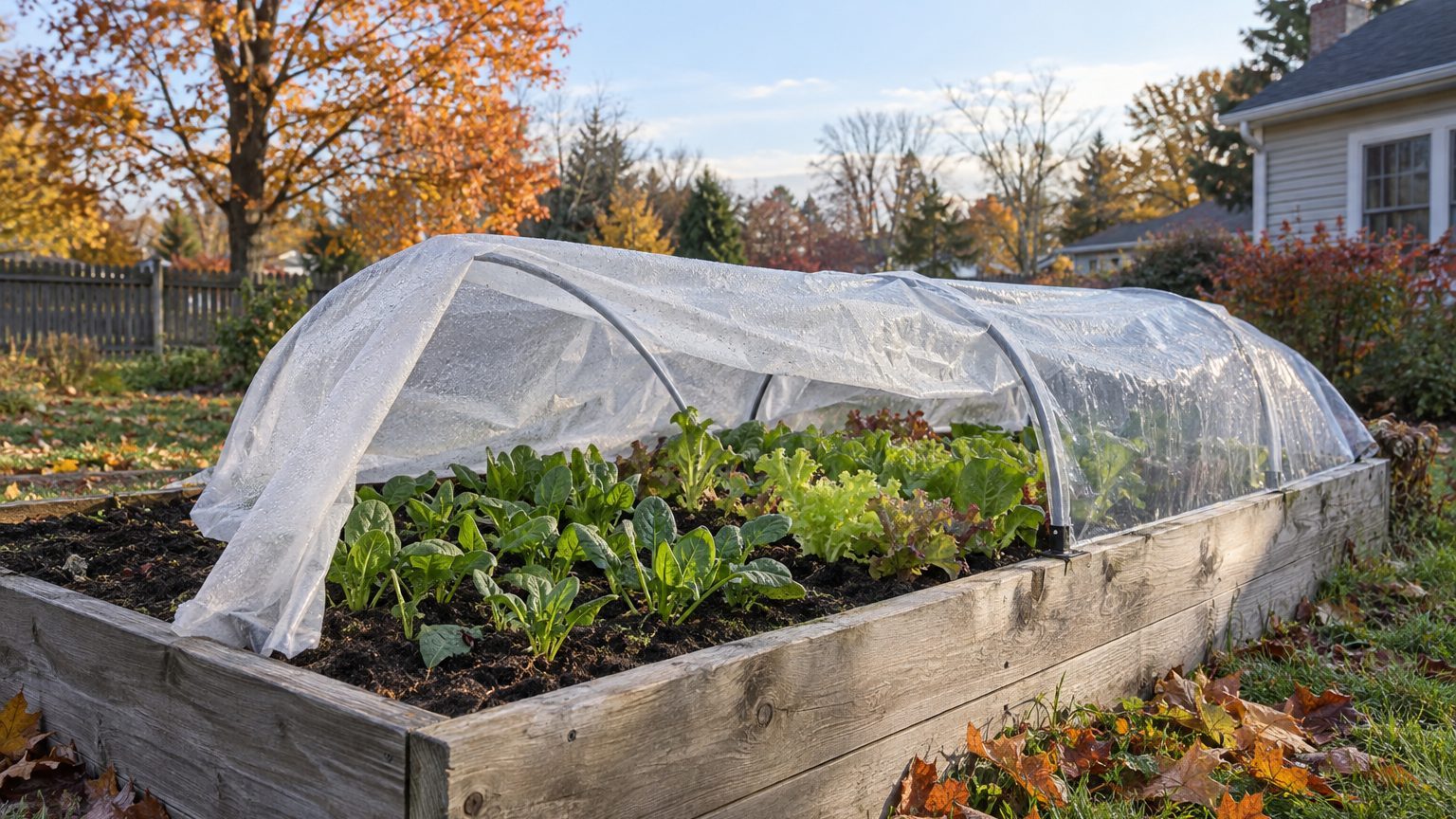

Start season extension in the Northwest Territories around the last week of May. At Yellowknife the mean last spring frost is May 25 and the mean first fall frost is September 18. Low tunnels, fabric and cold frames earn their keep at both ends of that window by buying some days, and no more. They cannot supply warmth the sun and soil do not provide, and they cannot beat the daylight that fades by autumn.
When the soil is warm enough in Northwest Territories
When is the last spring frost in the Northwest Territories?
At the Yellowknife A station, Environment and Climate Change Canada puts the average last spring frost on May 25 (Canadian Climate Normals, 1981-2010). That is a midpoint. In one year out of two the last frost comes later, so treat May 25 as the middle of a window and never as a safe date. Gardens farther north, and those in the Mackenzie Valley or the Arctic coast districts, run weeks behind the capital.
Frost date is a rough stand-in for what a season-extension grower really waits for, which is warm soil. Frost is an air-temperature event. Soil lags behind it, and in the north it lags a long way. Ground that spent the winter frozen solid has to thaw from the top down, and the sun has to do the work. The soil warms after the frost risk ends, so a bed can be frost-free for a week and still be too cold for beans, squash or cucumbers to germinate.
How do you tell the soil is ready?
Push a trowel in. If the top several inches are thawed, crumbly and no longer clammy, cool-season crops such as peas, spinach, radishes and lettuce can go in. They germinate in cold ground. Warm-season crops want the soil to feel distinctly warmer, and a cheap soil thermometer set at planting depth in the morning, when the bed is at its coolest, gives a better answer than the calendar does. Raised beds thaw and warm earlier than flat ground because they drain and catch the sun on their sides.
A cover speeds this up through simple physics. Clear plastic or fabric lets sunlight reach the soil, the soil absorbs it, and the cover slows the escape of that heat as the ground radiates it back at night. The gain is real, but it varies with the material, the night, the wind and whether the ground was warm to start with.
A cover also shifts the frost limit without removing it. A bed under fabric can ride out a light frost and still lose everything to a hard freeze on a clear, still night. Anything closed, such as a cold frame or a plastic tunnel, needs ventilation on every sunny day. In spring sun a shut frame can cook its contents within an hour, even when the air outside is near freezing. Prop the lid or open the ends in the morning and close them again in the evening.
How long the season lasts here
How many frost-free days does Yellowknife get?
The Yellowknife A station has about 116 frost-free days between the mean last spring frost on May 25 and the mean first fall frost on September 18. Both dates are midpoints, so in half of all years the window opens later or closes earlier. A cover can stretch each end a little, but the frost can still arrive ahead of the average.
What does a window that short allow?
It allows one good sowing of most crops. Here the first sowing is usually the only one for anything with a long maturity, so timing it well matters more than repeating it. Quick crops are the exception. Radishes, lettuce, spinach and other leafy greens mature fast enough to be sown again in June and July, and the succession sowing guide on this site lays out how far apart to space those plantings. Leaf crops also tolerate the cool nights of late August, which gives a fabric cover a real job extending them into September.
Crops sown directly in the ground, such as carrots, beets, peas, beans and squash, count their days to maturity from sowing. Under a cover the clock still depends on warm soil, so the packet number is a minimum and not a promise. Crops that are transplanted, such as tomatoes, peppers and brassicas, count from the day they go into the bed, which is why starting them indoors saves so much of the short summer.
Is transplanting worth the root check in a short season?
Often it is, but the roots decide. A transplant that sat root-bound in its cell stalls for a week or two after planting, and in a 116-day window that is a large share of the summer. Before setting a seedling out, slide it from its pot and look. White roots running through the soil ball are fine, and a dense mat circling the outside means loosen it gently or pick a younger plant. Harden seedlings off over a week, and set them out under fabric so the first nights do not undo the work. Crops that resent root disturbance, including carrots, beets and most vines, do better sown in place under a cover. Extending the Season: What a Cover Buys, and What It Cannot goes further into where that trade stops paying.
Heat and water in Northwest Territories
Do hot days matter for northern gardens?
Rarely. That count describes one station, not the whole territory. Heat stress is not what limits crops here. A cool, damp summer brings other problems instead. Powdery mildew, leaf blights and slow ripening show up when cool nights and damp mornings keep leaves wet. Fabric and plastic hold humidity around the plants, so airflow matters as much as warmth. Open the ends of a low tunnel in the morning and space plants so air moves between them. The one place heat becomes real is inside a closed structure on a sunny day, where temperatures climb far above those outside. That is a ventilation problem, solved by opening it up.
How does daylight limit the season at 62.46 degrees north?
Latitude is the governing fact. Yellowknife sits at 62.46 degrees north, and a garden near the edge of the territory should check its own latitude, because the far north behaves differently. Around the June solstice the sun is up for most of the day and twilight covers the rest, so plants get enormous amounts of light. By September daylight shrinks quickly. Past a certain date in autumn the light is too weak and the days too short for plants to put on new growth, whatever the temperature under the cover. After that date a cover holds a crop alive rather than growing it, so a fall cover is for storing what has already matured. Day length also tells an onion when to stop making leaves and start making a bulb, so long days at this latitude suit onion varieties bred for northern summers.
Winter cold sets a second limit. The mean daily minimum of the coldest month at Yellowknife is -29.5 °C (-21.1 °F), and Natural Resources Canada places the city in Canadian hardiness zone 1b, a system that does not convert to USDA zones. Light fabric is enough for edge frosts in spring and fall. In deep winter only a framed, insulated structure holds anything, and even that only preserves hardy roots and greens. For a higher-latitude comparison, see Extending the Growing Season in Nunavut. For the opposite problem of strong sun and swinging temperatures at altitude, see Extending the Growing Season in Colorado.
Which season extension suit Northwest Territories
Which cover types fit a short northern season?
A short season favors the simplest, earliest-acting types. A cool, humid-leaning summer makes airflow part of every choice, and heat protection is rarely needed. The four common types differ mainly in how much they shift the frost limit and how closely they must be watched.
| Type | Best use | Ventilation | Limit |
|---|---|---|---|
| Floating fabric over beds | Light spring and fall frosts | Passes air and water | Little help in a hard freeze |
| Low tunnel on hoops | Warming soil early, shielding young plants | Open ends on sunny days | Overheats if left shut |
| Cold frame | Hardening off, early greens, fall holding | Prop the lid every sunny day | Cooks in an hour of spring sun if closed |
| Unheated greenhouse or high tunnel | Warm-season crops, longer fall | Doors and vents open daily | Holds crops alive in late fall, does not grow them |
Pair each type with the right crop. In a window this short, the earliest-maturing types of each crop are the safest bets under a cover, because a cover gains days but cannot add many. Choose crops that tolerate cold, such as peas, spinach, kale, radishes and lettuce, for the edges of the season. Reserve the sheltered frame for tomatoes and peppers that need every warm day. Where mildew follows damp summers, pick disease resistance first, and spacing plants for airflow helps whichever type you choose.
Where do you find varieties that actually work here?
Variety choice is best taken from local trials. Maturity, cold tolerance and disease resistance vary from one selection to the next, and only a variety grown through subarctic summers shows whether it ripens before the fall frost. The Government of the Northwest Territories agriculture services can point to what local growers have trialled and where to find it. Ask about the dates in your own community too, since a garden in Inuvik or Fort Simpson is not the Yellowknife record.
Common questions
Is May 25 a safe planting date in the Northwest Territories?
No. May 25 is the average last spring frost at the Yellowknife A station, so frost falls after that date in about half of all years. Cool-season crops and hardened-off transplants under fabric can go out around then. Warm-season crops should wait for warm soil, which usually arrives later.
Can a cover make plants frost-proof?
No. A cover traps heat that rises from the soil and holds still air around the plants, so it shifts the frost limit by an amount that varies with the material, the night and the wind. A hard freeze on a clear, still night can still destroy a covered bed.
Do I need to open a cold frame on cool days?
Yes, whenever the sun is out. A closed frame in spring sun can overheat within an hour, even if the air outside is near freezing. Prop the lid in the morning and close it at night. Adding heat sources inside covered structures is a fire and carbon monoxide risk, so rely on sun and soil alone.
Can I grow through the winter under cover?
Mostly no. The mean daily minimum of the coldest month at Yellowknife is -29.5 °C, and daylight in midwinter is too short for plants to grow. A framed structure can store hardy roots and greens that matured in the fall, but it will not produce new growth in the dark months.