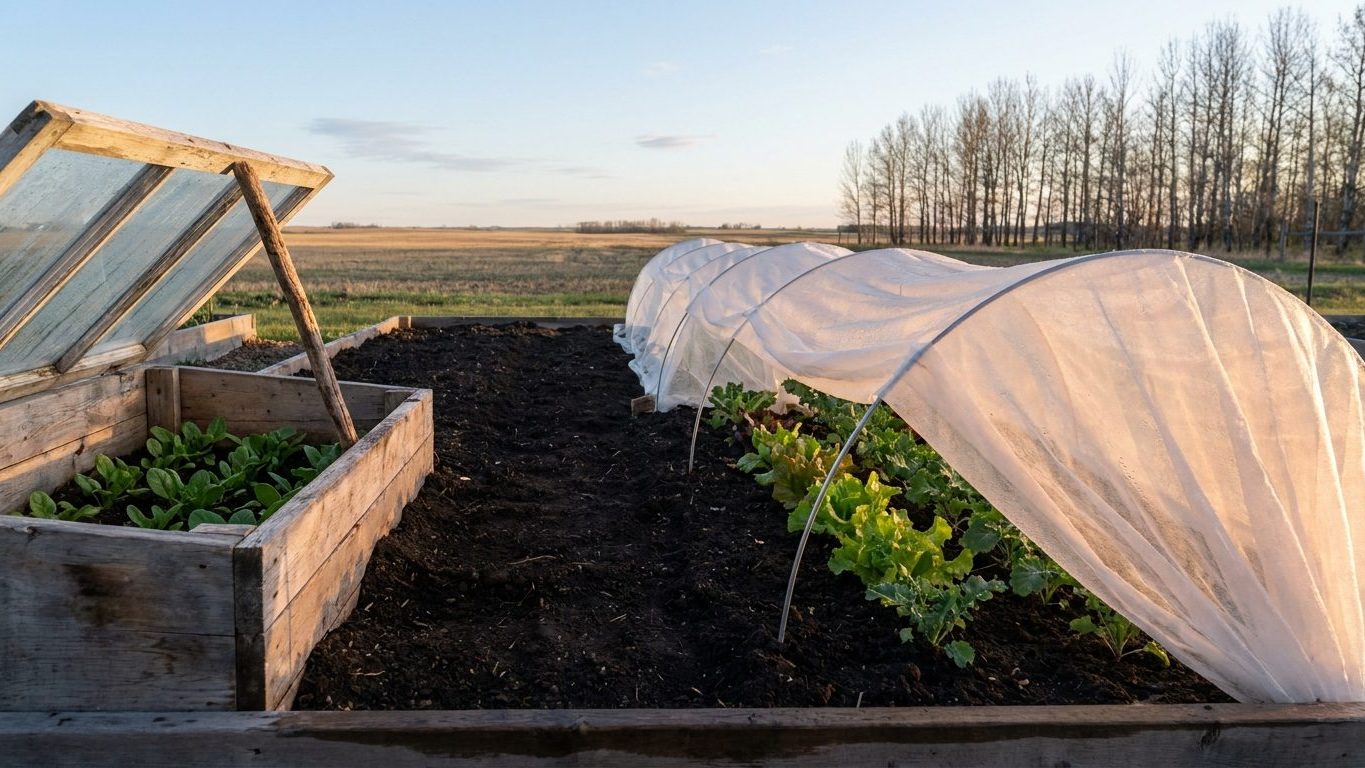

The extenders that pay off in Nova Scotia are the cheap, vented ones: floating row cover, low tunnels and cold frames. Each buys a few weeks of growing time. Each runs into the same limits: a cool, damp coastal climate, frequent wind and very short winter days. Knowing where those limits sit saves money on covers that look impressive and do little.
The short answer for Nova Scotia
Use lightweight floating row cover over hoops for spring and fall frost protection, and a cold frame for hardy greens that need to hold into winter. Plastic-covered low tunnels add warmth for spring transplants and early cool-season crops, as long as someone can open the ends on sunny days.
The reason is the shape of the season. At the Halifax Stanfield station, the mean last spring frost is May 7 and the mean first fall frost is October 18 (Environment and Climate Change Canada normals, 1981-2010), which leaves about 164 frost-free days between them. Those are mean dates. In one year out of two the last frost falls later than May 7, and in one year out of two the first fall frost arrives earlier than October 18. Treat each date as the middle of a window, with a few weeks of risk on either side. Extenders work by pushing the edges of that window outward.
Light matters as much as cold. Halifax sits at 44.88 degrees north, so check your own latitude if you garden near the edge of the province. Under cover, spinach, kale, mâche and similar hardy crops survive deep into winter, but they grow very little once days shorten. The cover keeps them alive and harvestable. It does not make them grow.
Which season extender fits which job in Nova Scotia?
| Extender | Best job | Main limit |
|---|---|---|
| Floating row cover | Frost nights in May and October; insect barrier | Only a few degrees of protection; wind lifts it unless edges are pinned |
| Low tunnel with plastic | Warming soil for early transplants | Overheats fast on sunny days; needs venting |
| Cold frame | Hardy greens from fall through winter, hardening off seedlings | Small footprint; lid needs opening on mild days |
| Unheated walk-in tunnel | Larger fall and winter harvest, early tomatoes | Cost, wind and snow load on the frame |
A walk-in tunnel is the step up for anyone who wants real fall and winter harvests. It makes sense once the smaller tools have shown you how much you will actually use.
What will not work here
Eastern Nova Scotia has plenty of mild-looking weather that tempts people into over-building. Several common choices fail for reasons tied directly to the local climate.
Why do sealed plastic tunnels fail in a damp coastal climate?
Humid air and fog are common near the Atlantic. Under plastic, sealed covers with no venting trap that moisture, and a sunny spring afternoon can push the inside temperature far above what seedlings tolerate. Then the night chills it and condensation drips on the leaves. Gray mold and other fungal problems follow. If you cannot open the ends or sides daily, use row cover instead, because the fabric breathes.
Can tender crops go out on the average last frost date?
No. Tomatoes, peppers, basil and squash set out on May 7 meet a later frost in half of all years. Soil is also slow to warm in a maritime spring, so even frost-free plants sit and wait. Wait for settled weather, then use row cover or low tunnels to give transplants a head start on top of that.
Will a single layer of row cover carry crops through January?
It will not. The mean daily minimum of the coldest month at Halifax is -10.4 °C (13.3 °F), which means many January nights are colder than that. A light fabric adds only a few degrees. Hardy greens tolerate that cold under a cold frame or a double layer, but tender crops die. Heat-loving crops such as melons and sweet potatoes also need a long warm stretch that a cool coastal summer may not deliver, even with black plastic and a tunnel.
Do loose covers survive Nova Scotia wind?
Rarely. Coastal gales and winter storms tear unpinned fabric and lift hoops. Bury or weigh down the edges with soil, boards or sandbags, and anchor tunnel frames deep. In snowy districts, a flat-topped frame can collapse under wet snow, so choose a rounded hoop or brush the snow off after storms.
What changes across Nova Scotia
Halifax is a reference point, not the whole province. The frost dates above come from the Halifax Stanfield station, and the zone for the city is 6b in Canada’s plant hardiness system (Natural Resources Canada, 1991-2020 normals). That is a Canadian zone, built from seven climate variables, and it does not translate into a USDA zone. Natural Resources Canada says plainly that there are no simple conversions between the two systems.
There is no single zone for the province, and so no single answer on covers. Gardens near the Atlantic and the Bay of Fundy are moderated by the water, with milder winters and cooler summers. Inland, upland and northern districts run weeks behind Halifax in spring and reach their first fall frost sooner. A reader on the Cape Breton highlands, or on higher ground anywhere, should expect a shorter window than 164 days.
The practical shift is simple. Plan on starting later in spring, use a heavier layer or a tunnel where Halifax gardeners would use row cover alone, and put hardy crops under cold frames earlier in fall. On the coast, spend more effort on wind anchoring and venting than on extra warmth. Latitude changes too: a reader well north of 44.88 degrees should check their own, since the shorter winter days cut winter growth even further.
To see which zone your municipality falls in, use the map at Canada’s Plant Hardiness Site. Look up your own municipality rather than assuming the Halifax number applies.
Where to check this for your own county
The Nova Scotia Department of Agriculture is the provincial source for growing guidance. Look for two things there: a planting calendar written for your part of the province, and a list of the crops and varieties that have been trialled in your county or region.
A recommendation for your county beats a provincial one every time. A province-wide overview has to average a coastal garden near Halifax with an upland plot in the north, and no single date or cover choice fits both. Where a local calendar and a general one disagree, follow the local one.
Local sources also catch things a general guide misses. They can tell you which varieties handle damp summers without disease, how snow load has affected tunnels in your area, and when frost has actually arrived in recent years. The frost dates used here are 1981-2010 normals, so recent local records matter.
For the bigger picture on covers, see Extending the Growing Season in Nova Scotia. For timing, When to Cover Your Garden in Nova Scotia walks through when to put covers on and take them off.
Checking this against your own garden
Your own ground outranks every date above. Three observations tell you more than a calendar can.
- Soil warmth by feel. Push your hand a few inches into the bed in the morning. If it feels cold and clammy, it is too early for warm-season transplants. Compare a sheltered, south-facing bed with one in a low spot. The gap shows how much a tunnel or black plastic would help.
- The first male flowers on squash and cucumbers. If they appear late, your garden runs cool, and a cover or warm microclimate will bring the harvest forward.
- The first true leaves on seedlings. After the rounded seed leaves come leaves with the plant’s real shape. If seedlings under cover reach that stage quickly, the protection is working. If they stall, check for cold nights, wet soil or too little light.
Write down the dates you see each spring and fall, along with the first frost on your lawn. After a few years, those notes are a calendar made for your yard.
Common questions
What is the cheapest season extender for Nova Scotia?
Lightweight floating row cover on simple hoops. It gives a few degrees of frost protection, breathes in damp weather, and works in spring and fall. Pin the edges against wind.
Can I grow vegetables through winter in Nova Scotia?
Hardy greens such as spinach and kale can survive winter under a cold frame or an unheated tunnel. Growth nearly stops when days are short, so sow in late summer and harvest through winter from what has already grown.
When is it safe to plant tomatoes outside?
No date is safe every year. The mean last spring frost at Halifax is May 7, and in one year out of two the last frost comes later. Wait for settled weather and warm soil, and keep row cover on hand.
Should I use plastic or fabric?
Fabric row cover is more forgiving in damp climates because it breathes and does not overheat as quickly. Plastic warms soil and air faster and suits low tunnels and cold frames, but it has to be vented every sunny day.