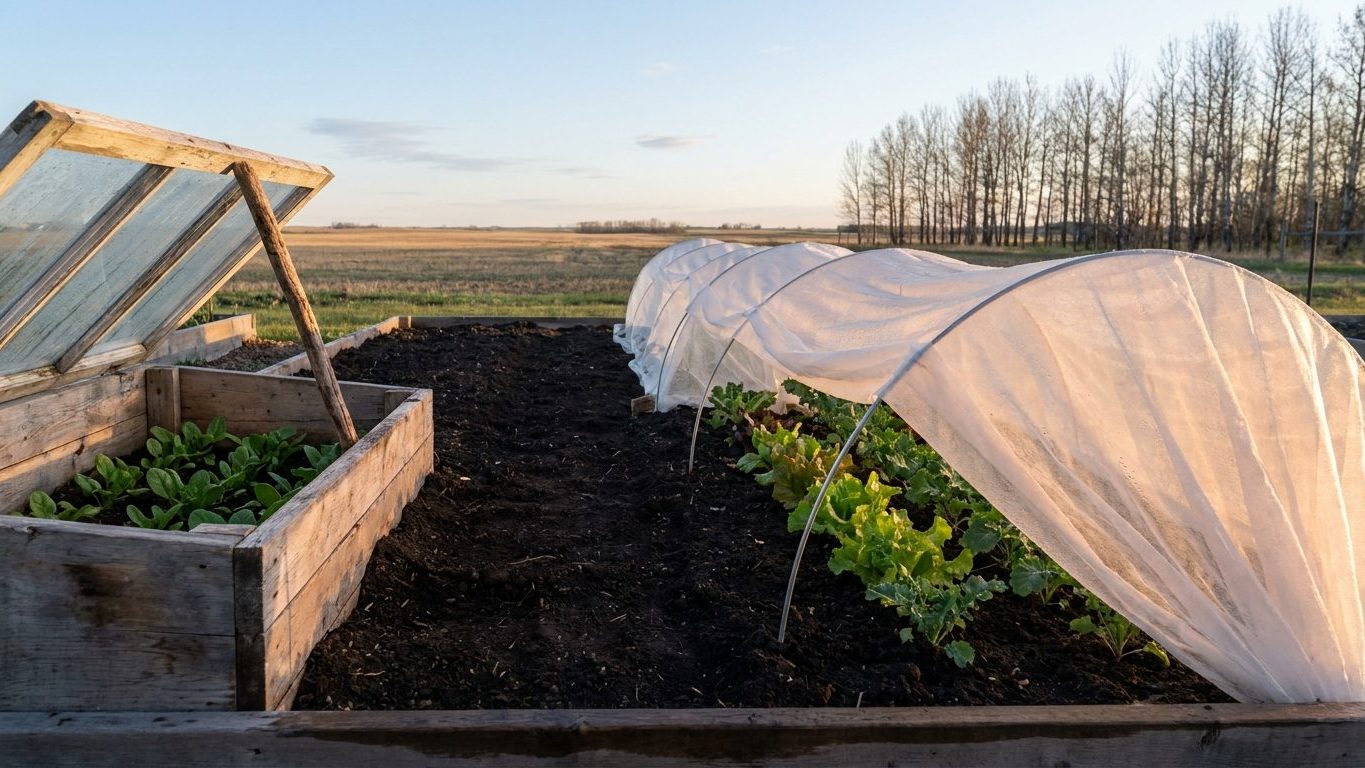

Lightweight row covers over wire hoops are the most useful season extender in South Dakota. Cold frames come next for spring greens, and an unheated high tunnel suits gardeners willing to anchor it hard. Each one buys a few weeks at either end of the season. None turns January into a growing month. Your choice depends on which end of the season you want to stretch and how much wind your yard takes.
The short answer for South Dakota
Buy a floating row cover and a set of hoops first. That kit handles both a late-April frost and a September cold snap for little money. Add a cold frame for early greens and hardening off seedlings, and a high tunnel only once you have the budget and the anchoring plan.
The calendar explains why. At the Sioux Falls airport station (43.59 degrees north), the last spring freeze falls between April 29 and May 9, and the first fall freeze between September 24 and October 4. Those dates mark the band where the chance of a 32°F freeze runs between 30 and 70 percent. They describe the reference city. Suburban and rural gardens usually freeze later in spring and earlier in fall, often by one to two weeks, and more at elevation. A cover works inside that margin. It gives a few degrees of protection, enough for a light frost but not a hard one.
Which season extender fits which job in South Dakota?
| Extender | Best job | Main limit |
|---|---|---|
| Floating row cover | Frost nights in spring and early fall; keeps insects off brassicas | Little help in a hard freeze; wind lifts it unless the edges are pinned |
| Low tunnel (hoops with plastic) | Warming beds before planting; early carrots, lettuce and peas | Overheats on sunny days unless vented |
| Cold frame | Early greens, hardening off, late fall lettuce | Small growing area; must be opened and closed daily |
| Unheated high tunnel | Largest gain; earlier tomatoes and peppers, greens well into fall | Cost, wind anchoring, snow load |
| Black plastic mulch | Warming soil for squash, melons and peppers | Warms the ground, but leaves still freeze |
Spring gains come mostly from warmer soil, and fall gains from frost protection. A garden that struggles to ripen tomatoes before October needs a different tool than one that wants lettuce in early April.
What will not work here
Can you garden through a South Dakota winter under a cover?
No. The mean daily minimum of the coldest month is 8.5°F at Sioux Falls, and a layer of plastic over hoops holds only a few degrees against that. Spinach, kale and lettuce under a low tunnel stay alive deep into fall, but growth slows as days shorten, and a single-digit January night freezes the soil beneath thin plastic. Plan to harvest the bed down by November and count anything left as a bonus. Fall-planted garlic survives winter because of a thick mulch, and the tunnel adds little.
Does covering a bed let you plant tomatoes in April?
Not safely. April 29 is the early edge of the last-frost band, so a freeze is still close to a coin flip, and rural gardens often run a week or two behind. A cover protects leaves on a frosty night but does little for cold soil. Tomato and pepper transplants sit and stop growing when roots are chilled. Wait for the later end of the band, or later still outside the city, and use the cover as insurance.
Unvented plastic fails in another way. A sunny April afternoon can bake seedlings under a closed low tunnel even when the night before dropped below freezing. Tunnels need to be opened in the morning and closed again before sunset, which suits a retired gardener better than someone commuting an hour to work. Fabric covers forgive that schedule. Clear plastic does not.
Wind is the other big failure. Prairie gusts lift loose fabric and shred plastic that is only tucked under a few rocks. Bury the edges in soil, or pin them with boards or sandbags, and push hoops deep. A wet spring snow can also flatten a low plastic tunnel, so brush it off or leave the hoops bare when the forecast is heavy.
Covers also cannot turn a long-season variety into a short-season one. Melons, sweet potatoes and big slicing tomatoes still need more warm weeks than a September frost allows in many yards, so start with early varieties and add the cover second. If you are unsure when to put fabric on and take it off, When to Cover Your Garden in South Dakota walks through the timing.
What changes across South Dakota
South Dakota is not one garden. The USDA Plant Hardiness Zone Map (2023 edition, built on 1991-2020 normals) places the state anywhere from zone 3b to zone 5b. That spread means no single recommendation fits everyone, and Sioux Falls sits near the eastern edge rather than the middle. Zone ratings come from the average annual extreme minimum temperature, so they tell you which perennials survive winter. They say less about how many weeks a tomato has, which depends on frost dates.
Gardeners in the colder parts of the state, in the north or at altitude such as the Black Hills, should shift the plan in two ways. Move spring planting later, and bring fall protection earlier. The one-to-two-week gap between the airport and a rural yard grows with elevation. A row cover that is insurance in Sioux Falls may be a necessity in a cold-pocket valley. Hardier tools, like heavier fabric or a double layer, earn their cost there, while the lightest fabric may be enough in a sheltered yard in the southeast.
The latitude of 43.59 degrees belongs to Sioux Falls only. A reader far to the north has a shorter day length in spring and fall, and a bed that warms slowly in March. West of the Missouri River, wind exposure usually matters as much as the cold, so anchoring weighs more than the choice of material. Look up your own zone on the USDA map by ZIP code rather than assuming one. Then read it alongside local frost dates, because the zone alone will not tell you when to cover.
Where to check this for your own county
Start with SDSU Extension, the state’s land-grant extension service. Look for two things: the local planting calendar for your area, and the vegetable varieties that have been trialled in your county or one close to it. A variety that ripens well in the southeast corner may fall short in the northwest, and trial results say so.
Your county extension office can also tell you the typical frost dates for your town, which usually differ from the airport reference city. Ask whether local gardeners use high tunnels, how much snow load they plan for, and which wind-protection habits work in your township. Everything above gives a state-level picture built around Sioux Falls, and a county recommendation beats it every time.
For a broader look at the whole toolkit, Extending the Growing Season in South Dakota covers how the pieces fit together across the year.
Checking this against your own garden
Your own observations outrank every date above. Three are worth watching, and none needs equipment.
- Soil warmth by feel. Push a hand a few inches into the bed in the morning. If it feels cold enough to numb your fingers, warm-season transplants will sit idle. If one bed feels warmer than another, you have found your early spot, probably beside a south-facing wall or fence.
- The first male flowers on squash and cucumbers. They open before the female flowers. When they appear, the plant is established and the cover can come off for pollinators.
- The first true leaves on direct-sown seedlings. The first pair are seed leaves. Once real leaves with the crop’s typical shape unfold, the plant can handle more exposure and wind.
Write down the date of each observation for a couple of seasons. After two years, that log tells you more about your yard’s last and first frosts than any airport station can.
Common questions
Is a row cover enough for a September frost?
For a light frost, usually yes. A cover gives a few degrees of protection and carries tomatoes, peppers and beans through a cold night in late September. A hard freeze overwhelms it, so watch the forecast and pull the fabric over the evening before.
Do cold frames work in South Dakota winters?
They stretch the season at both ends but do not grow food through January. With the coldest-month mean minimum at 8.5°F in Sioux Falls, expect hardy greens to survive into early winter and restart growing in late winter or early spring.
Should I use plastic or fabric?
Fabric is easier for beginners because it breathes and does not cook plants on sunny days. Plastic warms more but needs daily venting. Many gardeners use fabric on hoops for flexibility and plastic only for early spring warming.
Does black plastic mulch protect against frost?
No. It warms the soil, which helps heat-loving crops get started, but leaves above it still freeze. Pair it with a row cover on cold nights.