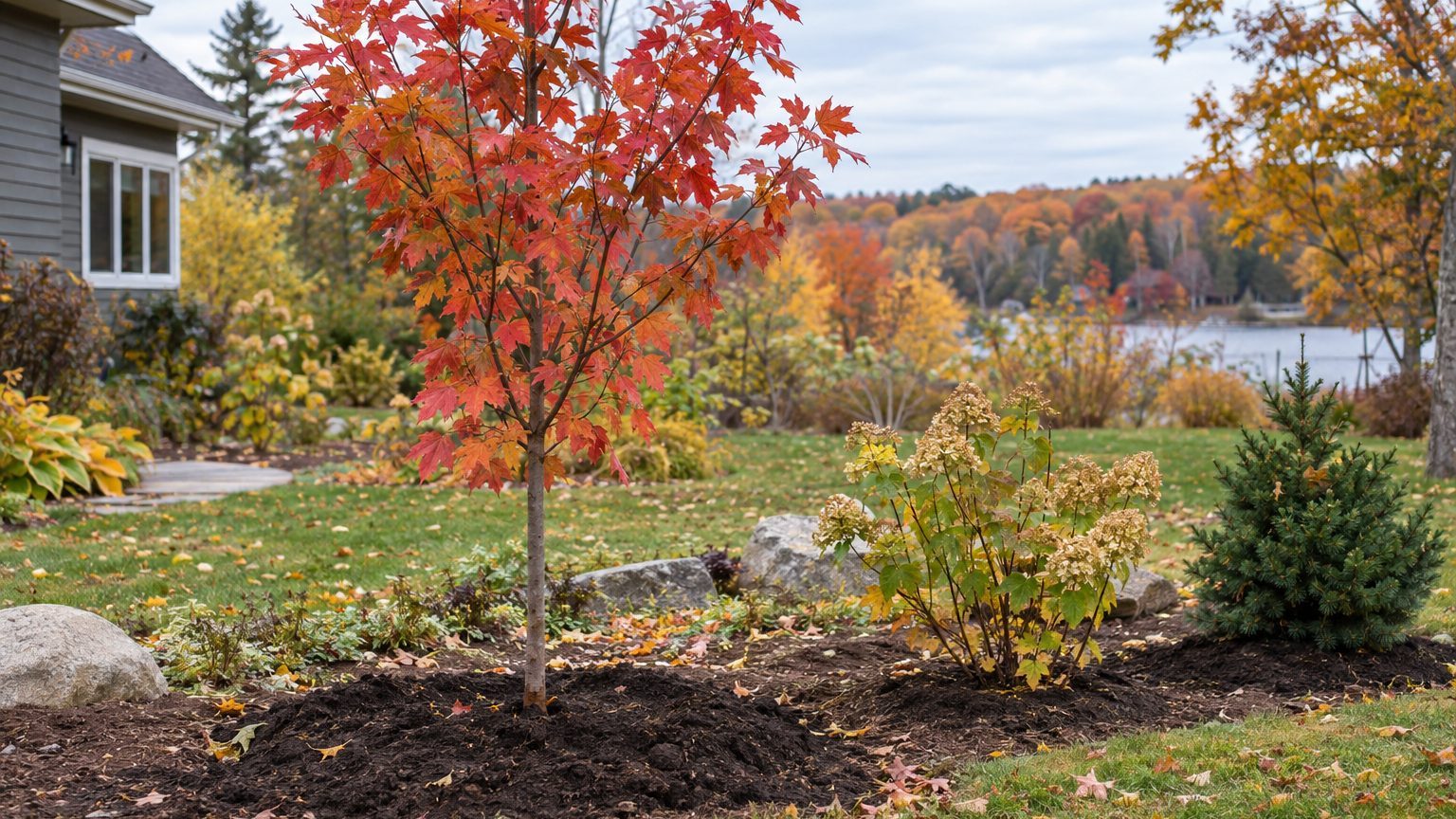

In Louisiana, the safe cutoff for planting trees and shrubs in fall runs from November 5 to November 27, which is six weeks before the first fall frost of December 17 to January 8. That cutoff is conservative. Across south Louisiana, where the ground rarely freezes, fall and winter are the best planting months, and the real danger is the heat of the following summer. Farther north, freezes arrive more reliably and the calendar tightens.
The deadline in Louisiana
Roots keep growing as long as the soil is workable and above freezing, which is long after the air turns cold. Cornell Cooperative Extension states the rule this way: “Fall is an excellent time for transplanting, provided you get them to their new home at least 6 weeks before the ground freezes, allowing them time to establish roots before winter dormancy.” The clock runs from frozen soil, and soil freezes later than the air does.
How do you work out the deadline for your yard?
Start with the first fall frost. The NOAA NCEI 1991-2020 Climate Normals, using the 30 to 70 percent band of 32F freeze probabilities, put it between December 17 and January 8. Count back six weeks and you get November 5 to November 27. Treat that as the date to write on the calendar.
The true limit, the day the ground freezes, usually falls after that range, so a tree planted a week or two late can still make it. The range is a safety margin. It is not a hard wall. The colder end of the state, meaning north Louisiana, reaches frost earlier than the southern parishes, so its deadline lands earlier in the range. Look up your own parish on the First and Last Frost Dates in Louisiana page and count back from there.
Does the deadline apply in south Louisiana?
Mostly, it does not. At the New Orleans reference station, the mean daily minimum of the coldest month is 46.1°F (NOAA NCEI Climate Normals 1991-2020). That is well above 32°F, so the ground does not freeze there, and a six-week countdown to frozen soil has nothing to count down to. Fall and winter are the best planting seasons, and December, January and February are all fair game.
The same station records a 32F freeze in only 86.8 percent of years. Roughly one year in seven has no freeze at all, and the first-frost window straddles New Year’s Day. A planting calendar built around frost does not fit this climate. Summer heat is the limit. A tree set out in November gets a whole cool, moist season to root before its first July. A tree set out in May has a few weeks.
The USDA Plant Hardiness Zone Map (2023 edition, built on 1991-2020 normals) places Louisiana in zones 8a to 10a, and that range is built on the average annual extreme minimum temperature. Dated advice here uses New Orleans as the reference, and other parts of the state run colder or warmer than it does.
What to plant late, and what to wait on
Container-grown and balled-and-burlapped trees and shrubs that are fully hardy in your zone establish well in fall. They arrive with intact root systems, and the cool, damp months let them spread roots while the top stays quiet. Oaks, maples, hollies and similar hardy landscape plants fit this description across much of Louisiana, as long as the label matches your hardiness zone.
Borderline plants are the risky group. A shrub rated for the very edge of your zone has had no time to build reserves if a hard freeze arrives in its first winter, and 86.8 percent of years at the New Orleans station do see a freeze. Hold borderline plants until spring, once the danger of freeze has passed, and give them a full growing season to harden before the next cold season.
Evergreens need extra attention because they lose water through their leaves or needles all winter, even while the roots are slow. A broadleaf evergreen planted in late fall has a small root system trying to feed a full canopy. Plant evergreens at the early end of your window so the roots get a head start, and keep the soil moist through the winter.
Where you live inside the state shifts the call:
| Plant type | Fall planting in Louisiana | What to watch |
|---|---|---|
| Hardy container-grown trees and shrubs | Good. Plant through the safe window in the north, and into winter in the south | Water through any dry stretch |
| Hardy balled-and-burlapped trees | Good. Same timing as container plants | Keep the root ball moist and set it firmly |
| Borderline plants near their cold limit | Wait for spring | A freeze in the first winter can set them back hard |
| Evergreens, broadleaf and needled | Early in the window | They keep losing water all winter, so moisture matters |
North Louisiana gardeners near the Arkansas line can compare their calendar with How Late Can You Plant Trees and Shrubs in Fall in Arkansas?. The direction is simple: the farther north and higher you are, the earlier the fall deadline lands. For the general mechanics of setting a plant in the ground, Planting and Caring for Trees, Shrubs and Perennials covers hole size, root flare height and backfill.
Watering and mulch until the ground freezes
The first winter is about roots, not growth. Top growth slows or stops as days shorten, but roots keep expanding into cool soil as long as it stays workable. A newly planted tree is spending those months building the root system that will carry it through next summer. That is why a fall planting needs steady moisture even when the branches look asleep.
How much should you water a fall-planted tree?
Water deeply, soaking the whole root ball and the soil just beyond it, then let the top layer dry slightly before the next soaking. Frequent light sprinklings keep roots shallow. Keep that routine going until the ground freezes. In north Louisiana, where freezes are more reliable, that means watering through the fall and stopping once the soil is frozen. In south Louisiana, where the ground does not freeze, the watering never has a freeze-up to end it. It simply continues through dry spells all winter, because a dry fall followed by a mild winter can pull moisture out of a small root zone. Check the soil with a finger or a trowel instead of trusting the calendar.
Fertilizer can wait. Pushing top growth in late fall forces tender shoots that the next freeze can damage, and the plant gets more from putting its energy into roots.
How deep should mulch be around a new tree?
NC State Extension, in its Extension Gardener Handbook chapter on woody ornamentals, gives two figures for two purposes. On weeds: “A 2-inch to 3-inch layer of mulch suppresses most annual weed seeds and makes it easy to hand-pull any that do germinate.” On trees: “Provide a 3-inch layer of mulch to reduce water loss and maintain uniform soil moisture and temperature around roots.” The two figures agree. Spread a 2-inch to 3-inch layer in a ring and stop there, because deeper mulch smothers roots and holds too much water against the bark.
The ring should be wide, roughly the width of the planting hole or wider, and open in the middle. Pull the mulch back so the trunk flare stays bare. A mound piled against the trunk, the so-called volcano, keeps the bark wet and invites rot and pests. Our page on Mulching Without Killing the Plant shows what the ring should look like and how to fix a volcano already in place.
What goes wrong
Planting too late for the local climate is the most common mistake in north Louisiana. A tree planted after the ground has begun to freeze has had no time to root, and a freeze-thaw cycle can then lift a shallow root ball out of the soil. Use the early end of the range if you live in the north, which means November 5. Further south, where the ground does not freeze, planting in winter carries no such risk, and the late mistake is planting into summer heat instead.
Winter burn shows up on evergreens in places where the soil freezes and cold wind keeps pulling water out of the leaves. The leaves turn brown at the edges or tips because the frozen roots cannot replace what the wind removes. Watering well before the freeze and mulching in a ring give evergreens in north Louisiana their best chance. In the southern parishes, where the ground stays unfrozen, the risk is different: the leaves keep working all winter and need moisture to match.
Heaving affects shallow, loosely set root balls in ground that freezes and thaws repeatedly. If a tree sits too high in the hole, or the backfill is loose, the soil can push it upward. A properly set root flare and a firmly packed hole prevent most of it.
Drying out is the quiet failure that hits everywhere, including the warm south. A dry fall, a stretch without rain, and a gardener who has decided the season is over can add up to a dead tree by spring. Water on the soil’s schedule, not the calendar’s, and keep checking until the plant is clearly growing on its own.
Common questions
Can you plant trees and shrubs in Louisiana in December and January?
In south Louisiana, yes. The ground at the New Orleans reference station does not freeze, so December and January are good months for hardy plants, and the roots get the whole cool season. In north Louisiana, December is past the early end of the safe range, so planting then is a gamble that depends on how mild the winter turns out.
Does the six-week rule apply in New Orleans?
No. The rule counts back from the day the ground freezes, and at the New Orleans station the coldest-month mean daily minimum of 46.1°F stays above 32°F. The deadline of November 5 to November 27 is a safe target for places that freeze, and it does not restrict planting in the south.
Is fall better than spring for planting in Louisiana?
Usually. A fall planting lets roots grow through a cool, damp season before summer heat arrives, and heat is the main limit on young plants in Louisiana. A spring planting has only a few weeks of mild weather before the heat sets in, so it needs far more watering through its first summer.
How much mulch should go around a new tree?
Use a 2-inch to 3-inch layer, in a ring, with the trunk flare left clear. NC State Extension gives the same order of depth for weed control and for moisture, so there is no reason to go deeper. More local timing is in the Louisiana guides, and your parish’s LSU AgCenter extension office can confirm your own frost dates.