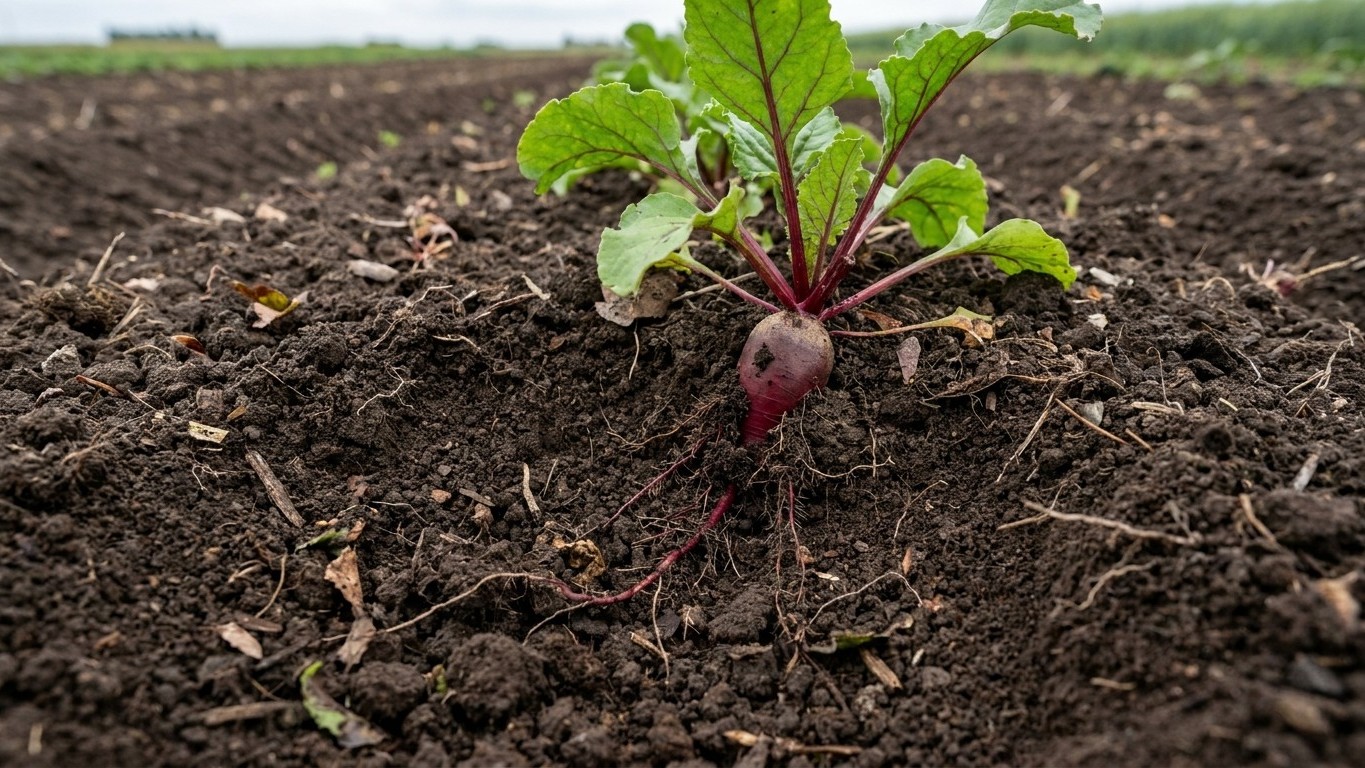

Pull beets 60 to 80 days after seeding. For south Louisiana, a sowing from late December to late January puts that harvest between the end of February and mid-April, ahead of the first stretch of 85 F heat. Storage is where the usual root-crop advice flips. Topped beets keep best at 33 to 36 F, and the USDA’s own handbook says 32 to 34 F brings more black spot and rot. Colder is not better.
The short answer
Louisiana’s state soil is the Ruston series, an Ultisol: old, heavily weathered, leached, naturally acid and low in nutrients. The representative surface layer is 65 percent sand, 11 percent clay and 24 percent silt, with about 1.8 percent organic matter and a surface pH near 5.5. It is well drained. Utah State University Extension describes the beet’s ideal as deep, sandy, well-drained soil rich in organic matter, and the Ruston delivers the first three. A root can run straight down through that sand without hitting a wall. The organic matter is where it falls short. At 1.8 percent, the ground sheds water quickly and holds little in reserve, and a beet needs steady moisture early in life. Extension’s guidance is to amend with no more than 1 inch of composted organic matter per 100 sq ft, so the fix is modest, not a mountain of compost.
Your garden is not the Ruston series
A state spans hundreds of soil series, and this one is a starting point. It represents Louisiana on paper, not every backyard in it. River bottoms, clay-heavy ground in the south, hill country in the north, and any lot a builder has scraped or filled can behave nothing like it. The figures above are USDA’s representative values for the mapped surface layer, not a reading from a worked garden bed, and the pH is not your pH. Use them to expect that Louisiana ground often drains fast and runs acid, then get your own number from a soil test. The Beet Soil in Louisiana: What the Root Will Meet page goes deeper on what to do with the result.
Heat and the woody root
Woodiness is a heat problem. Utah State University Extension ties it to temperatures above 85 F combined with water stress, and that combination tends to show up in the weeks before harvest. How many days a year the reference station in south Louisiana passes 90 F is not published in the figures behind this page, so no count appears here. The practical point does not need one. Louisiana’s warm season arrives early and stays long, and a sandy, low-organic soil dries out faster than a loam does. A beet left in the ground into that stretch is gambling.
That is why the answer to “when do I pull” is tied to the calendar. Pull on schedule, in the cool end of the season, and do not leave roots sitting while the weather warms.
The six weeks that decide it here
Beets are sown in place, so the clock starts at seeding. Sowing 2 to 3 weeks before the last spring frost is the standard timing, and NOAA NCEI’s climate normals put the last 32 F freeze for the south Louisiana reference station between January 18 and February 8. Count back and the sowing window runs from about December 28 to January 25. The first six weeks of a beet’s life then fall between early January and early March.
Those six weeks are when thirst does its damage. Utah State University Extension says water stress in the first 6 weeks causes premature flowering, the failure gardeners call bolting. A bolted beet puts its energy into a flower stalk, not a sweet root. The risk here comes from the weather’s habit of swinging: cold fronts, wet spells, then a few mild, breezy days that pull moisture out of the top inch. On sandy ground those dry stretches bite within days, because the soil has little organic matter to hold anything back. Winter rain can lull a gardener into skipping the hose, and a week of sun and wind afterward undoes the soaking.
Counting from seed to pull
The 60 to 80 days run from seeding, never from a transplant, since beets do not move well and are sown where they will grow. A sowing on December 28 reaches 60 days around February 26. A sowing on January 25 reaches 80 days around April 15. That is the window to pull inside, and checking a few roots at the early end beats waiting for the late end. The longer you wait, the closer you get to heat above 85 F.
The frost date is a loose guide in this part of the state. A 32 F freeze occurs in only 86.8 percent of years at this station, so roughly one year in seven has no freeze at all. South Louisiana barely freezes, and the limiting factor is summer heat, not frost. North Louisiana freezes far more reliably and its dates run later, though the exact range is not published here. Anyone starting from the beginning can use Growing Beets in Louisiana as the broader reference.
What goes wrong here
Bolting and woodiness come from different causes at different times, so they get separate fixes. The rest of the list covers the calendar and the storage mistakes that waste a good crop.
- Bolting from early thirst. Water stress in the first six weeks sends beets to flower. On fast-draining sandy ground, check moisture often through January and February, and water deeply instead of in light sprinkles. A thin mulch slows evaporation, and compost within the 1 inch per 100 sq ft limit gives the soil some staying power.
- Woody roots from late heat. This is a separate failure, caused by heat above 85 F with water stress, and early watering does not prevent it. The remedy is timing: sow in the cool window, count 60 to 80 days from seeding, and pull before the warm season settles in.
- Waiting for a frost-free calendar. A gardener who treats the last-frost date as a gate may sow late and run into heat. Since roughly one year in seven has no freeze at all, count back from the January 18 to February 8 range and sow in the cool season.
- Acid, low-nutrient ground. The Ruston is naturally acid and nutrient-poor, and a garden on similar ground may be too. A soil test through your local extension office gives your actual pH and nutrient levels, so you correct what the test shows and nothing else. Pest trouble is a separate matter, covered in What Eats Beet in Louisiana, and When.
- Storing them too cold. The USDA’s Handbook 66 says black spot and rot rise at 32 to 34 F compared with a little warmer. Aim for 33 to 36 F at about 98 percent humidity for topped roots, and keep pits or cellars between 31 F and 41 F. A cheap thermometer in the refrigerator beats guessing.
- Storing them with the leaves on. Bunched beets last only 10 to 14 days at 32 F and above 98 percent humidity. Cut the tops off first if you want them to keep longer.
- Saving the small ones. Large roots keep much better because they lose water and shrivel more slowly. Eat the small beets first and store the big ones.
Common questions
Can I leave beets in the ground until I need them?
Not for long here. Woodiness comes from heat above 85 F combined with water stress, and Louisiana’s warm season arrives early. Leaving roots in a drying, warming bed past the 60 to 80 day window invites it. Pull on schedule, then store them.
How cold should I keep harvested beets?
Topped beets keep best at 33 to 36 F and about 98 percent relative humidity, according to USDA Agricultural Handbook 66. At 32 to 34 F more black spot and rot occur than at slightly higher temperatures, so the coldest setting is the wrong one. The handbook is online at the USDA Agricultural Research Service.
Which beets should I store and which should I eat first?
Keep the big roots for storage. The handbook says large roots keep much better because they lose water and shrivel more slowly than small ones, so the small beets go on the plate first. Top every root before storing, since bunched beets with their leaves last only 10 to 14 days.
Do I need a frost date to time my sowing?
It helps as a reference. NOAA NCEI’s normals put the last 32 F freeze at the south Louisiana reference station between January 18 and February 8, which gives a sowing window of late December to late January. But a freeze occurs in 86.8 percent of years there, so some winters have none at all, and the real deadline is the arrival of heat. North Louisiana’s dates run later, though the numbers are not published here.