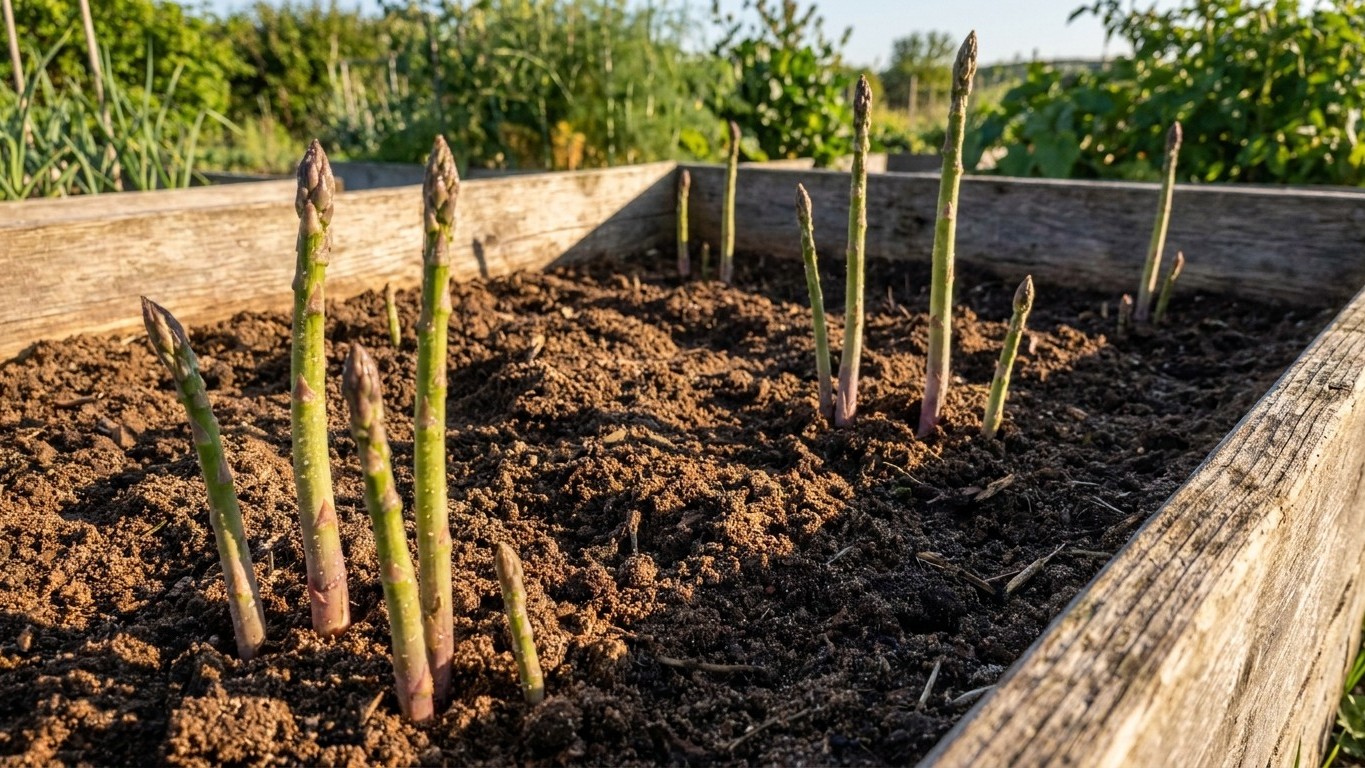

Stop cutting when most of the spears coming up are thinner than a pencil. That signal holds for any bed in British Columbia, and a young bed reaches its limit sooner because the length of the cutting season rises with the bed’s age. Once spears are in the kitchen, the job changes. Keep them at 0°C to 2°C with the cut ends wet, and cook them soon. The details below start with the cold, then move to the bed.
Keeping it, and for how long
What temperature keeps cut asparagus best?
The UC Davis Postharvest Technology Center gives the optimum for green asparagus as 0°C to 2°C (32°F to 35.6°F), with relative humidity of 95 to 100 percent. Its fact sheet calls high humidity essential to prevent desiccation. Spears are mostly water, and the cut end is where they lose it fastest. Dry air pulls moisture out of them from the moment they leave the plant.
What happens above or below that range?
The window is narrow, and both edges do damage. According to UC Davis, spear toughening occurs rapidly at temperatures above 10°C (50°F). A bunch left on a warm counter, or carried home in a hot car, starts toughening long before dinner.
The cold side is just as unforgiving. Freezing injury, which UC Davis describes as a water-soaked appearance leading to extreme softening, will likely result at -0.6°C (30.9°F) or lower. A spear that has frozen looks fine in the fridge and collapses when it thaws. The target is therefore the band from 0°C to 2°C with near-saturated air, and a few degrees of drift in either direction costs quality.
How long will cut asparagus keep?
Any storage life quoted for asparagus is a ceiling. It applies when temperature and humidity both stay in the optimum range from the minute of cutting. A fridge a few degrees warm, a dry shelf, or a bunch that sat in the sun before it went in will all shorten it, and cold cannot undo toughening that has already begun.
Home-cut spears have an advantage over store bunches that have travelled. You can have them in water within minutes of cutting. Use that head start by cooking them soon rather than treating the fridge as long-term storage. Before cooking, check the tips for sliminess and the cut ends for drying, and trim whatever has dried out.
Where in the house that actually is
Which fridge shelf comes closest to the optimum?
A domestic fridge runs warmer than 0°C to 2°C, and its door runs warmer still. Every opening sends a rush of room air across the door shelves, so spears stored there sit furthest from the target. The closest match is the lowest shelf, toward the back, where the coldest air settles. A crisper drawer with a tight seal can also work if you set it to its high-humidity position.
Keep the bunch off the back wall itself. Fridges can have cold spots there, and the freezing line for spears is -0.6°C (30.9°F), only a little under the bottom of the optimum range. A bunch pushed against a cold wall can freeze without anything looking wrong until it is cooked.
How do you give asparagus near-saturated air at home?
High humidity in a home kitchen comes down to water at the cut end, because that is where spears lose moisture fastest. Stand the bunch upright in a jar with about an inch of water, then loosen a plastic bag over the tips and set the jar on that lower shelf. Skipping the water means the cut ends dry out, and the spears shrivel while the fridge is doing its job on temperature.
If a jar will not fit, wrap the butts in a damp paper towel and slip the bunch into a bag. Lay it flat on the same shelf. Either method works as long as the cut ends stay wet. Swap the water if it turns cloudy, and rewet the towel if it dries.
When do you stop cutting asparagus in British Columbia?
Start with the bed’s age. Utah State University Extension describes asparagus planted as crowns in 8-inch furrows in early spring, with no harvest until the third year. After that, the bed produces for 10 to 15 years. The first two seasons get no cutting at all, not even a few spears for the table. In the third year the cutting season runs four weeks. The bed then produces for many years.
Within any season, the spears themselves tell you when to quit. Cut daily or every other day while they are thick. When most of the spears are thinner than a pencil, stop and let them grow into ferns. Those ferns feed the crown for next year, so a bed cut past this point pays for it later. The pencil is the rule, whatever week of the calendar you are in. Growing Asparagus in British Columbia covers the full cycle from crowns to established bed.
Spring frost shapes the start of the season. The mean last spring frost at the Vancouver International Airport station is March 18, according to Environment and Climate Change Canada’s Canadian Climate Normals. A mean date means frost falls later than that in one year out of two, so treat it as the middle of a window. Northern and upland districts of the province run weeks behind the coast, and the safe way to count is from the day your own spears show.
Will British Columbia soil keep the bed going after you stop cutting?
The furrow fills in gradually. Backfill gradually through the year, never all at once. Meanwhile the ferns need steady moisture and drainage, because the bed is a 10 to 15 year commitment in one spot.
The dominant profile in the province is encouraging. Agriculture and Agri-Food Canada’s soil survey puts Brunisols on 33 percent of the mapped surface, then Podzolic soils. The median surface horizon is loam to silt, at 52 percent sand, 10 percent clay and 38 percent silt, with about 5.0 percent organic matter, and it is well drained. The median surface pH runs about 5.8, slightly acid. Utah State notes that most soils will do provided they are well drained, so the typical ground here is a fair match.
Typical is not yours, though. The survey covers the agricultural regions, and river bottoms, muskeg and any lot a builder has scraped or filled can be completely different. If water stands in a test hole for a day after rain, build a raised bed or choose another spot, since a heavy soil under asparagus is a decision that cannot be undone. A soil test gives your own pH and texture. Will British Columbia Soil Hold an Asparagus Bed for Fifteen Years? goes through the drainage check in detail.
Rain matters during fern season. At the Vancouver airport station, June through August brings about 127 mm (5.0 inches), out of 1189 mm (46.8 inches) over the year, and July is the driest month at 36 mm (1.4 inches). Those are normals for one station, not a forecast. On a sandy surface a summer rain passes through within the day, and a single thunderstorm mostly runs off on hot days. A rain gauge on your own plot settles whether the ferns need a hose. What Eats Asparagus in British Columbia, and When covers what moves in on the ferns.
Common questions
Can I take a few spears before the third year?
No. Utah State University Extension has the first harvest in the third year, and the first two seasons are for letting the crowns establish. Cut spears early and you take growth the young crown needs.
Is a fridge colder than 0°C a safe place for spears?
No. UC Davis reports that freezing injury will likely result at -0.6°C (30.9°F) or lower. Spears turn water-soaked and extremely soft. The optimum is 0°C to 2°C, so aim for the lowest shelf rather than the back wall.
Does the variety change when I stop cutting?
The stop rule is the same for all of them: most spears thinner than a pencil. Your county extension office can advise on which crowns to plant. Your county extension office is the place to ask about flavor and yield.
Does March 18 apply to my garden?
Only if you garden near the Vancouver airport station, and even there frost comes later in half of all years. Elsewhere in the province, upland and northern gardens run weeks later. Watch your own spears, and ask your local extension office for the average in your district.