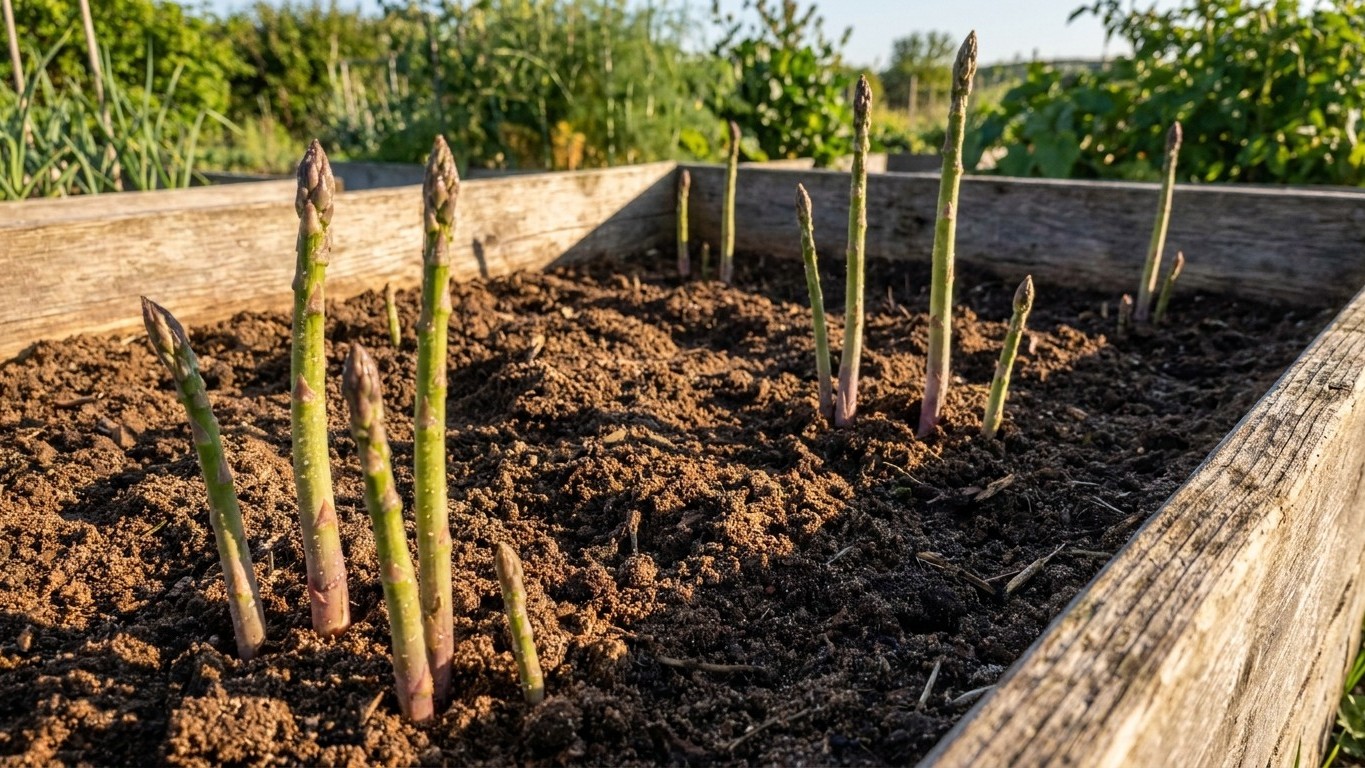

Yes, mostly. British Columbia’s dominant agricultural soil is a Brunisol, a young, well-drained loam that meets the one hard rule asparagus asks for: drainage. A bed planted this spring can realistically still be producing spears fifteen years from now, provided the specific patch of ground behaves like the province’s median profile. It often does. It doesn’t always.
The short answer
Asparagus is unusual among garden vegetables because the decision a gardener makes this year isn’t really about this year. According to Utah State University Extension, a properly planted bed produces for ten to fifteen seasons, and the only soil condition the source insists on is that the ground drains. Not fertility, not a particular texture, not a pH window, just water moving through and not sitting still. That single requirement matters more here than for almost anything else grown in a backyard, because a crop planted annually forgives a bad soil decision within a few months. Asparagus does not offer that exit. Get the spot wrong and the mistake sits there for over a decade.
British Columbia’s mapped agricultural soils lean toward Brunisols, roughly a third of the surveyed surface, which is the largest single category ahead of Podzolic soils. A Brunisol is a young soil, one where the horizons are only starting to differentiate, and it typically forms on coarse or recent parent material. The measured texture across the province’s surface horizons runs 52 percent sand, 10 percent clay and 38 percent silt, which lands in loam to silty loam territory, and the classification pegs it as well drained. Organic matter sits around 5.0 percent, and the median surface pH is about 5.8, slightly acid. None of those last two numbers are asparagus deal-breakers since the source is silent on pH preference. What matters for this specific question is the drainage rating, and on paper, it clears the bar.
That said, a provincial median is not a soil test for one backyard. Agriculture and Agri-Food Canada’s dataset covers the mapped agricultural regions of the province, drawn from thousands of soil components, and it describes what the ground tends to do, not what it does under one specific lawn. River bottoms drain differently than upland loam. Fill dirt behind a newer house drains differently than either. A low spot that holds water after a rainstorm for more than a day is telling the gardener something the provincial average cannot. The fix, if that’s the case, isn’t complicated: raise the bed six to eight inches with amended soil, or move the planting to higher ground on the same property. What doesn’t work is planting into standing water and hoping fifteen years of drainage problems will resolve themselves.
Will the summer here water it for you?
Rain is the second variable that decides whether a bed thrives or limps along, and the numbers here are worth laying out in order, because the asparagus watering schedule changes twice over the plant’s early life.
- Years one and two: the bed wants 1 to 2 inches of water every other week. Over a roughly three-month summer, that adds up to somewhere between 6 and 12 inches just for June through August, depending on which end of that range the weather demands.
- Year three onward: the schedule relaxes to every three weeks, cutting the total summer requirement roughly in half compared to the establishment years.
- What Vancouver-area normals deliver: Environment and Climate Change Canada’s 1981-2010 climate normals for Vancouver Int’l A put total summer rainfall at about 5.0 inches across June, July and August, with July as the driest month at 1.4 inches, June at 2.12 and August at 1.45.
- The gap: even in the low-end scenario, a young bed’s 6-inch summer requirement outruns the roughly 5.0 inches the sky is expected to provide, and that’s before accounting for the fact that rain doesn’t fall on the two-week schedule the plant wants. A single wet week followed by three dry ones leaves the crowns thirsty regardless of the monthly total.
The practical takeaway is that a hose or a drip line does most of the summer’s work during establishment, not the weather. Once the bed reaches its third year and the interval stretches to every three weeks, the gap narrows, but it doesn’t close on its own here. A rain gauge staked next to the bed is a cheap way to know, week by week, whether supplemental watering is optional or mandatory, because the 5.0-inch figure is a station normal for the reference airport, not a guarantee for a particular yard, and a slope, a fence line or a nearby building can shift how much of that rain actually reaches the soil.
When to put the crowns in
Crowns go into the ground in early spring, and for the Vancouver area the anchor point is the average last spring frost date of around March 18, drawn from Environment and Climate Change Canada’s 1981-2010 climate normals. That word “around” matters. A mean frost date is the midpoint of a range, not a promise, which means frost arrives later than March 18 in roughly half of all years on record. Gardeners further inland or at higher elevation in the province should expect their own local frost window to run later still, since this figure comes from a single coastal station.
Crowns are set into furrows about 8 inches deep, and the furrow isn’t filled in all at once. It gets backfilled gradually, roughly 2 inches of soil added every other month across the year, so the crown is never buried instantly under a full 8 inches of ground. Gardeners who’d rather skip the crown-buying step can start from seed instead, though that route adds a full growing season before the plants reach transplant size, pushing the whole fifteen-year clock back accordingly.
What comes after planting
Patience is the real ingredient here. There’s no harvest at all in year one or year two, no matter how vigorous the fern growth looks. Harvest doesn’t begin until year three, and even then it starts light: about 4 weeks of cutting the first harvest year, stretching to roughly 6 weeks the year after, and 8 weeks once the bed is fully established. The stopping point each season isn’t a date on a calendar; it’s a visual cue. Cutting stops when most of the spears coming up are thinner than a pencil, which signals the crown’s stored energy is running low for the season and needs to go back into growing fern rather than spears.
Choosing a variety
Utah State University Extension names four varieties, and the only distinguishing detail published is their sex, not flavor, yield or regional suitability.
| Variety | Sex type |
|---|---|
| Jersey Giant | All-male |
| Jersey Knight | All-male |
| UC 157 F1 | Male/female |
| Purple Passion | Male/female |
All-male varieties tend to put less energy into seed production since female plants set berries, but the source doesn’t rank one variety over another for British Columbia conditions, and no nursery recommendation is offered here.
Common questions
Does British Columbia’s soil need lime or sulfur before planting asparagus?
The source used here doesn’t publish a pH requirement for asparagus, so no adjustment can be recommended from this data. A local soil test is the only way to know whether the province’s median surface pH of about 5.8 applies to a specific yard.
What if a yard sits on heavier, slower-draining ground than the provincial average?
Since drainage is the one non-negotiable requirement, a raised bed built with amended, coarser soil solves the problem without needing to relocate the whole garden.
Can watering be skipped once the bed is established?
No. The schedule relaxes to once every three weeks from year three onward, but summer rainfall in the Vancouver area still falls short of that need in most seasons based on the 1981-2010 normals, so occasional supplemental watering typically remains part of the routine.
Is it risky to plant crowns right at the average last frost date?
The March 18 date is a long-term average, meaning frost occurs later than that in roughly half the years on record. Waiting a bit past the mean, or watching a local forecast, reduces the odds of a late cold snap damaging young crowns.