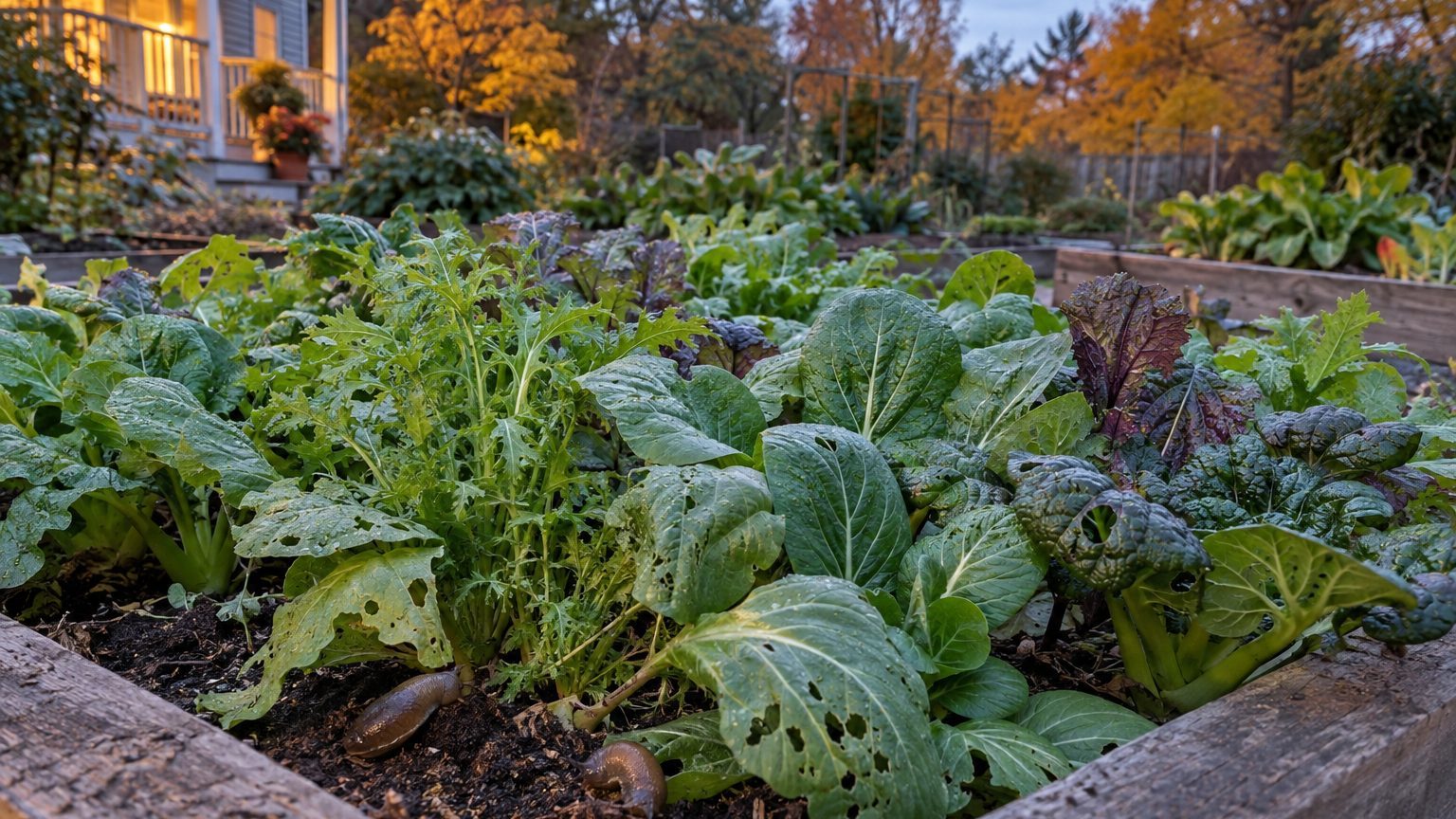

Slugs are the main fall pest of Asian greens, and they feed after dark. Daytime inspection shows ragged holes and silvery trails but no culprit. The fix is to remove the shelter and moisture they depend on, then check the bed at dusk. Most of the work is in how you lay out and water the bed, not in anything you spray.
What is actually going on
Why do slugs go after Asian greens in fall?
A slug has no shell and a skin that dries out fast. It survives by staying wet, which is why autumn suits it so well. Cool nights, dew, and rain keep the soil surface damp for most of the day, and the slug can feed over a much longer stretch of the year than in summer heat.
Asian greens give it cover as well as food. Mizuna, tatsoi, bok choy, and the leafy mustards grow in low, dense rosettes whose outer leaves rest against the soil. Underneath that canopy it stays humid and shaded, so a slug can sleep there all day and feed a few inches away at dusk. The leaves are also thin and tender, which makes them easy to rasp. A tough collard leaf gets chewed less than a baby bok choy.
Many slug species lay their eggs in autumn. The clusters are small, round, and translucent, and they sit in damp soil, under boards, and beneath debris. The slugs you see in October are therefore partly the beginning of next spring’s population, so reducing them now pays off twice.
How can you tell it is slugs and not something else?
Slugs leave irregular holes with smooth edges and a dried, silvery slime trail across leaves and nearby soil. Seedlings can be cut off at the base or grazed down to stubs. Caterpillars leave dark droppings and usually eat from the leaf edge. Flea beetles leave tiny shot-sized holes, and the beetles jump when you touch the plant. If the holes are large and wet-looking and you can find slime, it is slugs.
These crops are all brassicas, and turnips and rutabagas belong to that family too. They share their pests and diseases with cabbage, kale, and mustard. A bed that held any of them last season is not a fresh start, so check the crop rotation guide before you decide where this year’s sowing goes. The overview in Growing Asian Greens: Fast, Cold-Hardy, and Prone to Bolting covers the family as a whole.
In the garden
Where do slugs hide, and what reduces their numbers?
By day slugs shelter in anything that stays cool, dark, and damp. Look under flat stones, boards, pots, edging, thick mulch, fallen leaves, and in soil cracks near the base of the plants. Dealing with those places lowers the population. Treating only the damaged leaves leaves the slugs untouched. The table lists the main measures and what goes wrong with each.
| Measure | What it does | What happens when it goes wrong |
|---|---|---|
| Clear daytime shelter (debris, boards, weedy edges, loose clods) | Removes the hiding places next to the bed, so slugs have to settle farther away. | Cleared once and left alone, the bed fills back up. Leaf litter blows in, a board gets set down “just for now,” and the slugs return within days. |
| Water in the morning, at the soil, on a schedule | Lets the surface dry before dusk, when slugs start to move. See Watering Greens for Tender Leaves. | Evening overhead watering soaks leaves and soil just as feeding begins. The bed is at its most inviting exactly when you most want it dry. |
| Hand-pick at dusk with a flashlight | Takes out the actual feeding slugs, and the count shows you how bad it is. | One session does little. Slugs move in from the margins, so it needs to be repeated over several evenings. |
| Board or tile traps, checked each morning | Gives slugs a hiding place you can empty, so they gather where you can remove them. | Traps that are never emptied become a breeding spot. A board beside the bed also invites slugs to stay near your plants. |
| Spacing and thinning | Opens the canopy so air moves and the soil beneath dries between waterings. | Crowded rows stay damp underneath. Slugs shelter there all day and feed from the inside out. |
| Slug bait labeled for edible crops, used exactly as the label directs | Brings down numbers when hand removal cannot keep up. | Broadcast without checking the label, it can reach places it should not, and the slugs keep coming from the margins. |
How do you check a bed at night?
An hour after dark, go out with a flashlight and look at the undersides of the lower leaves and the soil around each plant. Do this after a damp day, when activity is highest. Slugs are easy to count at that hour, and the count tells you whether hand-picking will do or whether the bed needs more changes. Dropping the slugs you catch into soapy water is a common way to dispose of them.
Birds, toads, and ground beetles all eat slugs, so a few low, dry spots around the garden that give those predators cover help over time. Keep that habitat away from the greens themselves, though, since the same cover also hides slugs. Mizuna: The Fastest and the Most Forgiving is a good crop to start with when slug pressure is high, because it regrows after being cut and tolerates some damage.
What it depends on where you are
Which parts of slug control are the same everywhere?
The biology is national. Slugs need moisture, they hide by day, and they feed at night. The measures that follow from that, such as removing shelter, watering in the morning, and checking at dusk, work in a Vermont garden and an Oregon one alike. A hard freeze stops slugs from feeding wherever it arrives.
What changes with your region?
The timing and the severity are local. Three things move the answer:
- Season length. A long fall gives slugs weeks more to feed and lay eggs, while an early hard freeze shortens the problem.
- Summer heat. Where summers are hot and dry, many slugs retreat deep into the soil and come back with fall rain. Where summers stay mild and wet, they never really leave.
- Summer rainfall. A wet summer builds a larger population before your fall sowing even starts.
Mild, wet coastal regions often see slugs feeding through much of winter. Colder inland areas see activity end earlier. In the humid South, slugs can also carry a parasite called rat lungworm, which has been reported in Hawaii and in some Gulf Coast states. Washing greens thoroughly before eating them is a sensible precaution everywhere, and your state health department can tell you whether it is a concern locally.
For sowing windows, the state pages on this site give the planting calendar for each region. Your state extension service can tell you which slug species are common near you and which varieties have been trialled in your area. Local trial results on bolting and slug damage are more reliable than a general rule, so a call to the county extension office is worth making before you plant.
The mistake that costs the most
The costliest error is sowing the bed and then not looking at it until holes appear. A fall seedling has a few small leaves and almost no reserve. A group of slugs can graze a row of seedlings to the soil line in one or two nights, and the damage looks like the seeds never came up. Resowing then eats weeks of a season that is already getting shorter, and a second sowing can leave you with greens that are still small when hard cold arrives.
The fix starts before the seeds go in. Clear the bed’s edges and the ground around it of boards, leaf litter, and old mulch, because that is where the slugs will be sheltering. Water in the morning, and check the bed at dusk every evening for the first two weeks after sowing, which is when the plants are most vulnerable. If you find slugs feeding, pick them off that night rather than waiting for the weekend.
Keep checking once the plants are bigger, but at that stage a few holes in the outer leaves are cosmetic. The seedling stage is the one that decides whether you have a crop at all.
Common questions
Can I still eat greens that slugs have chewed?
Yes, once you trim away the damaged parts and wash the rest carefully. Discard any leaf with a soft patch, a slimy rot, or a weeping spot, because the damage can let rot organisms in. Slime trails and holes alone are not a reason to throw out a head of greens.
Do slugs stop when it gets cold?
They slow down as nights cool and stop feeding in a hard freeze, but a mild spell wakes them up again. Eggs laid in autumn survive the winter in the soil, so cold weather ends the feeding without ending the population.
Are Asian greens related to cabbage and turnips?
Yes. Mizuna, bok choy, tatsoi, and mustards are brassicas, as are cabbage, kale, turnips, and rutabagas. They share slugs, flea beetles, and soil diseases, so rotating among them gives no real break. Use the rotation guide to plan a bed that has not held any brassica recently.
Does a beer trap work?
It catches some slugs, but it works only within a short distance of the trap. It is useful as a way to see how many slugs are around. It does not replace removing shelter and watering in the morning. Empty the trap every day or two.