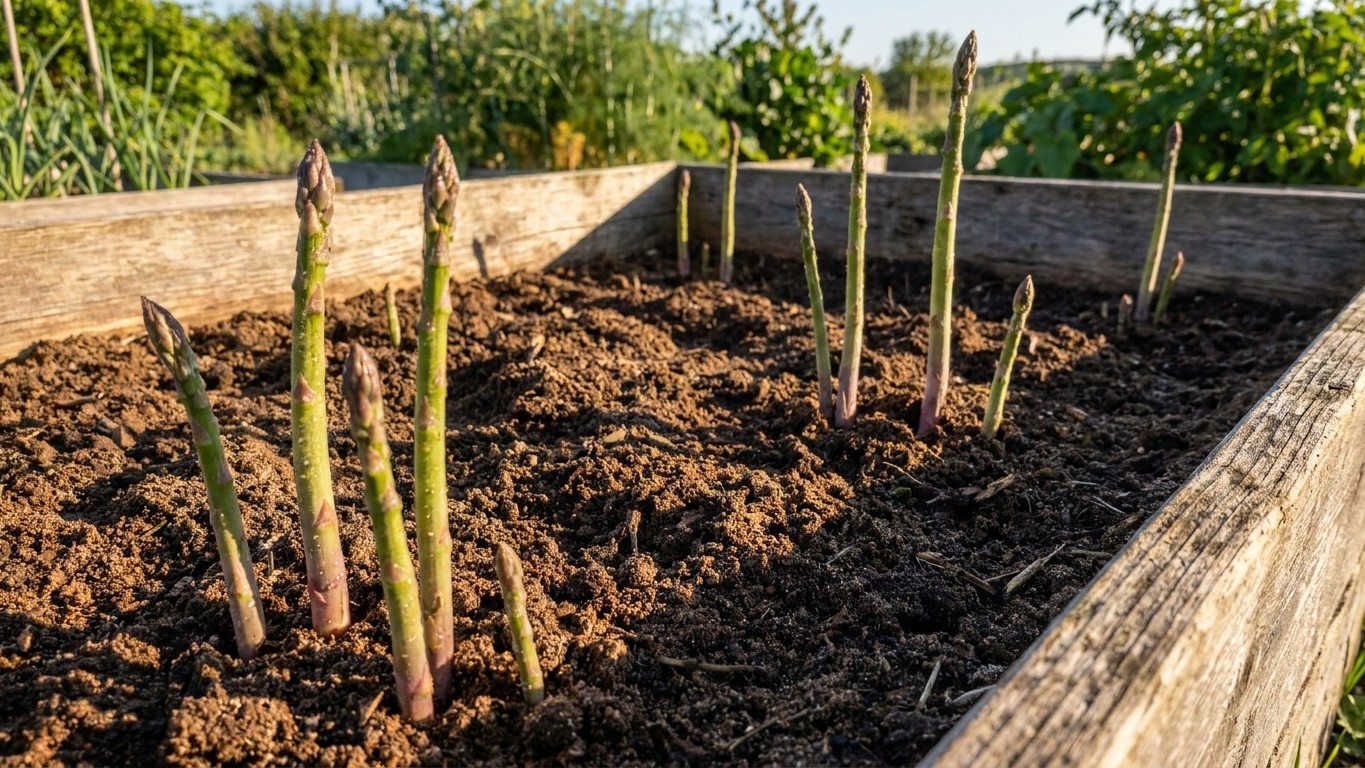

Stop cutting when most of the spears coming up are thinner than a pencil. That is the sign the crown needs its ferns to refill. Once spears are cut, they keep best in cold, near-saturated air at 32°F to 35.6°F. A home refrigerator needs a little help to get there.
Keeping it, and for how long
A cut spear is still alive. It keeps losing water through the cut end and its tissue keeps turning fibrous, which is why a spear cut in the garden and cooked within the hour tastes different from one that sat for a week. Cold slows the process but doesn’t stop it. The UC Davis Postharvest Technology Center puts the optimum temperature at 0°C to 2°C, which is 32°F to 35.6°F, with an optimum relative humidity of 95 to 100 percent. It calls high humidity essential to prevent desiccation, meaning the spears shrivel when the air around them is dry.
What temperature range keeps cut asparagus best?
Both edges of the window cause damage. According to UC Davis, spear toughening occurs rapidly at temperatures above 50°F. On the cold side, freezing injury is likely at 30.9°F or lower. The tissue turns water-soaked, then goes extremely soft. The target is only about three and a half degrees wide, and the freezing threshold sits barely a degree below the bottom of it. Plenty of kitchen refrigerators drift on both sides of that target, so a thermometer is worth more than guesswork.
How long does cut asparagus keep?
Any storage time quoted for asparagus is a ceiling that applies only when the spears sit at those exact conditions: 32°F to 35.6°F, with air at or near saturation. It is not a promise for the vegetable drawer of a household refrigerator. Every degree above the optimum, and every hour in dry air, shortens the usable life of the spears. The safest plan is to cook them soon after cutting and treat storage as a short bridge between the garden and the stove.
Think of cut flowers. A bouquet lasts longest in a cool room with its stems in water, and it fades fast on a sunny windowsill. Asparagus follows the same logic, and for the same reason: the cut end is where it loses water fastest.
Where in the house that actually is
A domestic refrigerator usually runs warmer than the optimum above, and its door runs warmer still. Every time the door opens, the shelves there take the first rush of room air. That makes the door the worst place for spears, and the countertop is worse. A room-temperature kitchen sits well above the 50°F line where toughening speeds up.
The coldest spot is usually the lowest shelf toward the back, because cold air settles there. A crisper drawer can also work, if you close its humidity vent so the drawer holds moisture. Keep the spears off the back wall itself. In some refrigerators that wall frosts over, and a spear that touches it can reach the freezing injury that UC Davis describes. An inexpensive appliance thermometer left on the shelf for a day will tell you which spot comes closest to the target.
High humidity in practice means putting water where the spears lose it. Stand the cut ends upright in a jar of water, as you would a bunch of flowers, and drape a loose bag over the tips. Skipping this step costs you the spears. They shrivel, the butts dry and the tips go limp well ahead of any spoilage. If a jar will not fit on your shelf, wrap the cut ends in a damp paper towel and slip the bundle into a bag. Either method gives the base of the spear the moisture the surrounding air can’t.
How do you know when to stop cutting asparagus?
The bed is planted as crowns in 8-inch furrows in early spring. Utah State University Extension says to wait until year 3 before harvesting, and then the bed can produce for 10 to 15 years. The wait is not negotiable.
In year 3, the cutting season runs about 4 weeks. The next year it can stretch to 6 weeks, and in the years after that, to 8. Those lengths are limits. The plant decides when the season ends, and the sign is in the spears. When most of the new spears are thinner than a pencil, stop cutting. Thin spears mean the crown is running low, so you leave them to grow into ferns that feed it for the next spring.
Weather will shift when the season starts. West of the Cascades, where the climate is mild and maritime, the last 32°F freeze falls between February 27 and March 18, according to the 30 to 70 percent probability band in NOAA NCEI climate normals for the Seattle reference station. Eastern Washington, beyond the mountains, is high desert with a much shorter season, so that window should not be applied there. A mild frost date also does not mean early planting. Cold, wet soil and low light hold spring crops back well past the last freeze, and your own bed will tell you more than the average.
What should the bed get after the last cut?
Let every spear that comes up after the last cut grow into a fern. Those ferns are the bed’s solar panels for the rest of the year. Pests that chew on them are a separate matter, covered in What Eats Asparagus in Washington, and When. For the overall plan from crowns to year 15, see Growing Asparagus in Washington.
Summer is the dry stretch. NOAA NCEI normals for the reference station show about 3.0 inches of rain across June, July and August, out of 39.3 inches for the year. July is the driest month at 0.6 inches, with June at 1.45 and August at 0.97. Those are averages for one station and say nothing about a particular slope or neighborhood. The bed should be watered when the soil a few inches down feels dry, and a rain gauge on your own plot settles how much help it needs. Rain that arrives in one thunderstorm mostly runs off, and very hot days dry the ground faster than the totals suggest.
The soil sets how quickly that dryness arrives. The USDA lists the Tokul series, an Andisol formed from volcanic ash, as Washington’s representative soil. It is light and porous, holds water and phosphorus unusually well, and is moderately well drained. The mapped surface is loam to silt, with 45 percent sand, 10 percent clay and 45 percent silt, and a pH of about 4.5, which is strongly acid. Its organic matter is about 75 percent, which means the mapped layer is a natural forest organic layer that a cultivated bed will not have. That is the soil that represents the state, and it is not the soil in every garden. River bottoms, hill country and ground a builder has scraped or filled can differ completely.
For a bed that has to last 10 to 15 years, drainage is the deciding factor. Utah State University Extension says most soils will do as long as they are well drained. A soil test gives the number for your own plot. If water stands in the bed after rain, the choice is made early: raise the bed or choose another spot. Will Washington Soil Hold an Asparagus Bed for Fifteen Years? goes through that decision.
The furrow itself fills in gradually. Backfill it over the first year, adding about 2 inches of soil every other month, rather than all at once.
Common questions
Can I cut asparagus in its first or second year?
No. The crowns are planted in early spring and not harvested until year 3. Then the first cutting season is about 4 weeks, followed by 6 weeks, then 8.
What happens if my refrigerator is too cold for asparagus?
Freezing injury is likely at 30.9°F or lower, according to UC Davis. The spears take on a water-soaked look and then go extremely soft when they thaw. The target is 32°F to 35.6°F, so a shelf that frosts the back of the carton is too cold.
How do I know the season is over?
Look at the spears coming up. When most are thinner than a pencil, stop cutting and let the ferns grow. A week count will not tell you this, because the thickness of the spears reflects how much the crown has left.
Can I leave cut asparagus on the counter?
Only for the short time between cutting and cooking. UC Davis says spears toughen rapidly above 50°F, and a room-temperature kitchen is above that. Stand the cut ends in water and move them to the refrigerator as soon as you can.