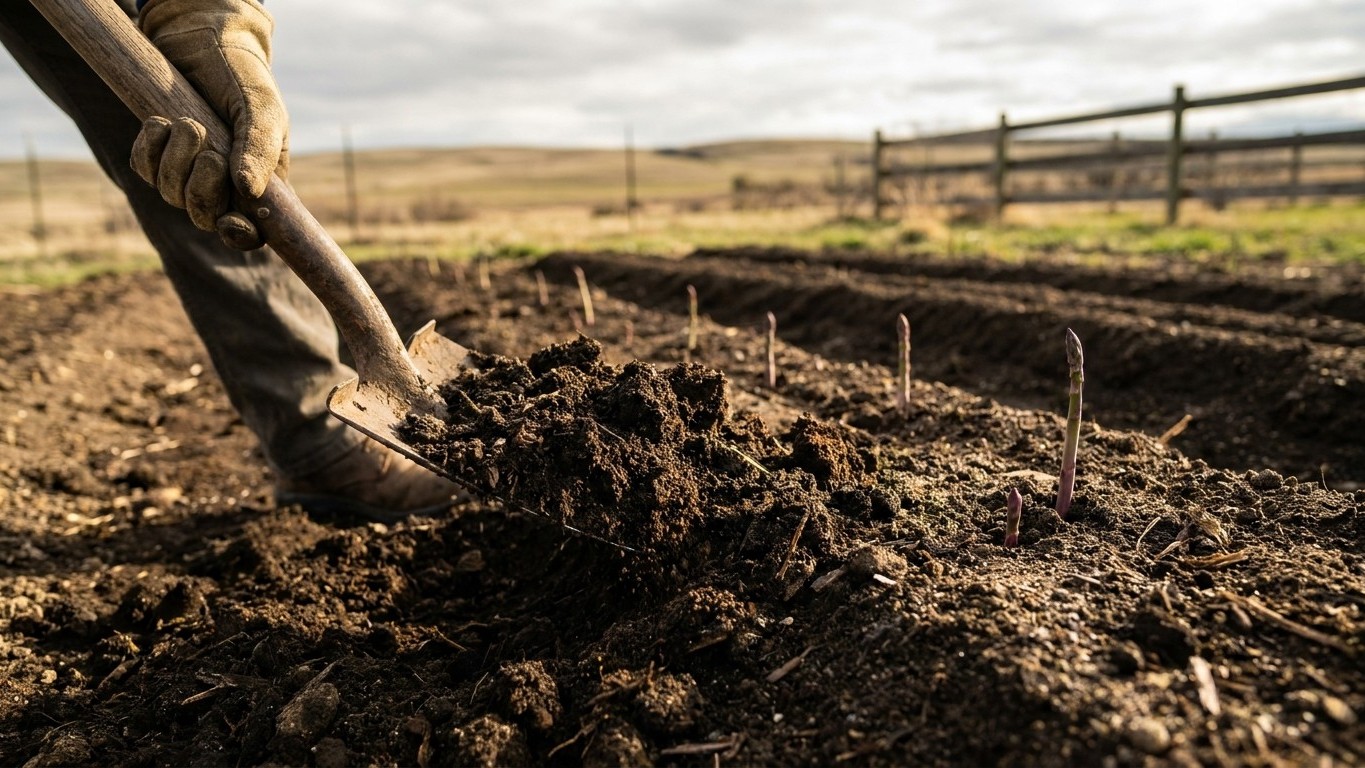

an Asparagus Bed asks for one thing above all: soil that drains. The Tokul series, the soil USDA lists as representative of Washington, is described as “moderately well drained” rather than simply “well drained”, a distinction that matters when the crop in question is expected to stay in the same 8-inch furrow for a decade or more. Whether that difference sinks the plan depends on what’s actually under a given yard, not on the state average.
The short answer
Start with what the Tokul series actually is. It’s an Andisol, built from volcanic ash rather than the more familiar clay-and-sand mixtures found east of the Cascades or across most of the Midwest. That ash origin makes it light and porous, and unusually good at holding onto both water and phosphorus at the same time, a combination that sounds ideal for a long-lived root crop. The catch is the surface pH, which runs around 4.5, strongly acid, and a number the source is otherwise silent about matching to asparagus’s own preference (the crop’s pH tolerance isn’t published in the reference used here, so no comparison can be made honestly).
The texture numbers back up the porous reputation: 45 percent sand, 10 percent clay, 45 percent silt, sitting in the loam-to-silt range. Low clay content generally means water moves through rather than pooling, which is the direction a fifteen-year bed wants. The organic matter figure, around 75 percent, is worth a pause rather than a celebration. A number that high on a mapped surface horizon usually signals a natural organic layer, peat, muck, or forest litter, sitting on top of the mineral soil as surveyed, not the composition of a bed that’s been tilled, planted, and cultivated for years. A gardener’s actual dug-over patch will not carry anything close to that organic-matter percentage once it’s been worked.
So does the state’s representative soil drain well enough for a bed meant to outlast a car loan? That’s really the question behind Will Washington Soil Hold an Asparagus Bed for Fifteen Years?, and “moderately well drained” is a step down from ideal, not a disqualification. It usually means water moves through in a reasonable window but not instantly, and on a fifteen-year commitment that’s a real gap between fine and definitely-fine. If a test hole fills with water and stays wet longer than a few hours after a hard rain, that’s the signal to act before the crowns go in the ground, not after. The fix is not complicated: raised beds, a few inches of coarse sand or compost worked into the planting trench, or simply relocating the bed to the highest, driest corner of the property. What doesn’t work is planting first and hoping the soil sorts itself out, because by the time root rot shows up in year six, the investment is already gone. Getting the drainage prep right matters just as much as When to Plant Asparagus Crowns in Washington, since timing and soil conditions work together to determine whether the bed thrives.
Will the summer here water it for you?
The rainfall normals for the reference station used here (USW00024233, 1991-2020) break down by month, and asparagus’s own water schedule breaks down by bed age. Lining the two up shows exactly where a hose becomes non-negotiable.
- June brings a normal of 1.45 inches, arriving in whatever number of storms the season happens to deliver rather than as a steady drip.
- July is the driest month on record for this station, at just 0.6 inches, which is the point in the summer where a newly planted bed is most exposed.
- August recovers slightly to 0.97 inches, bringing the three-month summer total to about 3.0 inches against an annual normal of 39.3 inches, meaning nearly all of the region’s rain falls outside the growing season.
- A bed in its first two years wants 1 to 2 inches every other week. Stretched across a roughly 13-week summer, that works out to somewhere between 6 and 13 inches of water over the season, several times more than the 3.0 inches the sky is expected to provide.
- Once the bed matures past year two, the schedule eases to every three weeks, cutting the season’s need to roughly 4 to 8 inches, still ahead of what summer rainfall normally covers.
- July’s 0.6-inch normal is where the shortfall bites hardest and shows up fastest, since it’s both the driest month and often the hottest, so a missed watering there tends to show up in the fronds within days rather than weeks.
None of this accounts for what the soil does with the rain that does fall. A porous, fast-draining surface like the Tokul series lets water move through quickly rather than holding it near the roots, so even a wetter-than-normal July won’t stretch as far as it would on a heavier soil. A rain gauge staked next to the bed is a better guide than any regional average, but the normals make one thing clear: this is not a climate where a gardener can plant and walk away for the summer.
When to put the crowns in
Crowns go into 8-inch furrows in early spring, and “early spring” here means working around the last frost rather than a fixed calendar date. For the reference station used in these figures, the 32°F freeze probability window runs from around February 27 to around March 18, a mean drawn from three decades of data rather than a promise for any single year. That window describes western Washington’s mild, maritime climate specifically. East of the Cascades, the terrain shifts to high desert with a shorter, harsher season, and this frost window should not be stretched across the whole state as if conditions were uniform.
A mild last-frost date doesn’t automatically mean an early planting date. Cold, wet soil and short daylight hold spring crops back well past the point when the freeze risk has technically passed, so “around” the frost window often means waiting a few extra weeks for the ground to actually warm and dry before digging furrows.
The furrow itself isn’t filled in one pass. Backfilling happens gradually across the first year, adding about 2 inches of soil back into the trench roughly every other month as the crown’s shoots grow taller, rather than burying the crown all at once at planting time.
Patience matters more here than in almost any other vegetable bed on the property, because there’s no harvest at all in year one or two. Cutting doesn’t start until year three, and even then it’s limited: about 4 weeks of harvest that first cutting year, extending to 6 weeks the following year, and 8 weeks once the bed is fully established. The rule for knowing when to stop cutting for the season isn’t a date on a calendar; it’s the spears themselves. Once most of what’s coming up runs thinner than a pencil, harvesting stops for the year so the plant can put energy back into the roots for next season.
On variety, the available information is limited to sex, not performance. Jersey Giant and Jersey Knight are all-male varieties; UC 157 F1 and Purple Passion are male-female mixes. No published source here compares their flavor, yield, or suitability to one climate over another, so the choice comes down to availability rather than a documented reason to prefer one over the rest. For gardeners weighing seed against purchased crowns, seed is the alternative starting point, though the timeline and step-by-step figures in the source used here cover only the crown method; most home growers choose crowns specifically because they reach productive size faster.
Checking this against your own county
Everything above describes a representative soil series and a single reference weather station, not any one backyard. Washington spans river valleys, hillsides, and fill dirt from decades of construction, and any of those can behave nothing like the Tokul series described here. Before committing a corner of the yard to a bed meant to last fifteen years, a soil test through the county’s own extension office settles the pH and drainage questions that a state-level figure can’t answer.
Washington State University Extension (extension.wsu.edu) runs county-level offices across the state, and they’re the direct route to local frost date records, soil testing services, and planting guidance calibrated to conditions on a specific piece of ground rather than a statewide average. Given how long an Asparagus Bed stays put once it’s planted, that’s a phone call worth making before the crowns go in.
Common questions
Does asparagus need acidic soil to grow well in Washington?
The Tokul series representative of the state runs around pH 4.5, strongly acid, but the extension source used here doesn’t publish asparagus’s own pH preference, so no direct match can be confirmed. A soil test is the only way to know whether a specific bed’s pH needs adjusting.
How do I know if my garden soil drains well enough for a fifteen-year bed?
A simple test hole is the practical check: dig it, fill it with water, and see how long it takes to drain. If water lingers for hours after a rain, the soil likely needs amending or the bed needs to move to higher ground before crowns go in.
Can eastern Washington follow the same frost timing as the rest of the state?
No. The frost window cited here comes from a western Washington reference station and reflects a mild, maritime climate. Eastern Washington’s high-desert conditions run a shorter, harsher season, and applying the same dates there would risk planting into ground that’s still frozen.
What if my soil doesn’t drain as well as the state’s representative soil?
Raised beds, working coarse sand or compost into the planting trench, or choosing the highest and driest spot on the property are the standard fixes. Given that the bed is expected to stay put for a decade or more, it’s worth solving a drainage problem before planting rather than after.