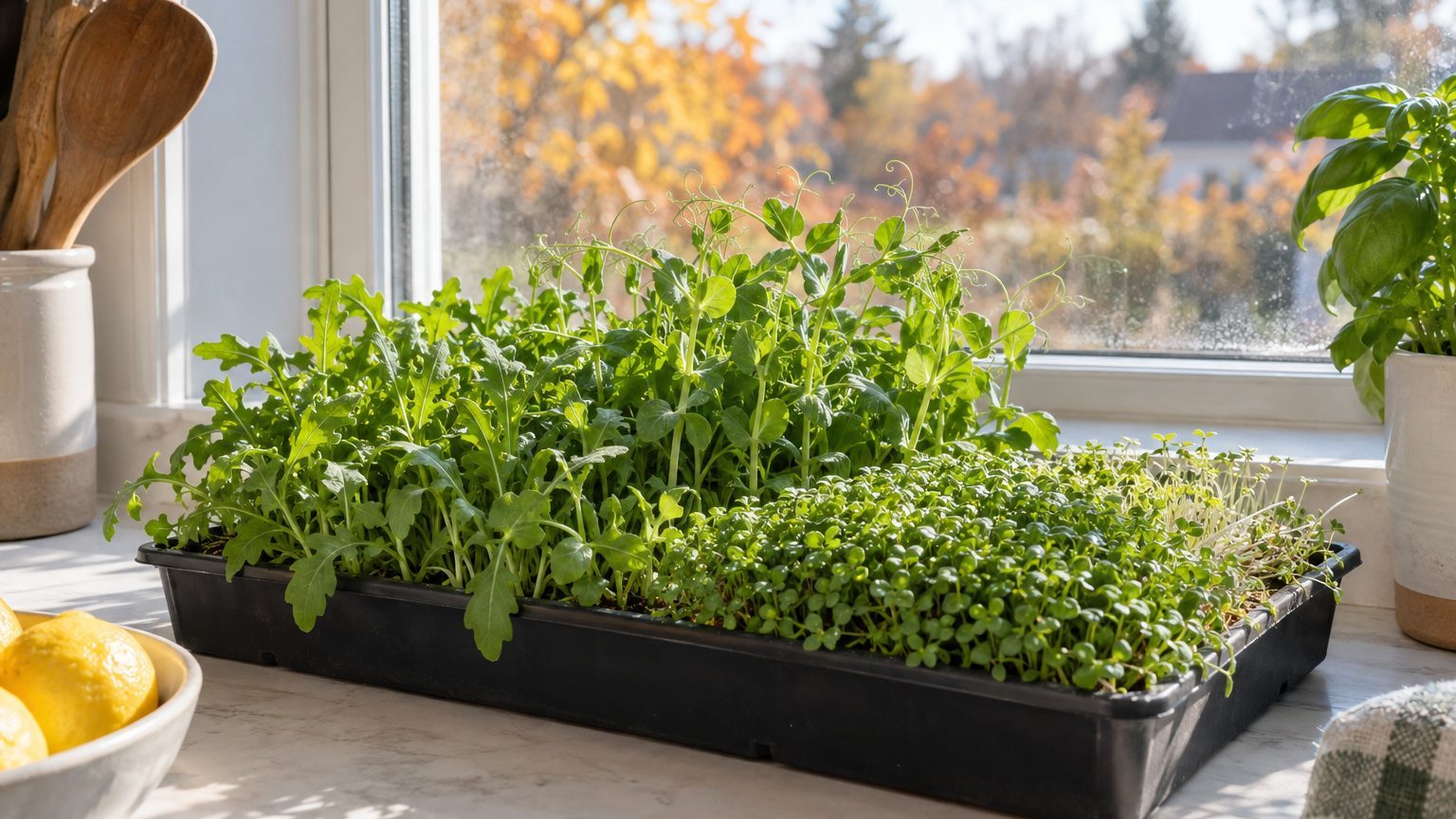

A sunny windowsill can give you winter salad, but only from a short list of crops, and only if you cut them young. Cresses, mustard-type greens, arugula, pea shoots and loose-leaf lettuce at the baby stage will grow in a bright window. Heading lettuce, chicories and anything that needs weeks to fill out will stretch, thin and stall. Light is the reason.
What is actually going on
A seed arrives with its own food supply. That reserve gets it through germination and the first small leaves, which is why almost anything sprouts on a kitchen counter. After that, every new leaf is built from sugars the plant makes out of light. A windowsill in winter supplies a fraction of the light a bed outdoors gets in spring, and a plant that has to build a full leaf needs more than that fraction.
How much light does a winter windowsill actually give?
Less than it looks like. The winter sun sits low and the days are short. Window glass takes some light out of what does arrive, and a pane in a cloudy week takes out more. Light also falls off quickly with distance from the glass, so a pot a foot back from the window gets noticeably less than one touching it. A shady spot outdoors on an overcast day is often brighter than a sunny sill indoors.
Plants tell you when they are short of light. Stems grow long and pale, leaves stay small, and the whole tray leans toward the glass. That is a plant spending its seed reserve on reaching for light it cannot find. If you see it, move the tray closer to the window or add light.
The crops that work indoors are the ones you harvest while the seed reserve and a few small leaves still carry most of the load. Seedling greens, cresses and baby leaves fit that description. A tight head of lettuce or a chicory rosette does not.
Can a grow light fix a dim windowsill?
Mostly, yes. A basic full-spectrum LED fixture hung a few inches above the tray and run on a timer for roughly a dozen hours a day supplies what the window cannot. It widens the list of crops you can grow and keeps growth compact instead of leggy. It covers a small area, though, so you are growing a tray or two, not a bed. And a plant under a light still sits in a cool, dry room, so watering habits matter just as much as they did before.
Many people get along without a light, using one bright south-facing window and a short crop list. Both approaches follow the same rule: match the crop to the light you actually have, not the light the seed packet assumes.
In the garden
The “garden” here is a tray, a shallow pot or a window box sown from packet seed. Nothing on this list comes from the wild. The table shows what manages indoors and what happens when it does not. For varieties that have been trialled in your area, ask your state’s cooperative extension service.
| Type of crop | Indoors in winter | What happens when it goes wrong |
|---|---|---|
| Seedling greens (pea shoots, radish, mustard, sunflower) | Works well, cut at the seedling stage | Left too long, stems go pale and floppy. If the tray stays soggy, a fuzzy gray or white mold shows up on the stems and soil. |
| Garden cress and other cresses grown from seed | Works well, fast and forgiving | Sown too thickly, the seedlings crowd, damp down and collapse in patches. |
| Arugula and mustard-type baby leaves | Works in a bright window or under a light | In dim light or a warm room, growth is slow and thin, and the leaves taste sharper than you wanted. |
| Loose-leaf lettuce, cut as baby leaves | Works with good light, cool nights help | Next to a radiator or in weak light, it stretches, flops and goes limp within days. |
| Heading lettuce, escarole, endive, radicchio | Disappoints | A loose, leggy rosette that never fills out. These do their best work in an outdoor bed or cold frame (see Endive, Escarole and Radicchio). |
Why does cut-and-come-again fail indoors in winter?
Outdoors, a lettuce cut an inch above the crown grows back because the roots hold reserves and the sun feeds the new leaves. Indoors in winter, the stump left after cutting has few leaves to make sugar. Regrowth comes up thin and pale, and each later cut is weaker than the one before.
A second problem hides below the soil. A cut plant uses far less water, but the pot stays damp in a cool room. Roots sitting in wet mix with little light above them are the usual start of rot and of the tiny flies that breed in soggy potting mix.
The practical routine is one cut, then resow. Cut the whole tray when the leaves are a few inches tall, compost the remains and start a fresh batch. Under a grow light, a second small cut from a lettuce sometimes comes through, but plan on the first cut being the best.
What it depends on where you are
Some of this holds in every state. The light mechanism, the short crop list and the one-cut routine are the same in Minnesota and in Georgia. Plants do not care about your zip code; they care how much light reaches the leaf.
The rest is local. Winter light changes with how long your gray spells run and how low the sun sits. A kitchen window in a region with weeks of overcast skies gives much less than one in a sunny, dry climate. Season length matters too. Where the ground freezes hard and stays frozen, a windowsill fills a real gap. Where winters are mild enough to keep outdoor beds, cold frames or low tunnels going, the windowsill is a convenience and the better salad is outside.
Summer heat and summer rainfall shift the picture further. Where summers are hot and humid, outdoor lettuce gives up early and the good salad season runs from fall into spring, so the indoor trays bridge a shorter stretch. Humid homes also grow mold more readily, which means more air movement and lighter watering. Where summers are dry and cool, outdoor salad lasts longer and the indoor season starts later in the year.
Your own house changes the answer as well: which way the window faces, whether a heating vent sits underneath it, and whether the glass is single or double pane. A cold sill can slow growth. A hot one pushes it too fast for the light.
For the broader picture of what grows through winter outdoors, start with Winter Salads: What Grows When Lettuce Will Not. The state pages on this site give regional timing, and your state’s cooperative extension service can tell you which varieties have been trialled where you live and how your local winter light behaves.
The mistake that costs the most
Sowing one big tray and waiting on it is the error that costs the most. It feels efficient. You fill a long planter in November, and for a few weeks it is lovely. Then everything is ready at once, the leaves outgrow the light, and the tray goes from a good cut to stretched, crowded plants that you try to nurse along. Mold arrives in the dense, damp middle. By January you are either throwing out a tray or eating leaves you would have thrown out earlier.
Indoor plants have a short window of usefulness because the light only supports them to a certain size. A big sowing puts all your salad into that one short window, and the weeks after it are empty.
The fix is small and steady. Sow a small tray or a few pots every week or so, so a new batch comes along just as the last one is cut. Each tray is a single harvest. When you cut it, pull the roots, add the soil to the compost and wash the container before refilling it with fresh seed-starting mix. That keeps stems compact, spaces the work out and gives you a little salad at a time instead of too much at once.
Outdoors, staggered sowings are an old habit, and the principle is the same indoors in a smaller, faster form. The method is laid out in Sowing Winter Salads in Succession. On a windowsill the gap between sowings is simply shorter, because each tray has a short working life. If you only have room for one tray, divide it into sections and sow one section at a time.
Common questions
Can I grow salad leaves on a north-facing windowsill?
Rarely with good results. A north window gives little direct light in winter, so plants stretch and stay small. If it is your only option, use a grow light or choose a brighter window elsewhere in the house.
Do I need a grow light?
No, but it helps. A bright south-facing window can handle seedling greens and cresses. A grow light on a timer lets you add baby lettuce and arugula, and it keeps growth compact in dim weeks.
How do I stop mold on the tray?
Sow thinly, water lightly from the bottom or at the soil line, and keep air moving across the tray. Cut crops while they are young. Mold usually starts where seedlings are crowded and the surface stays wet.
Can I reuse the potting mix?
It is better to start each tray with fresh seed-starting mix, since used mix can carry disease and fungus gnats from the last crop. Add the old mix to the compost pile or work it into outdoor beds.