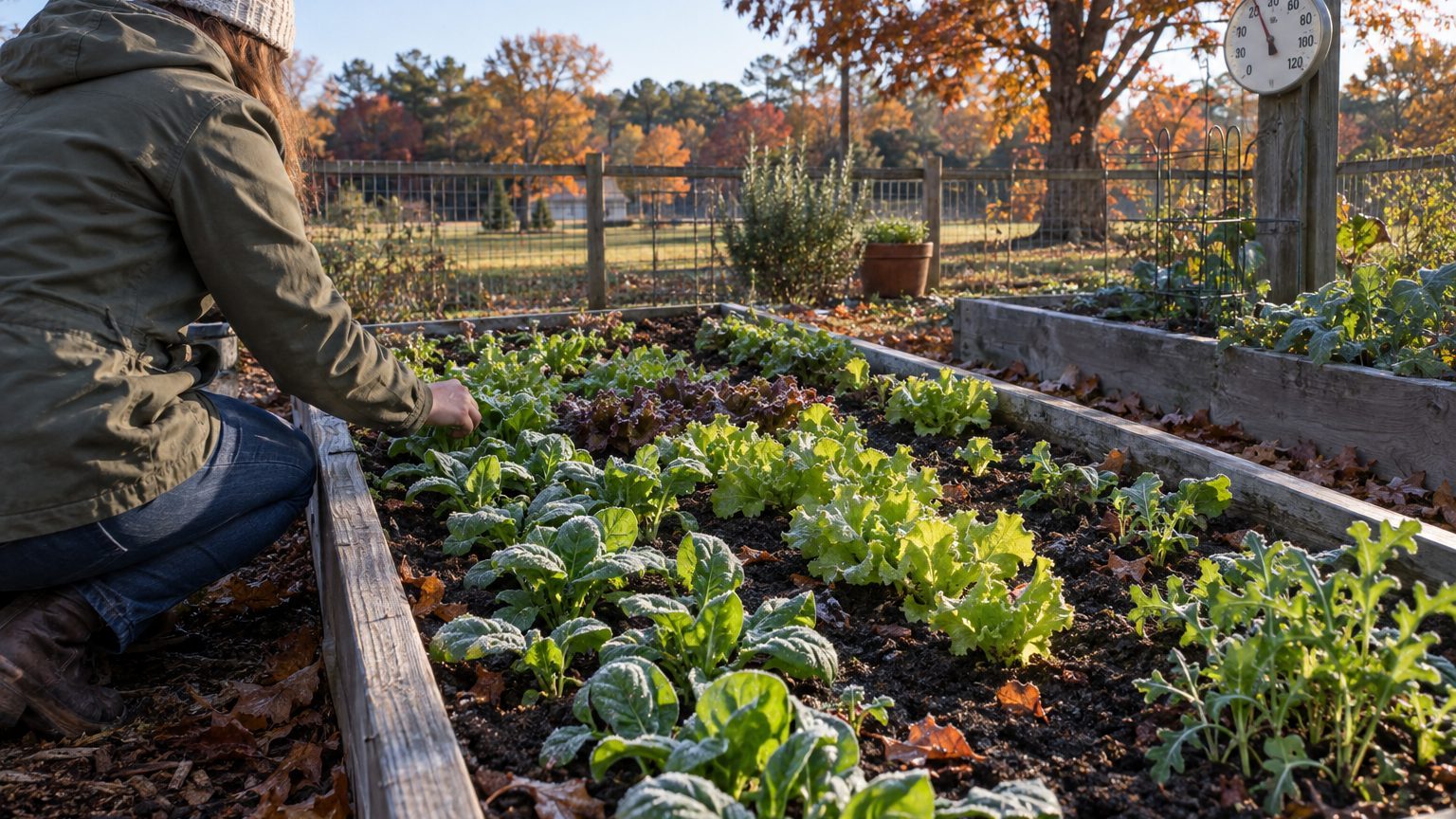

Sow winter salads in Nova Scotia from late July through mid-September, slow crops first and hardy ones last. Heading lettuce and endive go in late July or early August. Quick mixes and arugula follow in mid-August. Spinach, mâche and claytonia finish the run by mid-September. All of them need a row cover or an unheated tunnel before hard cold arrives.
The short answer for Nova Scotia
The window runs from late July to mid-September, counted back from a first fall frost that arrives on average October 18 at the Halifax Stanfield airport station. That date is a mean from Environment and Climate Change Canada’s 1981-2010 normals, so in one year out of two the first frost comes earlier. The mean last spring frost at the same station is May 7, and in one year out of two the final frost falls later than that. Treat both as the middle of a window, never as a safe date.
The reference station has a mean last spring frost and a mean first fall frost, and the gap between them is the frost-free window. That sounds generous, but winter salads do not run on frost-free days. They run on light. Once daylight shortens noticeably, growth slows to almost nothing until spring. A plant that is not close to full size by then will not get there. A plant that is will sit in the bed, alive and edible, and you pick from it all winter.
What is the sowing window for each type of winter salad?
Sort by how slowly the crop grows.
| Type | Sow roughly | Why then |
|---|---|---|
| Heading lettuce, endive, radicchio | Late July to about August 10 | Slowest to size up; needs the longest days |
| Baby-leaf mixes, arugula, mustards, Asian greens | Mid-August to early September | Quick to harvest size, but fade fast under 10 hours of light |
| Spinach, mâche, claytonia, kale | Late August to mid-September | Hardy enough to sit through winter at modest size |
Spring offers a second, gentler window. Hardy greens can go in under cover in late winter and outdoors as soon as the soil can be worked, since a light frost does not bother them. Wait until after May 7 plus a margin for anything tender. For picking varieties within each type, see The Best Winter Salads for Nova Scotia.
What will not work here

Sowing in October. With a mean first frost of October 18 and daylight shrinking every week, seed that goes in then produces seedlings that stall at a few leaves. They survive, and they will give a decent picking in March once light returns, but they will not feed you in December. If you miss the September window, plan the bed as a spring crop and stop expecting a winter harvest.
Open ground with no cover is the second failure. The mean daily minimum of the coldest month at Halifax is -10.4 °C, and that is an average night, so the worst nights run well below it. Leaf lettuce, arugula and most mustards will burn or die on exposed beds. Spinach, mâche, claytonia and kale handle far more, though even they do better under a layer of fabric. Wind off the Atlantic and the Bay of Fundy dries leaves out on bare, exposed sites, which adds damage that the thermometer alone does not explain.
Why does close spacing fail in a damp maritime climate?
Fog, drizzle and long damp spells keep leaves wet from October to April. Crowded plants hold that moisture, and gray mold and downy mildew move through them quickly. Slugs thrive in the same conditions and hide under dense foliage. Thin spinach and heading lettuce to the spacing on the packet, and open the tunnel ends on mild days so the air moves. Packing a bed tight, which works in a dry climate, backfires here.
The opposite problem hits in late July. Lettuce seed germinates poorly when the soil is very warm, and a sunny raised bed can get that warm even in a mild summer. Sow in the evening, water the row before and after, and lay a board or shade cloth over it until seedlings show. Low-pitched hoop tunnels can also fail under the heavy, wet snow the province gets. A steeper arch, or brushing snow off after each storm, protects the crop and the frame.
What changes across Nova Scotia
The Canadian plant hardiness zone for the reference city is 6b, according to Natural Resources Canada’s 1991-2020 data. That is the Canadian system, built on seven climate variables, and it does not convert to a USDA zone. Natural Resources Canada itself says there are no simple conversions between the two, and that Canadian zone 4a overlaps nine USDA zones, from 3a to 7a. Do not carry the number onto a US map.
It is also one city’s zone, not the province’s. The Atlantic coast is moderated by the ocean. Inland basins, hollows where cold air pools, and the uplands and northern districts are colder and run weeks behind Halifax in spring and fall. There is no single answer for Nova Scotia, and the Canadian plant hardiness map from Natural Resources Canada shows the zone municipality by municipality. Look up your own community there instead of assuming it matches the reference city.
A reader in the north or at elevation should shift in two ways. Start the sowing window earlier, so the late crops go in sooner and the hardy greens follow. And treat protection as required, not optional, because the first hard frost can come well before October 18. A second layer of fabric inside an unheated tunnel adds a few degrees at little cost. Coastal gardeners can lean toward the later edge of each range. For the broader picture of what grows in the province, see Winter Salads for Nova Scotia Gardens.
Where to check this for your own county
Start with the Nova Scotia Department of Agriculture, the provincial body that serves the role an extension service plays in the United States. Look for two things: a planting calendar for your part of the province, and any variety trials run near you. A planting calendar built on local frost records is worth more than a provincial average. A variety that performed well in a trial at your elevation and soil type is worth more than a seed catalog’s claim.
The dates above come from one airport station and normals that end in 2010, so they describe a typical year at Halifax. A recommendation for your county beats a provincial one, and the guidance here is the provincial one. If the department or a local grower group gives you a sowing date that differs from the ranges above by a week, follow theirs.
It also helps to find the weather station closest to your garden and look up its mean first fall frost. A station on the coast and one inland, only a short drive apart, can differ by that much.
Checking this against your own garden
Your own observations outrank every date here. Three are worth watching, and none needs a gadget.
- Soil warmth by feel. Push your hand into the bed in the morning. If it feels warm like bathwater, lettuce seed will not germinate well, so wait or shade it. If it feels cool, germination should be reliable. A bed that stays warm longest tells you which corner of your yard is the sheltered one.
- The first true leaves. After the two seed leaves come the first leaves that look like the adult plant. By the time frost threatens, fall sowings should have several true leaves. If seedlings are still on seed leaves in mid-October, they will overwinter small and give a spring harvest.
- The first frost on your own ground. Check the grass, the car windshield or the leaves of a tender plant like basil. If frost shows up in your yard a week or two before the Halifax date, your site is colder, and your calendar should shift earlier. If it arrives late, a low-lying neighbor may be seeing frost you are not.
Write the dates in a notebook this year. After two seasons, your own record will tell you more than the mean of a station that may be miles from your garden.
Common questions
Can I still sow winter salads in October in Nova Scotia?
Seed sown in October will germinate if the soil is not frozen, but growth stalls as light fades. Spinach, mâche and claytonia can overwinter as small plants under cover and give a first picking in March. Do not expect a harvest before then.
Do I need a tunnel, or is a row cover enough?
Hardy greens like spinach, mâche and kale often come through on open ground with a floating row cover in a mild winter. The mean daily minimum of the coldest month is -10.4 °C, and individual nights go lower, so an unheated tunnel with a cover inside it is a safer choice for lettuce, arugula and mustards.
Is May 7 a safe date to plant out in spring?
It is the mean last spring frost at the Halifax Stanfield station, which means that in one year out of two, a frost falls after it. Hardy salad greens tolerate a light frost and can go out earlier. Tender plants should wait for a margin of a week or two beyond that date, longer in colder districts.
Is Nova Scotia’s zone the same as a USDA zone?
No. The reference city is in Canadian zone 6b, a different system that uses seven climate variables. Natural Resources Canada states that there are no simple conversions to USDA zones, so check your municipality on the Canadian map.