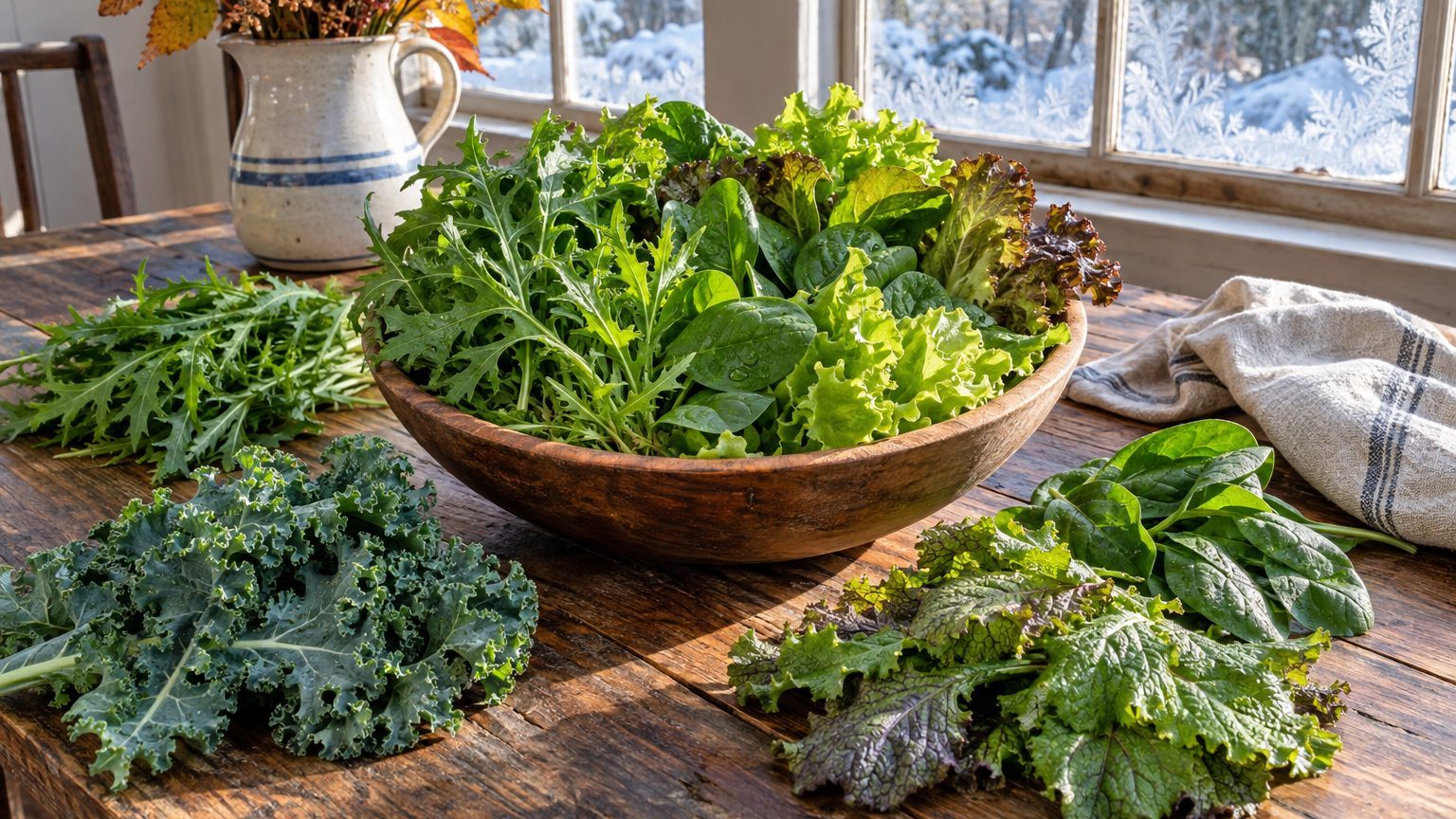

Hardy, small-leaved greens do best in Nova Scotia: mâche, claytonia, spinach and kale, plus arugula and Asian mustards for early winter. Head lettuce needs a low tunnel, and slow chicories are a gamble. The reasons are a fall that ends around mid-October on average, nights well below freezing in midwinter, and very little daylight.
The short answer for Nova Scotia
Sort the greens by how fast they grow and how much cold they take. Fast, tender types such as arugula, mizuna and leaf lettuce give the best fall harvest. The slower, hardy ones (mâche, claytonia, spinach, kale) carry the bowl through January and February. A plant that needs a long stretch of mild weather to finish is the wrong choice here.
The reference station at Halifax Stanfield airport has about 164 frost-free days, between a mean last spring frost on May 7 and a mean first fall frost on October 18. Both are midpoints. In one year out of two the last spring frost falls after May 7, and in one year out of two the first fall frost arrives before October 18. Plan around the early end of the window.
Which winter salad greens suit Nova Scotia’s season?
| Type | Cold tolerance | Speed | Role in the plan |
|---|---|---|---|
| Mâche, claytonia | Very hardy | Slow, steady in cool weather | Core midwinter crop |
| Spinach, kale (baby leaf) | Hardy | Moderate | Core crop, sown for fall and overwintering |
| Arugula, mizuna, tatsoi | Light frost outdoors, cover for deep cold | Fast | Fall and early winter harvest |
| Leaf lettuce, romaine | Light frost only | Moderate to fast | Under a tunnel, sown early |
| Radicchio, escarole, endive | Hardy once grown | Slow | Risky, needs a very early start |
Sowing dates for each type are laid out in When to Sow Winter Salads in Nova Scotia. The wider picture is in Winter Salads for Nova Scotia Gardens.
How cold does Nova Scotia get for winter salads?
The mean daily minimum of the coldest month at Halifax is -10.4 °C (13.3 °F). Half the nights run colder than that average suggests, so unprotected tender greens will not last. Mâche, claytonia and spinach take it, especially under a layer of row cover. In deep winter they mostly hold what they grew in autumn instead of making new leaves, so the harvest is built in the fall.
What will not work here

Late sowing of slow crops fails first. Radicchio, big-headed escarole and blanching endive need months to form, and a first frost around mid-October on average leaves little room. Sown in late summer, they stay half-grown when the light fades and growth nearly stops. Mâche, claytonia and spinach are the ones to sow late, because they are fine as small plants.
Tender lettuce and arugula left uncovered in January also fail. With a coldest-month minimum of -10.4 °C, a single hard night can turn the leaves to mush. Under a low tunnel they last longer, but a plain sheet of plastic on hoops is not a guarantee through the coldest weeks. Choose these for the first half of the season and treat any midwinter pick as a bonus.
Dense spacing is a bad bet in a damp climate. Coastal fog, long wet spells and mild thaws between freezes favor gray mold and slugs, and a crowded bed stays wet for days. Give plants room for air to move. On mild days, open the ends of the tunnel so humidity does not build up inside.
Weekly watering does not work for August and early September sowings. Lettuce and spinach seed germinates poorly in hot soil, and a seedbed in full afternoon sun dries out between waterings. Sow in the evening or in partial shade, and keep the surface moist every day until the seedlings are up.
Snow and wind take out poorly anchored structures. Heavy, wet snow flattens flimsy hoops, and a gale off the Atlantic lifts cover that is not pinned down. Bury the edges of the fabric or weigh them with boards, and brush off snow after a storm.
Finally, do not treat May 7 as a safe date for spring plantings. It is only the midpoint, and in half of all years frost comes later. Hardy greens shrug that off, but tender transplants set out on the date can be lost.
What changes across Nova Scotia
Halifax sits in zone 6b of the Canadian hardiness system, and that rating describes the reference city, not the province. The Canadian system draws on seven climate variables, and Natural Resources Canada says it does not convert to USDA zones. There is no single answer for Nova Scotia, because the coast, the Annapolis Valley, the uplands and Cape Breton differ from each other and from Halifax. Canada’s Plant Hardiness Site lets you look up your own municipality, and that lookup is the number to trust over any quoted here.
Northern and upland districts run weeks behind the Halifax Stanfield station in spring, and fall frost reaches them earlier. The frost dates also come from 1981-2010 averages, while the hardiness zones use 1991-2020, so the two are not perfectly in step. Both are still a starting point rather than a rule.
If you garden in colder or higher ground, shift your plan this way:
- Sow a couple of weeks earlier in late summer so plants have time to size up.
- Lean harder on mâche, claytonia, spinach and kale, and drop the chicories.
- Put covers on earlier in the fall and anchor them more firmly.
Near the coast, winters are often gentler, but wind, salt spray and fog become the problem. Windbreaks and ventilation matter more there than extra layers of cover.
Where to check this for your own county
The Nova Scotia Department of Agriculture is the place to go for local guidance. Look for a planting calendar written for your part of the province, plus any list of vegetable varieties that have been trialled in your county or nearby. Frost dates for the weather station closest to your garden are worth finding too, since they can differ from Halifax by weeks.
A county recommendation beats a provincial one every time. A provincial overview averages over very different ground, and the average may suit nobody in particular. Local trials show which cultivars survived a real winter in your area, and local agricultural staff can say how the last few seasons behaved.
Take what you find back to the calendar of sowing windows and adjust your dates to match. If the local advice says to sow earlier or to avoid a certain type, follow it.
Checking this against your own garden
Your own observations outrank every date quoted here, because your yard has its own microclimate. Three things are worth watching.
First, feel the soil in late summer. Push your hand into the bed in the morning and again in the afternoon. If it still feels warm at the depth of your knuckles, lettuce and spinach will germinate poorly, and you should wait or shade the bed. A bed that cools sooner than your neighbor’s is a good spot for early sowings.
Second, note when the first true leaves appear. Seedlings first show two rounded seed leaves, then the first leaf with the real shape of the plant. If that takes noticeably longer than the packet suggests, your site is cool or shaded. You will need to sow earlier next year, or move to the faster greens.
Third, watch where frost shows first. White frost on the grass or on a car roof marks the cold pockets, and the low corners of a yard often freeze before the high ones. A bed against a south wall, or on a slope where cold air drains away, will keep greens growing weeks longer.
Common questions
What is the hardiest winter salad green for Nova Scotia?
Mâche and claytonia are the usual picks. Spinach and kale are close behind. All four stay alive through hard freezes, especially under row cover, though they grow very little in the darkest weeks.
Can I grow lettuce through a Nova Scotia winter?
Only with protection. Leaf lettuce and romaine tolerate light frost, but the coldest month averages a daily minimum of -10.4 °C. A low tunnel helps, and even then expect a harvest in fall and early winter, not a steady supply in January.
Is May 7 safe for planting tender salads outdoors?
No. It is the mean last spring frost at the Halifax Stanfield station, so in one year out of two frost falls later. Colder districts run weeks behind that.
Does Nova Scotia’s hardiness zone 6b match a USDA zone?
No. Zone 6b belongs to the Canadian system, which uses seven climate variables, and Natural Resources Canada says there are no simple conversions to USDA zones. Look up your own municipality on the Canadian map instead.