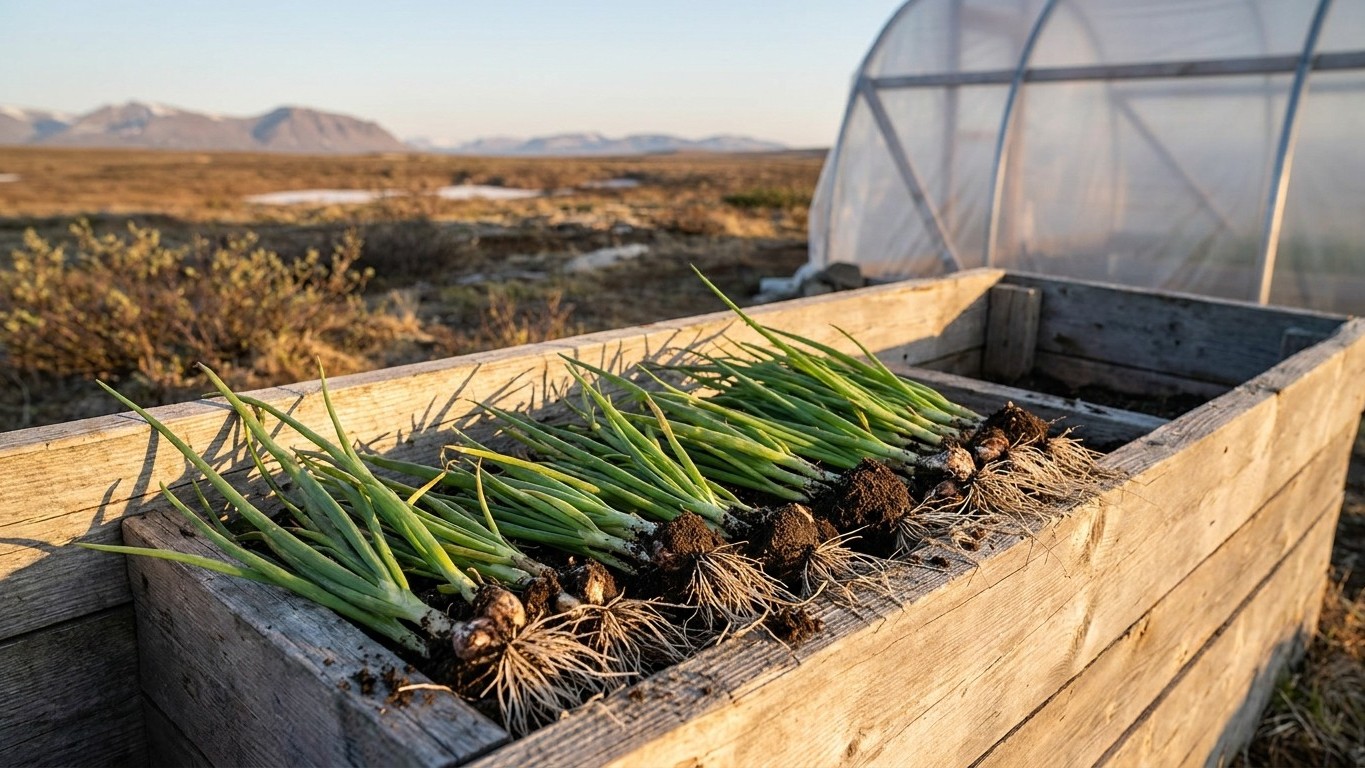

Lift onions once the tops have flopped over and the necks have gone soft, usually from midsummer on in New Mexico, depending on when they were planted. Cure them in a dry, shaded, breezy spot until the necks are tight and the skins rustle like paper. Only then do they go into storage, in a cool, dry room. A pungent onion handled this way can feed a household well into winter. A sweet one cannot, and no amount of curing changes that.
Keeping them, and for how long
Clemson Cooperative Extension’s Home & Garden Information Center states the target plainly: “Ideal conditions are between 45 °F and 55 °F, and 50 to 60 percent humidity.” Write down 45 °F to 55 °F and 50 to 60 percent humidity and measure against it. Cool air slows sprouting. Dry air keeps the skins from molding. That is the reverse of what carrots and other roots want, and it is why one damp cellar cannot hold both crops well.
Treat any storage time as a ceiling. Even in those ideal conditions, a well-cured pungent onion may feed you into March. A bulb with a thick, green neck, a nick in the skin, or damage from insects will go sooner (the pest guide What Eats Onion in New Mexico, and When explains which injuries lead to rot). One soft bulb sweats and spoils its neighbors, so go through the stored crop every few weeks and pull anything that gives under your thumb.
Why do sweet onions not keep as long as pungent ones?
University of Missouri Extension (publication G6355) says it directly: “As a rule, ‘sweet’ onions do not store as well as the more pungent types.” The reason is chemical. The bite of an onion comes from volatile sulfur compounds, and those same compounds help protect the bulb while it sits in storage. A sweet variety carries fewer of them. That makes it nicer raw and a poor bet for February. Eat sweet onions first, and keep the pungent ones for the long haul.
Does day length in New Mexico change how long onions keep?
It does, because day length, not warmth, tells an onion to stop making leaves and start making a bulb. Albuquerque sits at 35.04 degrees north and gets 14 h 22 of daylight on the longest day of the year. Short-day varieties begin bulbing at about 12 hours (a threshold published by Clemson Cooperative Extension), so they bulb early and stay on the sweet side. Long-day varieties wait for 14 to 16 hours, and Albuquerque’s longest day clears the bottom of that range by 22 minutes. Those onions are the ones that tend to keep longer.
Latitude varies across the state. Gardeners in the far north get a longer summer day than Albuquerque, and those in the far south get a shorter one. If you garden near either edge, look up your own latitude before choosing a variety. The Best Onion Varieties for New Mexico sorts the options by day length.
Where in the house that actually is
The refrigerator is the obvious cool place, and it runs colder than onions like. It is also humid inside, which is the wrong direction for a bulb that wants 50 to 60 percent. A heated living space overshoots the other way, and onions kept near a stove, a water heater or a sunny window warm up, sprout and soften. A garage looks promising until the weather moves. In much of New Mexico a garage drops below freezing on winter nights and bakes in summer, and a frozen bulb turns to mush once it thaws.
The best spot is usually an interior space that stays cool without a heat source nearby. Think of a closet on an inside wall, a pantry away from the kitchen’s appliances, or a spare room where the vent is closed. Houses here rarely have basements, so a true cellar is the exception. Keep the bulbs in a single layer or a loose, open-weave bag or mesh, in a crate or basket that lets air move around them. Plastic bags trap moisture and speed rot.
Before you commit the crop, put a thermometer where the onions will sit and read its low and high for a week. Skip that check and you are guessing, and a guess that runs warm costs you the stored crop by midwinter. A min/max thermometer is best because it catches the overnight swing. An inexpensive hygrometer, set at bulb level, covers the humidity side. Indoor air in much of the state runs dry in winter, so the reading may sit under 50 percent. If it does, the onions will usually handle it better than a damp room, but check them for shriveling.
If no room holds the range, split the crop. Keep the best pungent bulbs in the coolest, steadiest spot and use the rest first. Sweet onions can go in the kitchen where you will see them and use them within a short time.
How do you know when to lift onions, and how do you cure them?
Everything above assumes bulbs that have been cured properly. A bulb that goes into storage straight from the ground carries moisture in its neck, and that is where rot enters.
When are onions ready to lift?
Watch the tops, not the calendar. Onions are ready when the green leaves yellow and fall over, and the necks (the thin part just above the bulb) go soft and limp. Spring-planted onions in the state commonly reach this point from midsummer on, with the exact timing depending on the variety and the planting date. Early-bulbing short-day types finish first. Long-day types go down later.
Pick a dry day. Loosen the soil with a fork, lift each bulb gently, and avoid bruising it, since a bruise becomes a soft spot in storage. The summer monsoon can bring humid, wet spells to much of the state. If rain is in the forecast, lift on the last dry day and move the bulbs under cover instead of leaving them on wet ground.
How do you cure onions?
Spread the bulbs in a single layer in a dry, shaded place with good airflow, such as a covered porch, a shaded breezeway or a shed with the door open. Direct sun can scald the bulbs, so keep them out of it. Leave the tops attached. The leaves slowly draw moisture down and out of the neck.
Curing is finished when the neck is tight, with no give when you squeeze it, and the outer skins are dry and papery. Roots will be wiry and shriveled. Then trim the dried tops to an inch or so, brush off loose soil without washing the bulbs, and move them to storage. Sort as you go: any bulb with a thick neck, a soft spot or a damaged skin gets eaten first. For the full growing picture, start with Onions in New Mexico.
Common questions
Can I store onions in the refrigerator?
You can, but it is a poor fit for a whole crop. A refrigerator runs colder than the 45 °F to 55 °F range and is humid inside, while onions keep best in dry air at 50 to 60 percent humidity. Use the refrigerator only for a cut onion, wrapped, or for a sweet onion you plan to eat within a short time.
Why did my stored onions sprout or rot?
Sprouting usually means the room was too warm or the bulbs were not fully cured. Rot often starts at a thick, green neck, a bruise or a nick, and spreads from there. Damp air makes both worse. Check the room with a thermometer and a hygrometer, and cure any future batch until the necks are tight.
Should I wash onions before storing them?
No. Washing adds moisture right where you are trying to remove it. Let the soil dry on the bulbs during curing, then brush it off by hand. Wash them in the kitchen just before you cook.
Do sweet onions keep as long as storage onions?
No. University of Missouri Extension notes that sweet onions, as a rule, do not store as well as pungent types, because they have fewer of the sulfur compounds that give onions their bite and help protect them. Eat sweet ones soon after curing and save pungent varieties for winter. A county extension office can tell you which varieties do best at your elevation and latitude.