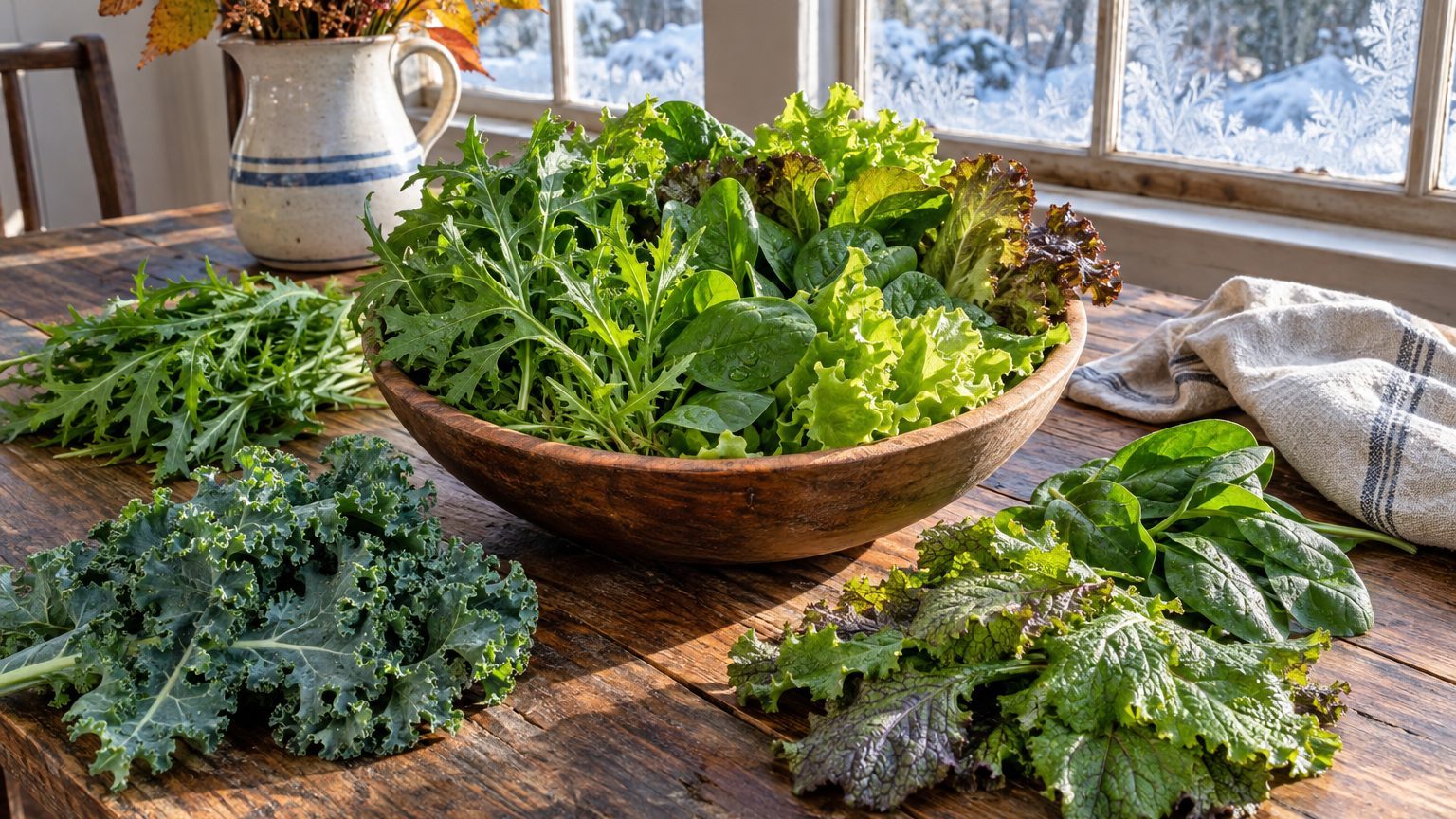

Spinach, kale, collards, mustard greens, arugula, mâche and claytonia are the winter salad crops that fit Oklahoma best. They sow in fall, handle the freezes that arrive in late October and November, and keep producing through most of the winter. Leaf lettuce works too, with row cover on the hardest nights. Spring is short, so plan to finish picking before the heat arrives.
The short answer for Oklahoma
At the reference station, Oklahoma City’s airport, the coldest month has a mean daily minimum of 27.0°F. That is a few degrees under freezing on an ordinary winter night. Hardy greens take that without trouble, and tender lettuces barely do. Real cold snaps drop below the average, so a crop has to tolerate more than the mean.
The frost dates set the sowing window. The last spring frost falls between March 28 and April 10, and the first fall frost between October 29 and November 8. Each range is the stretch of dates where the chance of a 32°F freeze sits between 30 and 70 percent. These are figures for the airport station. Suburban and rural gardens usually see the last spring frost one to two weeks later and the first fall frost one to two weeks earlier, and more so at elevation.
Which winter salad types suit Oklahoma?
Choose by type, based on how much cold each one takes and how fast spring heat ends the season.
| Type | Cold tolerance | Best use in Oklahoma |
|---|---|---|
| Spinach | Very hardy | Fall sowing, cut through winter, finish before spring heat |
| Kale and collards | Very hardy, sweeter after frost | Baby leaves or full leaves, held through the coldest weeks |
| Mâche and claytonia | Very hardy, small and slow | The coldest beds and cold frames |
| Mustards and tatsoi | Hardy to moderately hardy | Quick cuttings in fall and again in late winter |
| Arugula | Moderately hardy | Fall and early spring, bolts fast once days warm |
| Leaf lettuce | Tender to moderate | Under row cover or in a cold frame |
| Radicchio, endive, escarole | Moderate | Fall crop sown on time, covered on the hardest nights |
Direct-sown salad crops count their days to maturity from sowing, so a packet that says 30 days means 30 days from seed. For exact sowing dates by region, see When to Sow Winter Salads in Oklahoma. The broader overview is at Winter Salads for Oklahoma Gardens.
What will not work here

Butterhead and other tender lettuces left bare in the open bed are the first to go. With nights averaging 27.0°F in the coldest month and colder snaps on top, leaf edges blacken and plants can die in a hard freeze. A sheet of row cover or a cold frame changes the outcome. Without one, plant the hardy types instead.
Sowing in the wrong week fails in two directions, and Oklahoma’s long, hot fall makes the early mistake easy.
What goes wrong when you sow too early or too late?
Sown too early, in the hot, dry stretch of late summer, lettuce and spinach seed germinates poorly in warm soil. The seedlings that do come up have shallow roots and dry out between waterings. A gardener who waters once a week will lose a lot of these. Seedlings need light, frequent watering until they have real roots, usually a few weeks.
Sown too late, after the first fall frost range of October 29 to November 8 at the reference station, the seed sits in cold soil. Seedlings that do come up stay small through December and January, when days are short and growth nearly stops. They will not size up until the light returns in February. Heading types such as radicchio suffer most, because they need weeks of steady growth to form a head before the cold arrives.
Spring sowing is the other trap. Once the last frost window of March 28 to April 10 has passed, warm days come quickly. Spinach and arugula sown then bolt, sending up a flower stalk, before they give more than a couple of cuttings. Spring is for harvesting what went in the ground in fall.
A last problem is winter dryness. Evergreen leaves keep losing water through dry, windy weeks, and unmulched beds dry out faster than most people expect. A thin mulch and a drink on a mild afternoon are enough to prevent it.
What changes across Oklahoma
Oklahoma spans USDA hardiness zones 6a to 8a, so there is no single answer for the state. The USDA system is built on one variable, the average annual extreme minimum temperature. It says how cold the worst night of the year tends to get. It does not say how hot September runs or when the first frost arrives, and those two decide a winter salad crop as much as the lowest night does.
Gardeners in the north, in the Panhandle, and on higher ground sit toward the cold end of that spread. Frost arrives earlier there, often a week or two before the airport dates, so sowing moves earlier too. Lean on the hardiest types (spinach, kale, mâche, claytonia) and keep row cover or a cold frame ready for anything more tender. Spring heat comes later in these areas, which gives spinach and arugula a little extra time before they bolt.
Gardeners in the south and southeast, toward the warm end of the range, have a longer fall and milder winter nights. Leaf lettuce and arugula are more dependable there without much protection, and sowing can slip later in the fall. The tradeoff is that heat comes sooner in spring, so the season for cool-weather greens ends earlier.
Nobody should guess their zone from a neighbor or a seed packet. Look up your own location on the USDA Plant Hardiness Zone Map, which searches by ZIP code, and then adjust the airport dates above for your side of the state.
Where to check this for your own county
A county recommendation beats a state one. The dates and types above describe Oklahoma City’s airport and the state as a whole. Your garden may differ by a week or two on either end of the season.
Oklahoma State University Extension is the place to check. Every county has an extension office, and the office staff and Master Gardener volunteers know the local soil, wind and frost pockets. Two things are worth finding there.
- A local fall planting calendar for cool-season vegetables, with sowing dates for your county rather than for the state.
- Lists of varieties that have been trialled in your county, including which spinach, lettuce and kale held up through winter and which bolted early.
If the county office has no salad-specific calendar, ask for the fall vegetable calendar and read the entries for spinach, lettuce, kale and mustard greens. Ask which of them overwinter locally without cover. Written dates are a good starting point, and the people who answer the phone usually know what happened in the last hard winter.
Checking this against your own garden
Your own observation outranks every date in this article. Three things are worth watching, and none of them needs equipment.
Soil warmth by feel. Press your hand flat into the bed around mid-morning. If the soil still feels warm, like a sun-heated stone, lettuce and spinach seed will germinate poorly, so wait. Check different spots too. A bed against a south-facing wall warms and cools sooner than one in an open yard, and that difference tells you how much of a head start or delay your garden has.
The first true leaves. Seedlings first show a pair of rounded seed leaves, then the first true leaves with the shape of the adult plant. When those appear, the seedling has real roots and can take cold. If they have not appeared by the time hard freezes arrive, cover the bed. The number of days it takes in your yard is worth writing down for next year.
The bolting stalk. In late winter, watch the center of spinach and arugula rosettes. When the center rises into a stalk and the leaves turn bitter, the plant is bolting. The date it happens marks the end of your season. In a cold spot it comes later, and in a sheltered spot it comes sooner.
Common questions
Can you grow lettuce through an Oklahoma winter?
Yes, with protection. Leaf lettuce does best under row cover or in a cold frame, because nights average 27.0°F in the coldest month at the reference station and colder snaps do occur. Without cover, lettuce is the crop most likely to be lost.
What is the easiest winter salad crop for beginners?
Spinach and kale. Both are very hardy, both are sown in fall, and both tolerate a freeze that would kill lettuce. Kale also gets sweeter after frost.
Do winter salads need row cover?
Hardy types usually do not on most nights. Leaf lettuce, arugula and the heading chicories benefit on the hardest nights. A lightweight row cover costs little and covers several beds at once.
When does the winter salad season end?
When days warm and plants bolt. At the airport reference station the last spring frost falls between March 28 and April 10, and heat follows quickly. Cut leaves while they are still sweet. In cooler parts of the state the season runs longer.