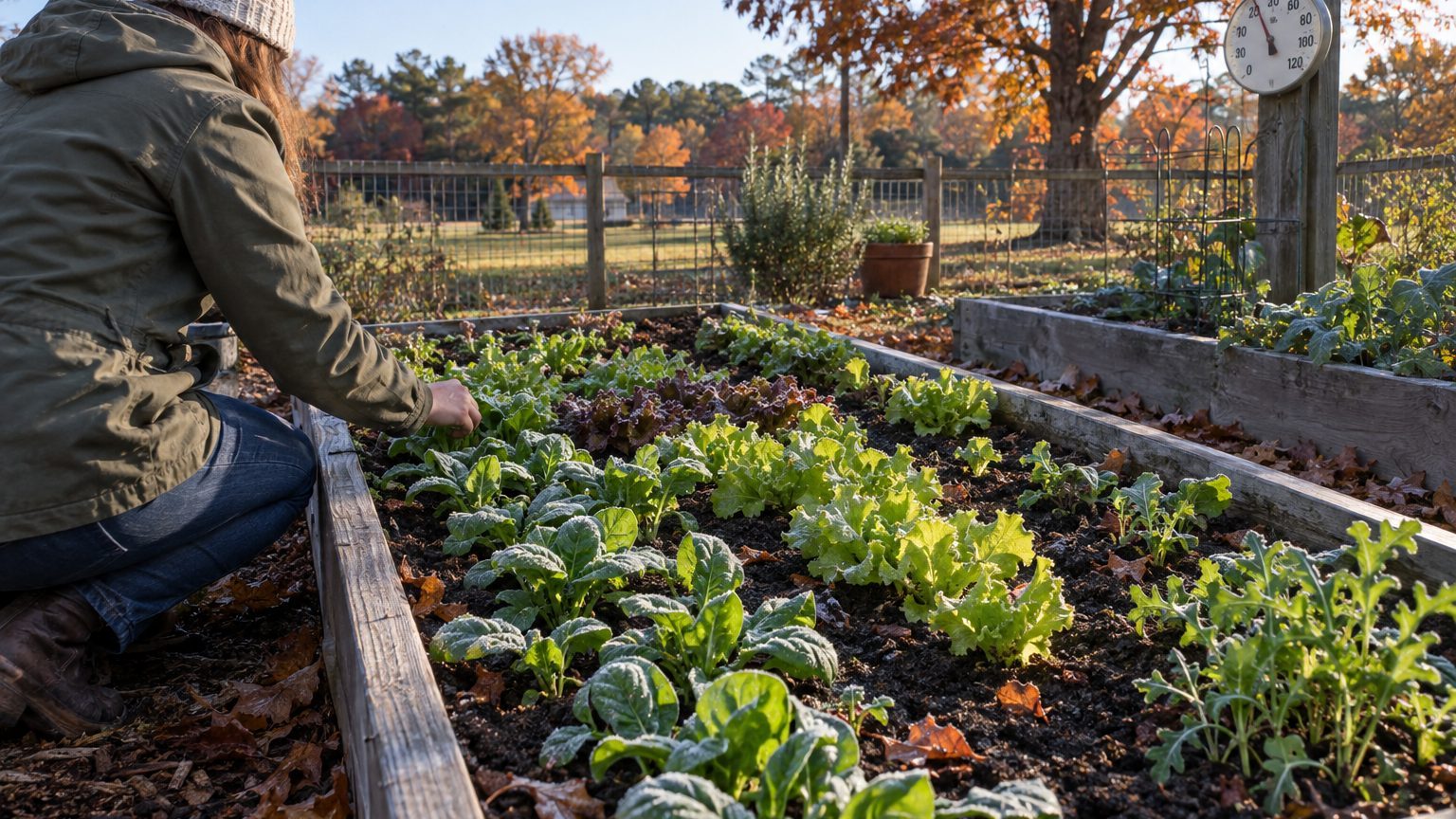

Sow winter salads outdoors from late August through September, with a last round under cover in early October. Those dates come from Philadelphia, the mildest corner of Pennsylvania. Colder counties should start earlier and finish sooner. The sections below explain how the window is built, what falls outside it, and how to adjust it for your ground.
The short answer for Pennsylvania
Sow spinach, arugula, mustard greens, baby kale and most lettuce between late August and the end of September. Mâche and claytonia can go in as late as early October if you cover them. The window is counted backward from the first fall frost.
NOAA’s 1991-2020 climate normals for Philadelphia give the frost dates. The last spring freeze falls between March 29 and April 6, and the first fall freeze between November 5 and November 16. Both ranges are the middle band of the odds: the dates when the chance of a 32°F freeze has reached somewhere between 30 and 70 percent. An earlier fall frost or a later spring one is still possible, so treat the dates as the center of a spread.
How do you count back from the first fall frost?
Winter salads need to be close to harvest size before growth slows. By early to mid November, daylight in Pennsylvania is short, and leaves mostly hold their size rather than grow. Packet days to maturity count from sowing for direct-sown greens like these. Take the number on the packet, add a couple of weeks because days shorten and soil cools through autumn, and count back from early November.
| Type of salad | Sow outdoors | Note |
|---|---|---|
| Spinach, arugula, mustard greens, baby kale | Late August to late September | Fast and cold-tolerant; the safest first choices |
| Leaf lettuce | Early to mid September | Wait for cooler soil; cover for winter |
| Radicchio, escarole | Mid-August to early September | Heading types need the longest runway |
| Mâche, claytonia | September into early October | Slow starters, but they handle the cold best |
The coldest month averages a daily minimum of 26.0°F in Philadelphia. That is the typical coldest night, and real cold snaps run lower. Spinach, mâche and claytonia usually come through in the open at that level. Lettuce and arugula do better under row cover, which holds in a few degrees of warmth. For choosing varieties within each type, see The Best Winter Salads for Pennsylvania.
What will not work here

Lettuce sown in August heat tops the list of failures. Lettuce seed tends to go dormant when soil stays warm, and Pennsylvania’s humid summers keep the top inch warm well into September. A row sown on August 20 may produce a few stragglers. Shade the bed with a board or cloth until seedlings show, water the row in the evening, or start trays in a cool spot and transplant.
Why do October sowings stall?
Seed sown in late October often sprouts, then sits. With nights near the 26.0°F average and daylight shrinking, seedlings stay at the first true leaves until March. Spinach sown that late can still overwinter as a small plant and give an early spring picking. A winter harvest needs the September start.
Heading crops fail first when you start late. Radicchio and escarole need several weeks of good growth to form tight heads, and a sowing made after mid-September gives you loose rosettes at best. If you sow late, pick fast leaf crops instead.
Close spacing is another trap in a state with damp autumns and long stretches of overcast. Crowded rows stay wet, and downy mildew and gray mold move through them quickly. Thin baby greens and lettuce so the plants have room to size up. Water at the base in the morning so leaves dry before dark.
Sealed tunnels cause trouble late in the season. A closed plastic tunnel on a sunny day in February or March can climb far above the outside air, and the spike cooks tender leaves or invites rot. Open the ends on any sunny day above freezing. Heavy clay that holds standing water through winter also drowns roots, so build a raised bed or at least a mounded row where drainage is poor.
What changes across Pennsylvania
Pennsylvania has no single answer. The USDA Plant Hardiness Zone Map (2023 edition, built on 1991-2020 normals) runs from 5a to 7b across the state. A gardener at the 5a end faces winters that look nothing like those of a gardener at the 7b end.
Hardiness zones rest on one number, the coldest night of an average year. They tell you what survives winter. They do not tell you when to sow, because frost dates and the length of the growing season decide that. The two measures usually move together, but treat them separately.
Philadelphia sits at the mild end. The northern tier and the Alleghenies run two to four weeks later in spring, and fall frost reaches them sooner. A reader in those parts should move the whole calendar earlier. Where the table says late August, think mid-August, and plan on cover for every crop except spinach, mâche and claytonia. Altitude matters inside a county too: a hilltop bed can freeze later than a valley floor that collects cold air, and the valley bed can freeze weeks before the hilltop.
To find your zone, look up your location on the USDA map instead of guessing from a neighbor’s garden. A few miles and a few hundred feet of elevation can shift a half zone. The Winter Salads for Pennsylvania Gardens hub lays out the wider picture for the state.
Where to check this for your own county
Penn State Extension is the state’s land-grant extension service, and it is the place to confirm your dates. Look for two things there. The first is a planting calendar built for your region, which will tell you when fall and spring plantings fit your local frost pattern. The second is any list of vegetable varieties trialled near you, since a variety that thrives in the southeast may stall in a cold northern valley.
Your county office is worth a call or a visit. Extension staff and Master Gardener volunteers see the same weather you do and know which fall sowings succeeded or failed in recent years. Ask what happened last October and which cover materials local growers use. That kind of detail is not in any statewide table.
A county recommendation beats a state one. What you have just read is the state version, anchored on Philadelphia’s frost record, with adjustments for the colder north. It gives a sound starting window. Your county’s advice should override it wherever the two disagree.
Checking this against your own garden
Your own observations count for more than any date printed here. Three are worth watching, and none needs equipment.
Soil warmth by feel. In late August, push your fingers into the bed in the morning. If it still feels warm, like bathwater rather than cool earth, hold off on lettuce and sow spinach or mustard instead. A bed that cools sooner than your neighbor’s tells you it is shaded or sits in a low spot.
First true leaves. Seedlings first show two rounded seed leaves, then the first true leaves with the shape of the mature plant. Note how many days that takes after sowing. In early September it may take a while. By mid-October it can take twice as long. When the gap stretches that far, your growth window is closing, and that is your cue to stop sowing and start covering.
Where frost shows first. On the first white morning, walk the yard. Frost on the lawn but not on the south wall means that wall is a warm pocket, a good spot for the tender crops. Frost lingering in a low corner marks the place to avoid. Write down the date you see the first frost, and next year you will have a local number to set beside NOAA’s.
Common questions
Can I still sow winter salads in October in Pennsylvania?
Yes, under cover and with the right crops. Mâche, claytonia and spinach handle early October sowings. Expect small plants that wait out winter and grow again in March, not a full winter harvest.
Do I need a cold frame or row cover?
Spinach, mâche and claytonia can stand in the open in the milder parts of the state. Lettuce, arugula and the heading chicories do better under cover. In the northern tier and the Alleghenies, plan on cover for nearly everything.
When can I sow salads again in spring?
Hardy greens tolerate frost, so you can sow as soon as the soil is workable, well before the last spring freeze. In Philadelphia that freeze falls between March 29 and April 6. Colder regions run two to four weeks later, so sow later there.
What if frost comes early?
Hardy greens shrug off a light frost, and a sheet of row cover handles most early cold snaps. A hard freeze in October mostly hurts tender seedlings and lettuce. Keep fabric on hand and cover the bed when the forecast calls for frost.