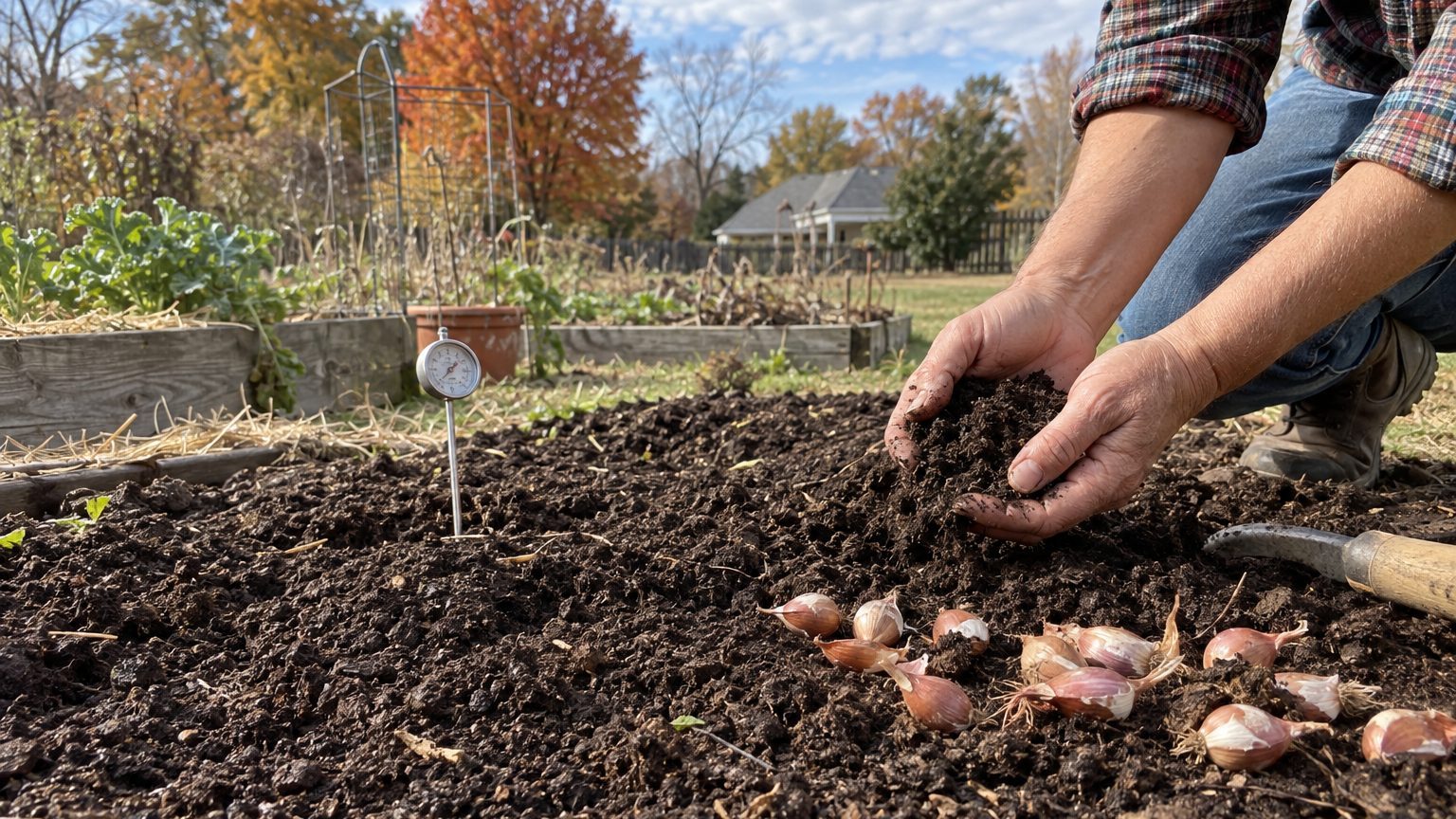

Plant shallots in New Brunswick as soon as the soil can be worked in spring. Set autumn planting aside unless your ground drains well and holds snow. At Moncton, the average last spring frost falls on May 23 and the average first fall frost on October 2. That leaves a bulb crop little time to size up and dry down before cold returns, so a early start matters.
When the soil is warm enough in New Brunswick
The average last spring frost at the Moncton station is May 23, according to Environment and Climate Change Canada’s 1981-2010 normals. It is a midpoint. In one year out of two, frost arrives later than that, and upland or northern districts of the province run weeks behind Moncton. Treat May 23 as the middle of a window, not as a safe date.
The date matters less than the ground under it. Shallots respond to soil conditions, and soil warms after the last frost risk has passed, not on the same day. A cold, saturated bed holds bulbs back and invites rot. A bed that has drained, crumbles in your hand and no longer shows standing water in the low spots is ready.
Can shallots go in before the last frost?
Sets (small bulbs) tolerate light frost once they are in the ground, so they can go in as soon as the bed is workable, which in much of the province means April or early May. Seed-grown shallots raised indoors as transplants are tenderer. Harden them off and set them out when hard frost has become unlikely, which in practice means waiting until close to the May 23 midpoint. A cover of floating row fabric buys a few days of protection on a cold night.
What about shallots and garlic?
Shallots share a lot with garlic: autumn planting is an option, the bulbs need curing, and both belong to the allium family, so they should not follow onions, leeks or garlic in the same bed. Our garlic pages cover those practices in depth. Shallots differ in a few ways. Each set multiplies into a cluster of bulbs, the planting is shallower, and the crop tolerates being set out as a small bulb in spring far better than garlic tolerates a late start. For the general method, see Growing Shallots: One Bulb In, a Handful Out.
Curing is where food safety enters. Once the tops fall over and yellow, lift the bulbs and let them dry in a shaded, airy spot until the necks are tight and the skins rustle. Then inspect each one. A soft neck or a moldy base ends the question, and that bulb goes in the compost, not the pantry. A bulb that looks fine on the outside is not proof it is sound, so check by touch and smell, and check again during storage.
Types matter at planting time too, and your provincial agriculture department is the right place to ask which suit your district. More on that below.
How long the season lasts here
The Moncton station has about 132 frost-free days between the mean last spring frost on May 23 and the mean first fall frost on October 2. Those two dates come from the same 1981-2010 normals and carry the same caution: in half of all years, the spring frost comes later and the fall frost earlier.
A window of that length is workable for shallots, but it does not leave much slack. A shallot has to grow leaves, form bulbs, then finish and cure before the weather turns. If planting slips from early May to early June because the ground stayed wet, the crop loses weeks it cannot get back.
Is there room for a second planting?
For bulbs, no. A first planting in spring is the only one that will mature fully. A second planting made in midsummer will not size up before October frost. What a second planting can give you is a handful of young shallots pulled green for the kitchen. If you want staggered harvests of that kind, a few small plantings two to three weeks apart work, and our succession sowing guide lays out the spacing logic.
Is transplanting worth the root check?
With a short window, it can be. Seed-grown shallots started indoors in late winter reach the garden with a head start, and that head start is worth more here than it would be in a long-season state. The cost is the root check: cell-grown seedlings that sit too long in their trays circle their roots and stall when planted. Start them on time, move them out before the roots tangle, and handle them gently. Sets skip the issue entirely. They arrive with a bulb’s worth of stored energy and need only a bed that has drained.
Neighboring places give you a sense of the spread. Growing Shallots in Prince Edward Island deals with a cooler, maritime season, and Growing Shallots in Yukon shows what a much shorter window does to the planning.
Heat and water in New Brunswick
Heat is not the main problem here. At the Moncton station, summers are mild enough that hot-weather stress, the kind that makes bulbs bolt or scorch, is unusual. Plan for the opposite: a cool, damp summer. That brings foliar disease such as downy mildew and leaf blights, slow ripening and bulbs that finish later than you hoped. Spacing and airflow matter more than shade cloth. Plant in rows with room between them, keep weeds down, and water in the morning if you water at all.
Rainfall is the other half. Shallots want steady moisture while they are sizing, then dry conditions as the tops fall. A wet August keeps the necks green and the bulbs soft, which makes curing harder and storage riskier. Raised beds or ridged rows shed water, and they are the single most useful fix on heavy ground.
Autumn or spring planting?
Winter decides this. The coldest month at the Moncton station has a mean daily minimum of -13.9 °C (6.9 °F), and the reference city sits in Canadian hardiness zone 5a. That is a Canadian system built on several climate variables, and it cannot be converted to a USDA zone. Cold on that scale is survivable for a mulched shallot bulb, but it leaves little margin.
Where the ground freezes hard and stays wet through thaws, autumn-planted sets rot or heave out of the soil, and spring planting is the safer call. In a milder winter, or on a well-drained slope with steady snow cover, autumn planting gives larger, earlier bulbs, which is why growers choose it elsewhere. If you want to try it, plant a small row, mulch it after the ground cools and see what the winter does. Keep your spring planting as the main crop until you have a few seasons of results. The safe default in New Brunswick is spring.
One more thing about water in a wet province. Raised, loose soil lets roots reach down, and a little compost or aged manure worked in before planting helps with both drainage and fertility. Avoid heavy nitrogen late in the season, which pushes leaf growth when the plant should be ripening.
Which shallots suit New Brunswick
Choose by type before you choose by name. Three traits decide whether a shallot does well in this climate: how early it matures, how well it handles damp, and how it stores. A season of about 132 frost-free days at Moncton favors early-maturing types. A humid, cool summer makes disease resistance the first thing to check on a seed or set description. Airflow around the base matters more than heat tolerance.
Between sets and seed-grown types, sets are the more forgiving option for the region. They get going in cool soil and carry the plant through a slow start. Seed-grown shallots can give heavier yields in warm climates, but they ask for indoor starting, careful hardening off and a root check at transplanting. They suit gardeners who already start onions from seed.
A shallot that does well in one province can sulk in another, and the only recommendation worth following is a variety that has been trialled in your own district. The provincial agriculture department can tell you what local growers and trial plots have found, and Agriculture and Agri-Food Canada lists federal resources for growers. Call or write before ordering, because the best sets sell out early in spring.
Order from a supplier that sells to northern growers, and look at what the description says about maturity, disease and storage. Avoid grocery-store shallots as planting stock. They may carry disease and are often treated to prevent sprouting.
When the crop comes in, apply the same inspection every time you handle the bulbs. Firm necks, dry skins and clean bases are what you want. Anything soft at the neck, or with mold at the base, goes out. Do not trust a bulb that looks sound but feels light or smells off. Store only cured bulbs, in a cool, dry, ventilated place, and check them through the winter.
Common questions
When should I plant shallots in New Brunswick?
Plant sets in spring once the soil is workable and no longer waterlogged. Transplants raised from seed go out closer to the May 23 average last frost at Moncton, after hardening off. Remember that this is a midpoint, and that northern and upland areas run later.
Can I plant shallots in the fall in New Brunswick?
You can try on well-drained ground with reliable snow cover. The coldest month averages a daily minimum of -13.9 °C (6.9 °F) at Moncton, and freeze-thaw cycles can heave or rot bulbs. Plant a small test row and keep spring planting as your main crop.
Do shallots need a long season?
They need enough time to size up and cure before cold returns. Moncton has about 132 frost-free days between its mean last spring frost and mean first fall frost, which is enough for one planting if it goes in early. A second planting will not make full bulbs.
How do I know if a stored shallot is still good?
Check the neck and the base. A soft neck or a moldy base means the bulb is done, whatever the rest of it looks like. Look through the stored bulbs regularly and remove any that have gone soft, since one bad bulb can spoil its neighbors.