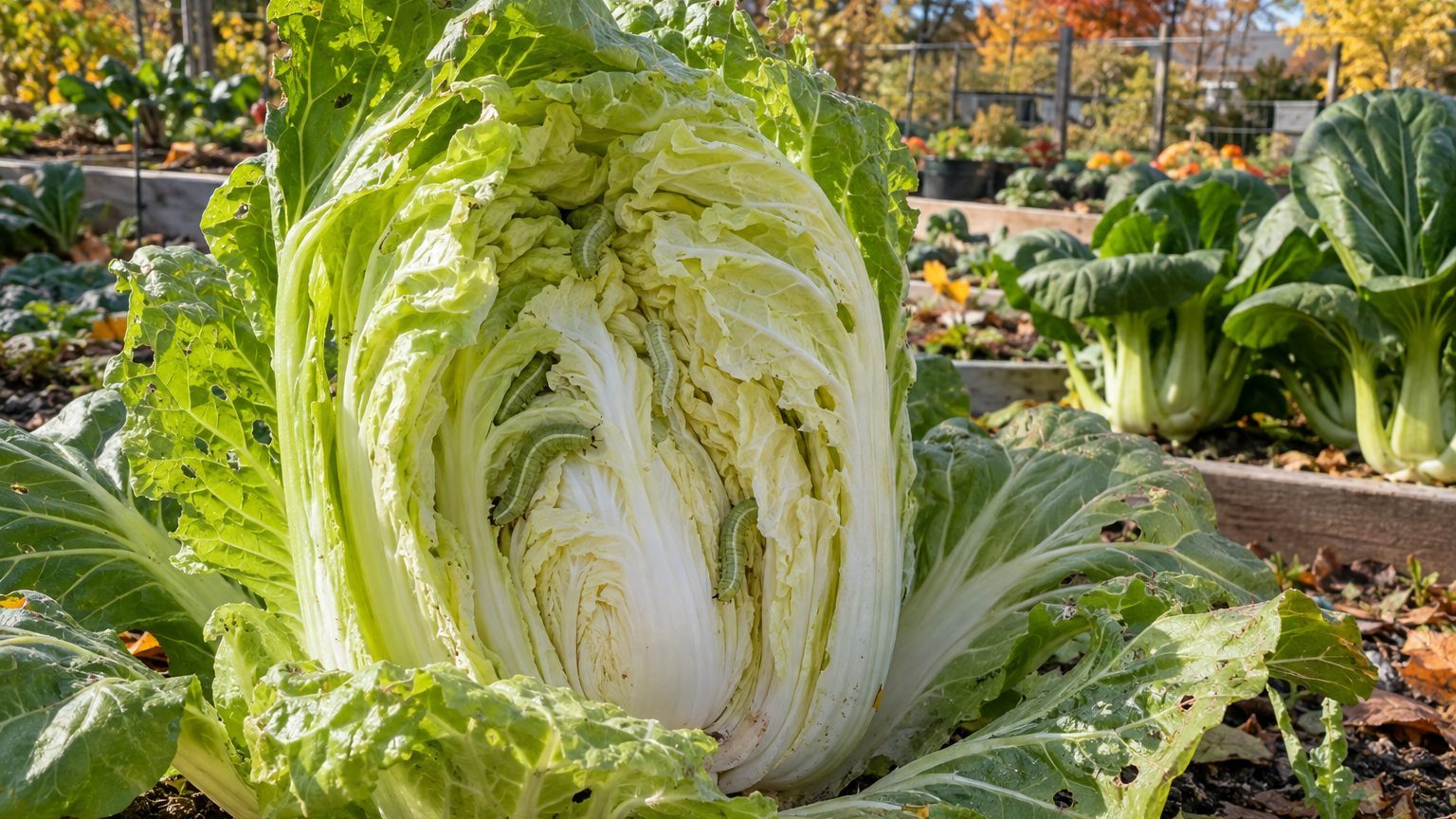

Cabbage worms are the caterpillars of a white butterfly and two small moths, and they eat every brassica in the garden. On Asian greens that fold into a head, such as napa, they end up feeding in the center, where leaves overlap. Once the damage shows from outside, they have been inside for a while. Stopping them has to happen before the head closes.
What is actually going on
The thing to understand is shelter. A young plant is open, and caterpillars on it are in plain sight. As a heading type matures, its inner leaves curl and press together, and the larvae follow the tender tissue inward. Inside the fold they are out of view, out of the rain, and out of reach of anything you put on the outside of the plant.
Which caterpillars are you dealing with?
Three species do most of the damage. The imported cabbageworm is velvety green, slow, and often shows a faint pale stripe down its back. The cabbage looper is also green, has thin pale lines along its sides, and arches its body as it crawls. The diamondback moth larva is small and slender, wriggles backward when touched, and may drop from the leaf on a silk thread. All three begin as tiny pale eggs laid on leaf undersides, and the adults fly in warm weather, so the egg-laying begins long before any head forms.
How do cabbage worms get into the heart of napa and bok choy?
Newly hatched larvae chew small holes in the outer leaves. Napa cabbage, the long, tightly wrapped member of the family, gives them the most cover once it starts to fold. Loose types such as bok choy hide them less, though the crowded center still shelters small larvae. A spray that works by being eaten, like a biological caterpillar treatment labeled for vegetables, can only help while the larvae are chewing on exposed leaves. After the head wraps, it mostly lands on leaves they are no longer eating.
How can you tell they are inside before you cut?
Look for dark green or black droppings (frass) lodged where leaf bases meet, ragged holes in the outer leaves, and a head that feels lighter or looser than its size suggests. White butterflies drifting over the bed are the earliest signal. Each one can lay many eggs over its life. Eggs and tiny larvae on the undersides of outer leaves are the last chance to find the problem while it is still easy to deal with.
In the garden
The practical approach is to keep the butterflies and moths from laying eggs in the first place. Once a head has closed, nothing applied from outside reliably reaches the larvae, and your only remaining option is to peel the head apart by hand. Timing runs from planting day to harvest, and each step has its own failure.
| When | What to do | What happens when it goes wrong |
|---|---|---|
| Before planting | Choose a bed where no brassica grew last season and clear old crop debris. | Pupae and eggs left in soil and residue hatch right beside the new plants, and a cover then seals them in with the crop. |
| Planting day | Set lightweight floating row cover over hoops right after sowing or transplanting. | Covering after butterflies have already visited just protects the eggs already laid. |
| Whenever the cover is on | Bury or pin down every edge and leave enough slack for the plants to grow. | A single gap lets a butterfly in, and with no predators under the cover the caterpillars grow undisturbed. |
| Weekly, as the plants grow | Lift the cover and check leaf undersides and the center. Crush eggs and pick off small larvae. | Skipping checks lets small larvae slip inside as the head folds. |
| Just before heading | Do a last thorough hand check of the center while the leaves are still open. | After the fold closes, you cannot see or reach them without taking the head apart. |
| At harvest | Cut the head, peel it leaf by leaf, and rinse under running water. | A head washed only on the outside can reach the kitchen with larvae and droppings still in it. |
Do turnips and rutabagas count in the rotation?
Yes. Turnip and rutabaga are brassicas, and they share their pests and diseases with cabbage, kale, mustard and every Asian green. A bed that held turnips last year has not rested from cabbage worms. Rotating means moving to a bed that last grew something from a different family, such as beans, onions or squash. The crop rotation guide on this site lays out the sequence.
Row cover has a trade-off. It lets light and water through, but it also holds some warmth, and in hot spells heading types can struggle underneath. Use a light weight and watch the plants. Slugs also love the damp shelter under a cover, so if they are a problem in your bed, read slugs in an autumn greens bed before you commit to a full enclosure.
What it depends on where you are
Some of this holds everywhere. The caterpillars hide in the center, prevention beats rescue, and every Asian green belongs to the cabbage family. Those rules do not change at a state line. Everything about timing does.
Season length decides how many rounds of butterflies and moths your crop meets. Where the warm season is long, new generations keep arriving, and a fall planting may face heavier pressure than a spring one. Where summers are short and cool, there may be only a few weeks of egg-laying, and a well-timed cover can carry the crop through. In the hottest, most humid regions, summer heat adds a second problem, because heading types may fail to fold tightly or may bolt, and the pest calendar shifts with the growing calendar.
Summer rainfall matters too. Wet weather keeps slugs active and favors rot in damaged heads, while dry spells push stressed plants to bolt. A plant already weakened by weather loses more to the same number of caterpillars.
A page written for the whole country cannot tell you when your first butterflies arrive. Your state’s page on this site covers your growing season. For the heading varieties that have been trialled in your area and for local pest timing, call or visit your county cooperative extension office. Their advice also tells you which caterpillars matter most nearby, and whether to expect trouble in spring, fall, or both.
The mistake that costs the most
The costliest mistake is waiting until you see damage before protecting the crop. By the time a gardener notices holes and droppings on the outside leaves, eggs were laid weeks earlier, and the larvae are already moving toward the center. Sprays and hand-picking at that point deal with the visible ones, while the survivors settle in as the head folds.
Cover or inspect from planting day, not from the first sign of trouble. Put the row cover on right after sowing or transplanting, with the edges sealed. If you grow without a cover, begin checking leaf undersides the week the seedlings go in, and keep going each week. Crush eggs, pick off small larvae, and look again just before the head begins to fold. That one habit costs a few minutes each week, and it keeps the caterpillars out of the one place you cannot reach.
If you are already late and the heads have closed, peel them in the kitchen and expect to lose some outer leaves and perhaps a whole head. A head that is soft, slimy or foul-smelling inside, or that weeps liquid or shows mold at the base, goes to the compost. A tidy outside does not tell you the inside is clean. After harvest, clear the residue so nothing overwinters beside next year’s planting. The fuller picture of the crop is in growing Asian greens.
Common questions
Are cabbage worms harmful if I eat one by accident?
They are not poisonous, but nobody wants droppings and larvae in a salad. Peel heads leaf by leaf and rinse thoroughly. Discard any head with rot, slime or mold.
Can I rescue a napa head that is already full of caterpillars?
Sometimes. Cut it, strip the outer leaves, and open the rest layer by layer under running water. If the center is chewed through, soft, or weeping, discard it. Spraying a closed head from outside rarely reaches the larvae.
Does row cover work on Asian greens?
Yes, when it goes on at planting and every edge is sealed. It fails if pests are already in the soil or on the plants, and in a hot spell it may need to be lifted or swapped for a lighter weight.
Which Asian greens suffer most?
All of them are brassicas and all are attacked. The tightly folded heading types lose the most, because the larvae are hidden. Open types like bok choy and loose mustards are easier to check, though they still need watching. Your state extension service can name the varieties that do best in your area.